Horus: Difference between revisions
imported>Rexodus |
imported>PharaohCrab m →Heru-ur (Horus the Elder): grammar |
||
| Line 9: | Line 9: | ||
| cult_center = [[Nekhen]], [[Edfu]]<ref>{{cite book|last=Sims|first=Lesley|title=A Visitor's Guide to Ancient Egypt|url=https://archive.org/details/visitorsguidetoa00lesl|url-access=registration|date=2000|chapter=Gods & goddesses|location=Saffron Hill, London|publisher=[[Usborne Publishing]]|page=[https://archive.org/details/visitorsguidetoa00lesl/page/29 29]|isbn=0-7460-30673}}</ref> | | cult_center = [[Nekhen]], [[Edfu]]<ref>{{cite book|last=Sims|first=Lesley|title=A Visitor's Guide to Ancient Egypt|url=https://archive.org/details/visitorsguidetoa00lesl|url-access=registration|date=2000|chapter=Gods & goddesses|location=Saffron Hill, London|publisher=[[Usborne Publishing]]|page=[https://archive.org/details/visitorsguidetoa00lesl/page/29 29]|isbn=0-7460-30673}}</ref> | ||
| symbol = [[Eye of Horus]] | | symbol = [[Eye of Horus]] | ||
| parents = [[Osiris]] and [[Isis]], [[Osiris]] and [[Nephthys]],<ref name="Lévai 2007">{{Cite book|last=Lévai|first=Jessica|url=https://books.google.com/books?id=C7vTAQAACAAJ&q=levai+jessica+aspects+of+nephthys|title=Aspects of the Goddess Nephthys, Especially During the Graeco-Roman Period in Egypt|date=2007|publisher=UMI|language=en|access-date=2021-11-17|archive-date=2023-04-03|archive-url=https://web.archive.org/web/20230403005225/https://books.google.com/books?id=C7vTAQAACAAJ&q=levai+jessica+aspects+of+nephthys|url-status=live}}</ref> [[Hathor]]<ref>{{Cite book|last=Najovits|first=Simson R.|url=https://books.google.com/books?id=Y72qrAmKcfEC&dq=%22hathor%22+%22mother+and+wife+of%22&pg=PA27|title=Egypt, Trunk of the Tree, Vol. I: A Modern Survey of and Ancient Land|date=2003|publisher=Algora Publishing|isbn=978-0-87586-234-7|language=en|access-date=2021-11-17|archive-date=2023-04-03|archive-url=https://web.archive.org/web/20230403005225/https://books.google.com/books?id=Y72qrAmKcfEC&dq=%22hathor%22+%22mother+and+wife+of%22&pg=PA27|url-status=live}}</ref> | | parents = [[Osiris]] and [[Isis]], [[Osiris]] and [[Nephthys]],<ref name="Lévai 2007">{{Cite book|last=Lévai|first=Jessica|url=https://books.google.com/books?id=C7vTAQAACAAJ&q=levai+jessica+aspects+of+nephthys|title=Aspects of the Goddess Nephthys, Especially During the Graeco-Roman Period in Egypt|date=2007|publisher=UMI|language=en|access-date=2021-11-17|archive-date=2023-04-03|archive-url=https://web.archive.org/web/20230403005225/https://books.google.com/books?id=C7vTAQAACAAJ&q=levai+jessica+aspects+of+nephthys|url-status=live}},</ref> [[Hathor]]<ref>{{Cite book|last=Najovits|first=Simson R.|url=https://books.google.com/books?id=Y72qrAmKcfEC&dq=%22hathor%22+%22mother+and+wife+of%22&pg=PA27|title=Egypt, Trunk of the Tree, Vol. I: A Modern Survey of and Ancient Land|date=2003|publisher=Algora Publishing|isbn=978-0-87586-234-7|language=en|access-date=2021-11-17|archive-date=2023-04-03|archive-url=https://web.archive.org/web/20230403005225/https://books.google.com/books?id=Y72qrAmKcfEC&dq=%22hathor%22+%22mother+and+wife+of%22&pg=PA27|url-status=live}}</ref> | ||
| siblings = [[Anubis]],{{efn|In some accounts.}} [[Bastet]]{{efn|Rarely attested.}} | | siblings = [[Anubis]],{{efn|In some accounts.}} [[Bastet]]{{efn|Rarely attested.}} | ||
| consort = [[Hathor]], [[Isis]], [[Serket]]<ref name="Gods, Goddesses, and Mythology, Volume 4">{{cite book |last= Littleson|first= C. Scott|date= 2005|title= Gods, Goddesses, and Mythology, Volume 4|publisher= Marshall Cavendish|isbn= 076147563X}}</ref> [[Nephthys]]<ref name="Lévai 2007"/> [[Ta-Bitjet]]<ref>{{cite book |last1=Pinch |first1=Geralidine |title=Handbook of Egyptian Mythology |date=2002 |publisher=[[ABC-Clio]] |isbn=9781576072424 |pages=145 |url=https://books.google.com/books?id=N-mTqRTrimgC&q=ta-bitjet |access-date=18 July 2020}}</ref> | | consort = [[Hathor]], [[Isis]], [[Serket]],<ref name="Gods, Goddesses, and Mythology, Volume 4">{{cite book |last= Littleson|first= C. Scott|date= 2005|title= Gods, Goddesses, and Mythology, Volume 4|publisher= Marshall Cavendish|isbn= 076147563X}}</ref> [[Nephthys]],<ref name="Lévai 2007"/> [[Ta-Bitjet]]<ref>{{cite book |last1=Pinch |first1=Geralidine |title=Handbook of Egyptian Mythology |date=2002 |publisher=[[ABC-Clio]] |isbn=9781576072424 |pages=145 |url=https://books.google.com/books?id=N-mTqRTrimgC&q=ta-bitjet |access-date=18 July 2020}}</ref> | ||
| offspring = [[ | | offspring = [[Four Sons of Horus|Imsety]], [[Four Sons of Horus|Hapy]], [[Four Sons of Horus|Duamutef]], [[Four Sons of Horus|Qebehsenuef]], [[Ihy]] | ||
| greek_equivalent = [[Apollo]] | | greek_equivalent = [[Apollo]] | ||
| hiero = <hiero>G5</hiero> | | hiero = <hiero>G5</hiero> | ||
| Line 19: | Line 19: | ||
}} | }} | ||
'''Horus''' ({{IPAc-en|h|ɔː|ɹ|ə|s}}),{{efn|{{langx|grc|Ὧρος|translit=Hō̂ros}}, {{IPA|grc|hɔ̂ː.ros}}; {{langx|la|Hōrus}}, {{IPA|la|hoː.rus}}}} also known as '''Heru''', '''Har''', '''Her''', or '''Hor''' ({{IPAc-en|h|ɔː|ɹ}}){{efn|{{langx|egy|ḥr}}; {{langx|cop|Ϩⲱⲣ|translit=Hōr}}, {{IPA|cop|hɔr}}}}<ref>{{Cite web |date=2023-07-05 |title=Horus {{!}} Story, Appearance, Symbols, & Facts {{!}} Britannica |url=https://www.britannica.com/topic/Horus |access-date=2023-08-02 |website=www.britannica.com |language=en}}</ref> in [[Egyptian language|Ancient Egyptian]], is one of the most significant [[ancient Egyptian deities]] who served many functions, most notably as the god of kingship, healing, protection, the sun, and the sky. He was worshipped from at least the late [[prehistoric Egypt]] until the [[Ptolemaic Kingdom]] and [[Egypt (Roman province)|Roman Egypt]]. Different forms of Horus are recorded in history, and these are treated as distinct gods by [[Egyptology|Egyptologists]].<ref name="oxford">"The Oxford Guide: Essential Guide to Egyptian Mythology", Edited by Donald B. Redford, Horus: by Edmund S. Meltzer, pp. 164–168, Berkley, 2003, {{ISBN|0-425-19096-X}}.</ref> These various forms may be different manifestations of the same multi-layered deity in which certain attributes or [[Syncretism|syncretic]] relationships are emphasized, not necessarily in opposition but complementary to one another, consistent with how the Ancient Egyptians viewed the multiple facets of reality.<ref>"The Oxford Guide: Essential Guide to Egyptian Mythology", Edited by Donald B. Redford, p106 & p165, Berkley, 2003, {{ISBN|0-425-19096-X}}.</ref> He was most often depicted as a [[falcon]], most likely a [[lanner falcon]] or [[peregrine falcon]], or as a man with a falcon head.<ref>Wilkinson, Richard H. (2003). ''The Complete Gods and Goddesses of Ancient Egypt''. Thames & Hudson. p. 202.</ref><ref>{{Cite web |last=Harvard |title=Horus Falcon Wearing Crown of Upper and Lower Egypt with Uraeus {{!}} Harvard Art Museums |url=https://harvardartmuseums.org/collections/object/303839 |access-date=2025-05-09 |website=harvardartmuseums.org |language=en}}</ref> | '''Horus''' ({{IPAc-en|h|ɔː|ɹ|ə|s}}),{{efn|{{langx|grc|Ὧρος|translit=Hō̂ros}}, {{IPA|grc|hɔ̂ː.ros}}; {{langx|la|Hōrus}}, {{IPA|la|hoː.rus}}}} also known as '''Heru''', '''Har''', '''Her''', or '''Hor''' ({{IPAc-en|h|ɔː|ɹ}}){{efn|{{langx|egy|ḥr}}; {{langx|cop|Ϩⲱⲣ|translit=Hōr}}, {{IPA|cop|hɔr}}}}<ref>{{Cite web |date=2023-07-05 |title=Horus {{!}} Story, Appearance, Symbols, & Facts {{!}} Britannica |url=https://www.britannica.com/topic/Horus |access-date=2023-08-02 |website=www.britannica.com |language=en}}</ref> [[wiktionary:ϩⲱⲣ|Ϩⲱⲣ]] ([[Coptic language|Coptic]]), in [[Egyptian language|Ancient Egyptian]], is one of the most significant [[ancient Egyptian deities]] who served many functions, most notably as the god of kingship, healing, protection, the sun, and the sky. He was worshipped from at least the late [[prehistoric Egypt]] until the [[Ptolemaic Kingdom]] and [[Egypt (Roman province)|Roman Egypt]]. Different forms of Horus are recorded in history, and these are treated as distinct gods by [[Egyptology|Egyptologists]].<ref name="oxford">"The Oxford Guide: Essential Guide to Egyptian Mythology", Edited by Donald B. Redford, Horus: by Edmund S. Meltzer, pp. 164–168, Berkley, 2003, {{ISBN|0-425-19096-X}}.</ref> These various forms may be different manifestations of the same multi-layered deity in which certain attributes or [[Syncretism|syncretic]] relationships are emphasized, not necessarily in opposition but complementary to one another, consistent with how the Ancient Egyptians viewed the multiple facets of reality.<ref>"The Oxford Guide: Essential Guide to Egyptian Mythology", Edited by Donald B. Redford, p106 & p165, Berkley, 2003, {{ISBN|0-425-19096-X}}.</ref> He was most often depicted as a [[falcon]], most likely a [[lanner falcon]] or [[peregrine falcon]], or as a man with a falcon head.<ref>Wilkinson, Richard H. (2003). ''The Complete Gods and Goddesses of Ancient Egypt''. Thames & Hudson. p. 202.</ref><ref>{{Cite web |last=Harvard |title=Horus Falcon Wearing Crown of Upper and Lower Egypt with Uraeus {{!}} Harvard Art Museums |url=https://harvardartmuseums.org/collections/object/303839 |access-date=2025-05-09 |website=harvardartmuseums.org |language=en}}</ref> | ||
The earliest recorded form of Horus is the [[tutelary deity]] of [[Nekhen]] in [[Upper Egypt]], who is the first known national god, specifically related to the ruling [[pharaoh]] who in time came to be regarded as a manifestation of Horus in life and [[Osiris]] in death.<ref name="oxford"/> The most commonly encountered family relationship describes Horus as the son of [[Isis]] and Osiris, and he plays a key role in the [[Osiris myth]] as Osiris's heir and the rival to [[Set (deity)|Set]], the murderer and brother of Osiris. In another tradition, [[Hathor]] is regarded as his mother and sometimes as his wife.<ref name="oxford"/> | The earliest recorded form of Horus is the [[tutelary deity]] of [[Nekhen]] in [[Upper Egypt]], who is the first known national god, specifically related to the ruling [[pharaoh]] who in time came to be regarded as a manifestation of Horus in life and [[Osiris]] in death.<ref name="oxford"/> The most commonly encountered family relationship describes Horus as the son of [[Isis]] and Osiris, and he plays a key role in the [[Osiris myth]] as Osiris's heir and the rival to [[Set (deity)|Set]], the murderer and brother of Osiris. In another tradition, [[Hathor]] is regarded as his mother and sometimes as his wife.<ref name="oxford"/> | ||
| Line 29: | Line 29: | ||
"son of Isis" and [[Harsiese (disambiguation)|Harsiese]] "Horus, Son of Isis". | "son of Isis" and [[Harsiese (disambiguation)|Harsiese]] "Horus, Son of Isis". | ||
Horakhti or Hor-Akhti, "Horus of the Two Horizons", was the personification of the Sun on the horizon according to Egyptian mythology.<ref>{{Cite web |title=Horajti |url=https://egiptologia.org/?page_id=2006 |access-date=2025-05-09 |website=La tierra de los faraones |language=es}}</ref> | |||
== Horus and the pharaoh == | == Horus and the pharaoh == | ||
| Line 51: | Line 51: | ||
{{tree chart| | | | |GEB|~|~|y|~|~|NUT|GEB=[[Geb]]|NUT=[[Nut (goddess)|Nut]]|}} | {{tree chart| | | | |GEB|~|~|y|~|~|NUT|GEB=[[Geb]]|NUT=[[Nut (goddess)|Nut]]|}} | ||
{{tree chart| |,|-|-|-|v|-|-|-|+|-|-|-|v|-|-|-|.|}} | {{tree chart| |,|-|-|-|v|-|-|-|+|-|-|-|v|-|-|-|.|}} | ||
{{tree chart|OSI|y|ISI| |HER| |SET|~|NEP|OSI=[[Osiris]]|ISI=[[Isis]]|HER='''[[#Heru-ur (Horus the Elder)| | {{tree chart|OSI|y|ISI| |HER| |SET|~|NEP|OSI=[[Osiris]]|ISI=[[Isis]]|HER='''[[#Heru-ur (Horus the Elder)|Horus]]'''<br>{{small|(The Elder)}}|SET=[[Set (deity)|Set]]|NEP=[[Nephthys]]}} | ||
{{tree chart| | | |!|}} | {{tree chart| | | |!|}} | ||
{{tree chart| | |HOR|~|~|~|HAT|HOR='''Horus'''|HAT=[[Hathor]]|}} | {{tree chart| | |HOR|~|~|~|HAT|HOR='''Horus'''<br>{{small|(The Younger)}}|HAT=[[Hathor]]|}} | ||
{{tree chart/end}} | {{tree chart/end}} | ||
== Mythological roles == | == Mythological roles == | ||
{{Hiero|1=rˁ-ḥr-3ḫty "Ra-Horakhty" |2=<hiero>G9-N27:N27</hiero>|align=right|era= | {{Hiero|1=rˁ-ḥr-3ḫty "Ra-Horakhty" |2=<hiero>G9-N27:N27</hiero>|align=right|era=egypt}} | ||
=== Sky god === | === Sky god === | ||
| Line 64: | Line 64: | ||
Since Horus was said to be the sky, he was considered to also contain the Sun and Moon.<ref>{{Cite news|url=https://www.worldhistory.org/Horus/|title=Horus|work=[[World History Encyclopedia]]|access-date=2019-02-22|language=en|archive-date=2021-04-14|archive-url=https://web.archive.org/web/20210414134748/https://www.worldhistory.org/Horus/|url-status=live}}</ref> Egyptians believed that the Sun was his right eye and the Moon his left and that they traversed the sky when he, a falcon, flew across it.<ref name="Sgt Wilko">{{cite book |last1=Wilkinson |first1=Richard H. |title=Reading Egyptian Art: A Hieroglyphic Guide to Ancient Egyptian Painting and Sculpture |date=1992 |publisher=Thames & Hudson |page=186}}</ref> Later, the reason that the Moon was not as bright as the sun was explained by a tale, known as ''[[The Contendings of Horus and Seth]]''. In this tale, it was said that Seth, the patron of [[Upper Egypt]], and Horus, the patron of [[Lower Egypt]], had battled for Egypt brutally, with neither side victorious, until eventually, the gods sided with Horus. | Since Horus was said to be the sky, he was considered to also contain the Sun and Moon.<ref>{{Cite news|url=https://www.worldhistory.org/Horus/|title=Horus|work=[[World History Encyclopedia]]|access-date=2019-02-22|language=en|archive-date=2021-04-14|archive-url=https://web.archive.org/web/20210414134748/https://www.worldhistory.org/Horus/|url-status=live}}</ref> Egyptians believed that the Sun was his right eye and the Moon his left and that they traversed the sky when he, a falcon, flew across it.<ref name="Sgt Wilko">{{cite book |last1=Wilkinson |first1=Richard H. |title=Reading Egyptian Art: A Hieroglyphic Guide to Ancient Egyptian Painting and Sculpture |date=1992 |publisher=Thames & Hudson |page=186}}</ref> Later, the reason that the Moon was not as bright as the sun was explained by a tale, known as ''[[The Contendings of Horus and Seth]]''. In this tale, it was said that Seth, the patron of [[Upper Egypt]], and Horus, the patron of [[Lower Egypt]], had battled for Egypt brutally, with neither side victorious, until eventually, the gods sided with Horus. | ||
As Horus was the ultimate victor he became known as ''ḥr.w or'' "Horus the Great", but more usually translated as "Horus the Elder". In the struggle, Set had lost a [[testicle]], and Horus' eye was gouged out. | As Horus was the ultimate victor he became known as ''ḥr.w or'' "Horus the Great", but more usually translated as "Horus the Elder". In the struggle, Set had lost a [[testicle]], and Horus's eye was gouged out. | ||
Horus was occasionally shown in art as a naked boy with a finger in his mouth sitting on a [[Nymphaea lotus#The white lotus in Ancient Egypt|lotus]] with his mother. In the form of a youth, Horus was referred to as ''nfr ḥr.w'' "Good Horus", transliterated Neferhor, Nephoros or Nopheros (reconstructed as {{IPA|naːfiru ħaːruw}}). | Horus was occasionally shown in art as a naked boy with a finger in his mouth sitting on a [[Nymphaea lotus#The white lotus in Ancient Egypt|lotus]] with his mother. In the form of a youth, Horus was referred to as ''nfr ḥr.w'' "Good Horus", transliterated Neferhor, Nephoros or Nopheros (reconstructed as {{IPA|naːfiru ħaːruw}}). | ||
[[File:Eye of Horus bw.svg|thumb|[[Eye of Horus]] or ''Wedjat'']] | [[File:Eye of Horus bw.svg|thumb|[[Eye of Horus]] or ''Wedjat'']] | ||
The [[Eye of Horus]] is an ancient Egyptian symbol of protection and royal power from deities, in this case from Horus or [[Ra]]. The symbol is seen on images of Horus' mother, Isis, and on other deities associated with her. In the Egyptian language, the word for this symbol was "wedjat" (''wɟt'').<ref>Pommerening, Tanja, Die altägyptischen Hohlmaße (''Studien zur Altägyptischen Kultur'', Beiheft 10), Hamburg, Helmut Buske Verlag, 2005</ref><ref>M. Stokstad, "Art History"</ref> It was the eye of one of the earliest Egyptian deities, [[Wadjet]], who later became associated with [[Bastet]], [[Mut]], and Hathor as well. Wadjet was a [[solar deity]] and this symbol began as her all-seeing eye. In early artwork, Hathor is also depicted with this eye.<ref>{{cite web|access-date=18 January 2015|archive-date=27 January 2010|archive-url=https://web.archive.org/web/20100127075746/http://www.hethert.org/ladyofthewest.html|title=Lady of the West|url=http://www.hethert.org/ladyofthewest.html|url-status=dead|website=hethert.org}}</ref> Funerary amulets were often made in the shape of the Eye of Horus. The Wedjat or Eye of Horus is "the central element" of seven "[[gold]], [[faience]], [[carnelian]] and [[lapis lazuli]]" bracelets found on the mummy of [[Shoshenq II]].<ref name="Silverman">{{cite book |author-link=David P. Silverman| last=Silverman |first=David P. |chapter=Egyptian Art |title=Ancient Egypt |publisher=Duncan Baird Publishers |year=1997 |page=228}}</ref> The Wedjat "was intended to protect the king [here] in the afterlife"<ref name="Silverman" /> and to ward off evil. Egyptian and Near Eastern sailors would frequently paint the symbol on the bow of their vessel to ensure safe sea travel.<ref>Charles Freeman, ''The Legacy of Ancient Egypt'', Facts on File, Inc. 1997. p. 91</ref> | The [[Eye of Horus]] is an ancient Egyptian symbol of protection and royal power from deities, in this case from Horus or [[Ra]]. The symbol is seen on images of Horus's mother, Isis, and on other deities associated with her. In the Egyptian language, the word for this symbol was "wedjat" (''wɟt'').<ref>Pommerening, Tanja, Die altägyptischen Hohlmaße (''Studien zur Altägyptischen Kultur'', Beiheft 10), Hamburg, Helmut Buske Verlag, 2005</ref><ref>M. Stokstad, "Art History"</ref> It was the eye of one of the earliest Egyptian deities, [[Wadjet]], who later became associated with [[Bastet]], [[Mut]], and Hathor as well. Wadjet was a [[solar deity]] and this symbol began as her all-seeing eye. In early artwork, Hathor is also depicted with this eye.<ref>{{cite web|access-date=18 January 2015|archive-date=27 January 2010|archive-url=https://web.archive.org/web/20100127075746/http://www.hethert.org/ladyofthewest.html|title=Lady of the West|url=http://www.hethert.org/ladyofthewest.html|url-status=dead|website=hethert.org}}</ref> Funerary amulets were often made in the shape of the Eye of Horus. The Wedjat or Eye of Horus is "the central element" of seven "[[gold]], [[faience]], [[carnelian]] and [[lapis lazuli]]" bracelets found on the mummy of [[Shoshenq II]].<ref name="Silverman">{{cite book |author-link=David P. Silverman| last=Silverman |first=David P. |chapter=Egyptian Art |title=Ancient Egypt |publisher=Duncan Baird Publishers |year=1997 |page=228}}</ref> The Wedjat "was intended to protect the king [here] in the afterlife"<ref name="Silverman" /> and to ward off evil. Egyptian and Near Eastern sailors would frequently paint the symbol on the bow of their vessel to ensure safe sea travel.<ref>Charles Freeman, ''The Legacy of Ancient Egypt'', Facts on File, Inc. 1997. p. 91</ref> | ||
Horus was also thought to protect the sky.<ref name=":2" /> | Horus was also thought to protect the sky.<ref name=":2" /> | ||
| Line 74: | Line 74: | ||
=== Conflict between Horus and Set === | === Conflict between Horus and Set === | ||
[[File:Abydos_Tempelrelief_Sethos_I._36.JPG|alt=Relief of a man wearing a tall crown lying on a bier as a bird hovers over his phallus. A falcon-headed man stands at the foot of the bier and a woman with a headdress like a tall chair stands at the head.|right|thumb|300x300px|Isis, in the form of a bird, copulates with the deceased Osiris. At either side are Horus, although he is as yet unborn, and Isis in human form.<ref>{{cite book|last1=Meeks|first1=Dimitri|last2=Favard-Meeks|first2=Christine |translator-first=G. M. |translator-last=Goshgarian |title=Daily Life of the Egyptian Gods |publisher=Cornell University Press |year=1996 |orig-year=French edition 1993 |isbn=978-0-8014-8248-9 |page=37}}</ref>]] | [[File:Abydos_Tempelrelief_Sethos_I._36.JPG|alt=Relief of a man wearing a tall crown lying on a bier as a bird hovers over his phallus. A falcon-headed man stands at the foot of the bier and a woman with a headdress like a tall chair stands at the head.|right|thumb|300x300px|Isis, in the form of a bird, copulates with the deceased Osiris. At either side are Horus, although he is as yet unborn, and Isis in human form.<ref>{{cite book|last1=Meeks|first1=Dimitri|last2=Favard-Meeks|first2=Christine |translator-first=G. M. |translator-last=Goshgarian |title=Daily Life of the Egyptian Gods |publisher=Cornell University Press |year=1996 |orig-year=French edition 1993 |isbn=978-0-8014-8248-9 |page=37}}</ref>]] | ||
Horus was told by his mother, Isis, to protect the people of Egypt from [[Set (deity)|Set]], the god of the desert, who had killed Horus' father, Osiris.<ref>{{cite web|url=http://www.mnsu.edu/emuseum/prehistory/egypt/religion/godslist.html |url-status=dead |archive-url=https://web.archive.org/web/20100604111722/https://www.mnsu.edu/emuseum/prehistory/egypt/religion/godslist.html |archive-date=4 June 2010 |title=The Goddesses and Gods of Ancient Egypt }}</ref><ref>{{cite web|url=http://www.egyptianmyths.net/horus.htm|title=Ancient Egypt: the Mythology – Horus|website=egyptianmyths.net|access-date=2007-08-25|archive-date=2019-11-29|archive-url=https://web.archive.org/web/20191129234140/http://www.egyptianmyths.net/horus.htm|url-status=live}}</ref> Horus had many battles with Set, not only to avenge his father but to choose the rightful ruler of Egypt. In these battles, Horus came to be associated with Lower Egypt and became its patron. | Horus was told by his mother, Isis, to protect the people of Egypt from [[Set (deity)|Set]], the god of the desert, who had killed Horus's father, Osiris.<ref>{{cite web|url=http://www.mnsu.edu/emuseum/prehistory/egypt/religion/godslist.html |url-status=dead |archive-url=https://web.archive.org/web/20100604111722/https://www.mnsu.edu/emuseum/prehistory/egypt/religion/godslist.html |archive-date=4 June 2010 |title=The Goddesses and Gods of Ancient Egypt }}</ref><ref>{{cite web|url=http://www.egyptianmyths.net/horus.htm|title=Ancient Egypt: the Mythology – Horus|website=egyptianmyths.net|access-date=2007-08-25|archive-date=2019-11-29|archive-url=https://web.archive.org/web/20191129234140/http://www.egyptianmyths.net/horus.htm|url-status=live}}</ref> Horus had many battles with Set, not only to avenge his father but to choose the rightful ruler of Egypt. In these battles, Horus came to be associated with Lower Egypt and became its patron. | ||
[[File:Edfu47.JPG|left|thumb|Horus spears Set, who appears in the form of a hippopotamus, as Isis looks on]] | [[File:Edfu47.JPG|left|thumb|Horus spears Set, who appears in the form of a hippopotamus, as Isis looks on]] | ||
According to ''The Contendings of Horus and Seth'', Set is depicted as trying to prove his dominance by seducing Horus and then having [[sexual intercourse]] with him. However, Horus places his hand between his thighs and catches Set's [[semen]], then subsequently throws it in the river so that he may not be said to have been inseminated by Set. Horus (or Isis herself in some versions) then deliberately spreads his semen on some [[lettuce]], which was Set's favourite food. After Set had eaten the lettuce, they went to the gods to try to settle the argument over the rule of Egypt. The gods first listened to Set's claim of dominance over Horus, and call his semen forth, but it answered from the river, invalidating his claim. Then, the gods listened to Horus' claim of having dominated Set, and call his semen forth, and it answered from inside Set.<ref>{{cite web|url=http://www.theologywebsite.com/etext/egypt/horus.shtml|title=Theology WebSite: Etext Index: Egyptian Myth: The 80 Years of Contention Between Horus and Seth|author=Scott David Foutz|website=theologywebsite.com|access-date=18 January 2015|archive-date=11 May 2017|archive-url=https://web.archive.org/web/20170511103316/http://www.theologywebsite.com/etext/egypt/horus.shtml|url-status=dead}}</ref><ref>Fleming, Fergus, and Alan Lothian. ''The Way to Eternity: Egyptian Myth''. Duncan Baird Publishers, 1997. pp. 80–81</ref> | According to ''The Contendings of Horus and Seth'', Set is depicted as trying to prove his dominance by seducing Horus and then having [[sexual intercourse]] with him. However, Horus places his hand between his thighs and catches Set's [[semen]], then subsequently throws it in the river so that he may not be said to have been inseminated by Set. Horus (or Isis herself in some versions) then deliberately spreads his semen on some [[lettuce]], which was Set's favourite food. After Set had eaten the lettuce, they went to the gods to try to settle the argument over the rule of Egypt. The gods first listened to Set's claim of dominance over Horus, and call his semen forth, but it answered from the river, invalidating his claim. Then, the gods listened to Horus's claim of having dominated Set, and call his semen forth, and it answered from inside Set.<ref>{{cite web|url=http://www.theologywebsite.com/etext/egypt/horus.shtml|title=Theology WebSite: Etext Index: Egyptian Myth: The 80 Years of Contention Between Horus and Seth|author=Scott David Foutz|website=theologywebsite.com|access-date=18 January 2015|archive-date=11 May 2017|archive-url=https://web.archive.org/web/20170511103316/http://www.theologywebsite.com/etext/egypt/horus.shtml|url-status=dead}}</ref><ref>Fleming, Fergus, and Alan Lothian. ''The Way to Eternity: Egyptian Myth''. Duncan Baird Publishers, 1997. pp. 80–81</ref> | ||
[[File: | [[File:Horus and Seth crowning Ramesses III.JPG|thumb|Horus (left) and Set (right) blessing [[Ramesses III]] in this statue, currently located in the [[Egyptian Museum]].]] | ||
However, Set still refused to relent, and the other gods were getting tired from over eighty years of fighting and challenges. Horus and Set challenged each other to a boat race, where they each raced in a boat made of stone. Horus and Set agreed, and the race started. But Horus had an edge: his boat was made of wood painted to resemble stone, rather than true stone. Set's boat, being made of heavy stone, sank, but Horus' did not. Horus then won the race, and Set stepped down and officially gave Horus the throne of Egypt.<ref name="ReferenceA">Mythology, published by DBP, Chapter: Egypt's divine kingship.</ref> Upon becoming king after Set's defeat, Horus gives offerings to his deceased father Osiris, thus reviving and sustaining him in the afterlife. After the New Kingdom, Set was still considered the lord of the desert and its oases.<ref>{{cite book|last=te Velde |first=Herman |year=1967 |title=Seth, God of Confusion: A Study of His Role in Egyptian Mythology and Religion |edition=2nd |series=Probleme der Ägyptologie 6 |location=Leiden |publisher=[[Brill Publishers|E. J. Brill]] |isbn=978-90-04-05402-8 |translator-first=G. E.|translator-last=van Baaren-Pape }}</ref> | However, Set still refused to relent, and the other gods were getting tired from over eighty years of fighting and challenges. Horus and Set challenged each other to a boat race, where they each raced in a boat made of stone. Horus and Set agreed, and the race started. But Horus had an edge: his boat was made of wood painted to resemble stone, rather than true stone. Set's boat, being made of heavy stone, sank, but Horus's did not. Horus then won the race, and Set stepped down and officially gave Horus the throne of Egypt.<ref name="ReferenceA">Mythology, published by DBP, Chapter: Egypt's divine kingship.</ref> Upon becoming king after Set's defeat, Horus gives offerings to his deceased father Osiris, thus reviving and sustaining him in the afterlife. After the New Kingdom, Set was still considered the lord of the desert and its oases.<ref>{{cite book|last=te Velde |first=Herman |year=1967 |title=Seth, God of Confusion: A Study of His Role in Egyptian Mythology and Religion |edition=2nd |series=Probleme der Ägyptologie 6 |location=Leiden |publisher=[[Brill Publishers|E. J. Brill]] |isbn=978-90-04-05402-8 |translator-first=G. E.|translator-last=van Baaren-Pape }}</ref> | ||
In many versions of the story, Horus and Set divide the realm between them. This division can be equated with any of several fundamental dualities that the Egyptians saw in their world. Horus may receive the fertile lands around the Nile, the core of Egyptian civilization, in which case Set takes the barren desert or the foreign lands that are associated with it; Horus may rule the earth while Set dwells in the sky; and each god may take one of the two traditional halves of the country, Upper and Lower Egypt, in which case either god may be connected with either region. Yet in the [[Memphite Theology]], [[Geb]], as judge, first apportions the realm between the claimants and then reverses himself, awarding sole control to Horus. In this peaceable union, Horus and Set are reconciled, and the dualities that they represent have been resolved into a united whole. Through this resolution, the order is restored after the tumultuous conflict.{{sfn|te Velde|1967|pages=59–63}}[[File:Seth + horus.jpg|thumb|Horus and Set binding together [[Upper Egypt|upper]] and [[lower Egypt]]]]Egyptologists have often tried to connect the conflict between the two gods with political events early in Egypt's history or prehistory. The cases in which the combatants divide the kingdom, and the frequent association of the paired Horus and Set with the union of Upper and Lower Egypt, suggest that the two deities represent some kind of division within the country. Egyptian tradition and archaeological evidence indicate that Egypt was united at the beginning of its history when an Upper Egyptian kingdom, in the south, conquered Lower Egypt in the north. The Upper Egyptian rulers called themselves "followers of Horus", and Horus became the tutelary deity of the unified polity and its kings. Yet Horus and Set cannot be easily equated with the two halves of the country. Both deities had several cult centers in each region, and Horus is often associated with Lower Egypt and Set with Upper Egypt. Other events may have also affected the myth. Before even Upper Egypt had a single ruler, two of its major cities were [[Nekhen]], in the far south, and [[Nagada]], many miles to the north. The rulers of Nekhen, where Horus was the patron deity, are generally believed to have unified Upper Egypt, including Nagada, under their sway. Set was associated with Nagada, so it is possible that the divine conflict dimly reflects an enmity between the cities in the distant past. Much later, at the end of the [[Second Dynasty of Egypt|Second Dynasty]] ({{Circa|2890–2686 BCE}}), Pharaoh [[Seth-Peribsen]] used the [[Set animal]] to write his [[serekh]] name in place of the falcon hieroglyph representing Horus. His successor [[Khasekhemwy]] used both Horus and Set in the writing of his serekh. This evidence has prompted conjecture that the Second Dynasty saw a clash between the followers of the Horus king and the worshippers of Set led by Seth-Peribsen. Khasekhemwy's use of the two animal symbols would then represent the reconciliation of the two factions, as does the resolution of the myth.<ref>Meltzer in Redford, pp. 165–166</ref> | In many versions of the story, Horus and Set divide the realm between them. This division can be equated with any of several fundamental dualities that the Egyptians saw in their world. Horus may receive the fertile lands around the Nile, the core of Egyptian civilization, in which case Set takes the barren desert or the foreign lands that are associated with it; Horus may rule the earth while Set dwells in the sky; and each god may take one of the two traditional halves of the country, Upper and Lower Egypt, in which case either god may be connected with either region. Yet in the [[Memphite Theology]], [[Geb]], as judge, first apportions the realm between the claimants and then reverses himself, awarding sole control to Horus. In this peaceable union, Horus and Set are reconciled, and the dualities that they represent have been resolved into a united whole. Through this resolution, the order is restored after the tumultuous conflict.{{sfn|te Velde|1967|pages=59–63}}[[File:Seth + horus.jpg|thumb|Horus and Set binding together [[Upper Egypt|upper]] and [[lower Egypt]]]]Egyptologists have often tried to connect the conflict between the two gods with political events early in Egypt's history or prehistory. The cases in which the combatants divide the kingdom, and the frequent association of the paired Horus and Set with the union of Upper and Lower Egypt, suggest that the two deities represent some kind of division within the country. Egyptian tradition and archaeological evidence indicate that Egypt was united at the beginning of its history when an Upper Egyptian kingdom, in the south, conquered Lower Egypt in the north. The Upper Egyptian rulers called themselves "followers of Horus", and Horus became the tutelary deity of the unified polity and its kings. Yet Horus and Set cannot be easily equated with the two halves of the country. Both deities had several cult centers in each region, and Horus is often associated with Lower Egypt and Set with Upper Egypt. Other events may have also affected the myth. Before even Upper Egypt had a single ruler, two of its major cities were [[Nekhen]], in the far south, and [[Nagada]], many miles to the north. The rulers of Nekhen, where Horus was the patron deity, are generally believed to have unified Upper Egypt, including Nagada, under their sway. Set was associated with Nagada, so it is possible that the divine conflict dimly reflects an enmity between the cities in the distant past. Much later, at the end of the [[Second Dynasty of Egypt|Second Dynasty]] ({{Circa|2890–2686 BCE}}), Pharaoh [[Seth-Peribsen]] used the [[Set animal]] to write his [[serekh]] name in place of the falcon hieroglyph representing Horus. His successor [[Khasekhemwy]] used both Horus and Set in the writing of his serekh. This evidence has prompted conjecture that the Second Dynasty saw a clash between the followers of the Horus king and the worshippers of Set led by Seth-Peribsen. Khasekhemwy's use of the two animal symbols would then represent the reconciliation of the two factions, as does the resolution of the myth.<ref>Meltzer in Redford, pp. 165–166</ref> | ||
=== Golden Horus Osiris === | === Golden Horus Osiris === | ||
[[File:Tomb_TT3_of_Pashedu_(Kairoinfo4u).jpg|right|thumb|A personified Eye of Horus offers incense to the enthroned god [[Osiris]] in a painting from the tomb of [[Pashedu]], thirteenth century BC{{sfn|Wilkinson|1992|pp=42–43}}]] | |||
Horus gradually took on the nature as both the son of Osiris and Osiris himself. He was referred to as Golden Horus Osiris.<ref>Yoyotte, Jean, Une notice biographique du roi Osiris, BIFAO 77 (1977), p.145</ref><ref>Hymn to Osiris Un-Nefer, Translated by E.A.Wallis Budge</ref><ref>Budge, E.A. Wallis; 1901, Egyptian Magic, Kegan, Paul, Trench and Trübner & Co., London</ref><ref>{{cite web|url=http://www.egyptiangods.co.uk/horus.htm|title=Horus - Egyptian God Horus - Egyptian Mythology - Horus - Eye of Horus|first=Kevin|last=Roxburgh|website=www.egyptiangods.co.uk|access-date=2018-06-02|archive-date=2016-03-01|archive-url=https://web.archive.org/web/20160301140900/http://egyptiangods.co.uk/horus.htm|url-status=live}}</ref> In the [[Dendera Temple complex|temple of Denderah]] he is given the full royal titulary of both that of Horus and Osiris. He was sometimes believed to be both the father of himself as well as his own son, and some later accounts have Osiris being brought back to life by Isis.<ref>E.A. Wallis Budge, Osiris and the Egyptian resurrection, Volume 2 (London: P. L. Warner; New York: G. P. Putnam's Sons, 1911), 31.</ref> | Horus gradually took on the nature as both the son of Osiris and Osiris himself. He was referred to as Golden Horus Osiris.<ref>Yoyotte, Jean, Une notice biographique du roi Osiris, BIFAO 77 (1977), p.145</ref><ref>Hymn to Osiris Un-Nefer, Translated by E.A.Wallis Budge</ref><ref>Budge, E.A. Wallis; 1901, Egyptian Magic, Kegan, Paul, Trench and Trübner & Co., London</ref><ref>{{cite web|url=http://www.egyptiangods.co.uk/horus.htm|title=Horus - Egyptian God Horus - Egyptian Mythology - Horus - Eye of Horus|first=Kevin|last=Roxburgh|website=www.egyptiangods.co.uk|access-date=2018-06-02|archive-date=2016-03-01|archive-url=https://web.archive.org/web/20160301140900/http://egyptiangods.co.uk/horus.htm|url-status=live}}</ref> In the [[Dendera Temple complex|temple of Denderah]] he is given the full royal titulary of both that of Horus and Osiris. He was sometimes believed to be both the father of himself as well as his own son, and some later accounts have Osiris being brought back to life by Isis.<ref>E.A. Wallis Budge, Osiris and the Egyptian resurrection, Volume 2 (London: P. L. Warner; New York: G. P. Putnam's Sons, 1911), 31.</ref> | ||
| Line 87: | Line 88: | ||
<gallery widths="160" heights="160" perrow="5"> | <gallery widths="160" heights="160" perrow="5"> | ||
File:Horus standing.svg| Horus represented as a falcon-headed man | File:Horus standing.svg| Horus represented as a falcon-headed man | ||
File:Re-Horakhty.svg|Ra-Horakhty, a form of [[Ra]] Syncretized with Horus | File:Re-Horakhty.svg|Ra-Horakhty, a form of [[Ra]] Syncretized with Horus | ||
File:horus-set.svg|Horus and [[Set (deity)|Set]] depicted as one | File:horus-set.svg|Horus and [[Set (deity)|Set]] depicted as one | ||
File:Horus and Set tying.svg|Her-sema-tawy, a form of Horus represented tying [[upper Egypt|upper]] and [[lower Egypt|lower]] Egypt together with [[Set (deity)|Set]] | |||
File:Horus the child.svg|[[Harpocrates|Heru-pa-khered]], a form of Horus represented as a child | |||
File:Her-iunmutef.svg|Her-iunmutef, a form of Horus represented as a [[Clergy of ancient Egypt|priest]] wearing a [[Leopard skin (clothing in Ancient Egypt)|leopard skin]] | File:Her-iunmutef.svg|Her-iunmutef, a form of Horus represented as a [[Clergy of ancient Egypt|priest]] wearing a [[Leopard skin (clothing in Ancient Egypt)|leopard skin]] | ||
File:Horus as falcon.svg|Horus as a falcon | File:Horus as falcon.svg|Horus as a falcon | ||
File:Horus as falcon (crowned).svg|Horus represented as a crowned falcon | File:Horus as falcon (crowned).svg|Horus represented as a crowned falcon | ||
| Line 108: | Line 108: | ||
| cult_center = [[Heliopolis (ancient Egypt)|Heliopolis]], [[Giza]] | | cult_center = [[Heliopolis (ancient Egypt)|Heliopolis]], [[Giza]] | ||
| symbol = falcon, falcon-headed man, [[Hieracosphinx]] | | symbol = falcon, falcon-headed man, [[Hieracosphinx]] | ||
| parents = [[Geb]] and [[Nut (goddess)|Nut]], or [[Ra]] and [[Heqet]] (in [[Kom Ombo]]) | | parents = [[Geb]] and [[Nut (goddess)|Nut]], or [[Ra]] and [[Heqet]] {{small|(in [[Kom Ombo]])}} | ||
| siblings = [[Osiris]], [[Isis]], [[Set (deity)|Set]], and [[Nephthys]], or Tasenetnofret (in [[Kom Ombo]]) | | siblings = [[Osiris]], [[Isis]], [[Set (deity)|Set]], and [[Nephthys]], or Tasenetnofret {{small|(in [[Kom Ombo]])}} | ||
| consort = [[Serket]], [[Hathor]], Tasenetnofret (in [[Kom Ombo]]) | | consort = [[Serket]], [[Hathor]], Tasenetnofret (in [[Kom Ombo]]) | ||
| offspring = | | offspring = the [[Four sons of Horus]] (Imsety, Hapy, Duamutef, and Qebehsenuef) or [[Panebtawy]] {{small|(in [[Kom Ombo]])}} | ||
| image_upright = 1 | | image_upright = 1 | ||
}}<!-- This section is linked from the redirect Horus the Elder --> | }}<!-- This section is linked from the redirect Horus the Elder --> | ||
'''Heru-[[Swallow (hieroglyph)|ur]]''', also known as '''Heru-wer''', '''Haroeris''', '''Horus the Great''', | '''Heru-[[Swallow (hieroglyph)|ur]]''', also known as '''Heru-wer''', '''Semsem''', '''Haroeris''', '''Horus the Great''', or '''Horus the Elder''', was the mature representation of the god Horus.<ref>Wilkinson, Richard H. (2003). The Complete Gods and Goddesses of Ancient Egypt. Thames & Hudson. p. 200</ref> This manifestation of Horus was especially worshipped at [[Letopolis]] in Lower Egypt. The Greeks identified him with the Greek god [[Apollo]].<ref name=":1" /> | ||
His titles include: 'foremost of the two eyes', 'great god', 'lord of Ombos', 'possessor of the ijt-knife, who resides in Letopolis', 'Shu, son of Ra', 'Horus, strong of arm', 'great of power' and 'lord of the slaughter in the entire land'.<ref>Minas-Nerpel, Martina (2017). ''Offering the ij.t-knife to in the Temple of Isis at Shanhur''. In: Illuminating Osiris. Egyptological Studies in Honor of Mark Smith (Material and Visual Culture of Ancient Egypt 2). Lockwood Press, Atlanta, 2017, p.264</ref> 'Foremost of the two eyes' was a common epithet which was referring to the two eyes of the sky god. The two eyes represent the sun and the moon, as well as the Wadjet-eye, and played an important role in the cult of Heru-ur. His cult center was originally Letopolis; later he was also worshipped in Kom Ombo and Qus.<ref>Minas-Nerpel (2017), p.266</ref> In Kom Ombo, he was worshipped as the son of Ra and [[Heqet]],<ref>Minas-Nerpel (2017), p.275</ref> the husband of his sister-wife Tasenetnofret and father of the child god [[Panebtawy]].<ref>Abdelhalim, Ali. (2019). ''Notes on the Bandeau-Texts of Columns of Kom Ombo Temple''. Bulletin of the Center Papyrological Studies, p.298</ref> | His titles include: 'foremost of the two eyes', 'great god', 'lord of Ombos', 'possessor of the ijt-knife, who resides in Letopolis', 'Shu, son of Ra', 'Horus, strong of arm', 'great of power' and 'lord of the slaughter in the entire land'.<ref>Minas-Nerpel, Martina (2017). ''Offering the ij.t-knife to in the Temple of Isis at Shanhur''. In: Illuminating Osiris. Egyptological Studies in Honor of Mark Smith (Material and Visual Culture of Ancient Egypt 2). Lockwood Press, Atlanta, 2017, p.264</ref> 'Foremost of the two eyes' was a common epithet which was referring to the two eyes of the sky god. The two eyes represent the sun and the moon, as well as the Wadjet-eye, and played an important role in the cult of Heru-ur. His cult center was originally Letopolis; later he was also worshipped in Kom Ombo and Qus.<ref>Minas-Nerpel (2017), p.266</ref> In Kom Ombo, he was worshipped as the son of Ra and [[Heqet]],<ref>Minas-Nerpel (2017), p.275</ref> the husband of his sister-wife Tasenetnofret and father of the child god [[Panebtawy]].<ref>Abdelhalim, Ali. (2019). ''Notes on the Bandeau-Texts of Columns of Kom Ombo Temple''. Bulletin of the Center Papyrological Studies, p.298</ref> | ||
| Line 146: | Line 146: | ||
=== Har-em-akhet (Horus in the Horizon) === | === Har-em-akhet (Horus in the Horizon) === | ||
Har-em-akhet | Har-em-akhet or Horemakhet (''Harmakhis'' in Greek) represented the dawn and the early morning sun. He was often depicted as a sphinx with the head of a man (like the [[Great Sphinx of Giza]]), or as a [[hieracosphinx]], a creature with a lion's body and a falcon's head and wings, sometimes with the head of a [[lion]] or [[Sheep|ram]] (the latter providing a link to the god [[Khepri]], the rising sun). It was believed that he was the inspiration for the [[Sphinx of Giza|Great Sphinx of Giza]], constructed under the order of [[Khafre]], whose head it depicts. | ||
=== Harpara (Horus the sun) === | === Harpara (Horus the sun) === | ||
Harpara ("Horus the sun") is the child of [[Montu]] and [[Raet-Tawy]], and formed with them the divine triad of North [[Karnak]] and [[Armant, Egypt|Armant]]. In [[Medamud]], Harpara was worshipped as the firstborn son of [[Amun]] and Raet-Tawy.<ref>Varga, Dániel (2023). The Children of Montu: Harpara and Horus-Shu in Ptolemaic and Roman Thebes. Journal of Ancient Egyptian Interconnections. Vol. 39. p.276.</ref> while he is elsewhere described as the son of [[Mehet-Weret]].<ref>Klotz, David (2008). Kneph: The Religion of Roman Thebes. Ann Arbor : ProQuest LLC. p.291.</ref> A local form of Thoth named Thoth-of-Armant was most likely worshipped as the adult form of | Harpara ("Horus the sun") is the child of [[Montu]] and [[Raet-Tawy]], and formed with them the divine triad of North [[Karnak]] and [[Armant, Egypt|Armant]]. In [[Medamud]], Harpara was worshipped as the firstborn son of [[Amun]] and Raet-Tawy.<ref>Varga, Dániel (2023). The Children of Montu: Harpara and Horus-Shu in Ptolemaic and Roman Thebes. Journal of Ancient Egyptian Interconnections. Vol. 39. p.276.</ref> while he is elsewhere described as the son of [[Mehet-Weret]].<ref>Klotz, David (2008). Kneph: The Religion of Roman Thebes. Ann Arbor : ProQuest LLC. p.291.</ref> A local form of Thoth named Thoth-of-Armant was most likely worshipped as the adult form of Harpara.<ref>Klotz (2018), p.307.</ref> In his capacity as the young manifestation of Thoth, Harpara was considered a lunar deity at Armant.<ref>Varga (2023), p.276.</ref> | ||
=== Other forms of Horus === | === Other forms of Horus === | ||
| Line 185: | Line 185: | ||
Horus appears in a 1980 science fiction graphic novel ''[[La Foire aux immortels]]'' written and illustrated by French cartoonist and storyteller [[Enki Bilal]]. | Horus appears in a 1980 science fiction graphic novel ''[[La Foire aux immortels]]'' written and illustrated by French cartoonist and storyteller [[Enki Bilal]]. | ||
Horus appears as a god that can be prayed to in 2023's ''[[Total War: Pharaoh]]''. Praying to Horus increases the movement speed of the player's armies and makes them immune to attrition.<ref>{{cite web|url=https://gamerant.com/best-gods-deities-pray-total-war-pharaoh/|title=Total War: Pharaoh - Best Gods To Pray To|first=Andrew|last=McLarney|date=November 11, 2023|access-date=September 28, 2025|website=gamerant.com|publisher=[[Valnet]]}}</ref> | |||
== Gallery == | == Gallery == | ||
| Line 191: | Line 193: | ||
File:La Tombe de Horemheb cropped.jpg|Horus (right) in the Tomb of Horemheb ([[KV57]]) in the Valley of the Kings | File:La Tombe de Horemheb cropped.jpg|Horus (right) in the Tomb of Horemheb ([[KV57]]) in the Valley of the Kings | ||
File:Temple of Edfu 05.jpg|Horus relief in the [[Temple of Edfu]] | File:Temple of Edfu 05.jpg|Horus relief in the [[Temple of Edfu]] | ||
File:Abydos Tempelrelief Sethos I. 24.JPG|Relief in the [[temple of Seti I (Abydos)|temple of Seti I]] of pharaoh [[Seti I]] presenting an offering to Horus | |||
File:Abydos Tempelrelief Ramses II. 15.JPG|Fragment of a painted relief of pharaoh [[Ramesses II]] being accompanied by Horus | |||
File:British Museum - Room 62 (21390272978).jpg|In Duat Horus conducts [[Hunefer]] to a shrine in which Osiris sits enthroned | File:British Museum - Room 62 (21390272978).jpg|In Duat Horus conducts [[Hunefer]] to a shrine in which Osiris sits enthroned | ||
File:Head of Horus for attachment MET LC-52 95 2 EGDP023644.jpg|Head of Horus statue, 664–30 BCE, Late Period–Ptolemaic Period | File:Head of Horus for attachment MET LC-52 95 2 EGDP023644.jpg|Head of Horus statue, 664–30 BCE, Late Period–Ptolemaic Period | ||
File:Copper alloy statues.jpg|Copper-alloy of Horus (centre) as a Roman officer with ''[[contrapposto]]'' stances ([[National Archaeological Museum, Athens]]) | File:Copper alloy statues.jpg|Copper-alloy of Horus (centre) as a Roman officer with ''[[contrapposto]]'' stances ([[National Archaeological Museum, Athens]]) | ||
| Line 203: | Line 206: | ||
File:Temple of Edfu, Statue of Horus 2, Egypt.jpg|Statue of Horus in the [[Temple of Edfu]] | File:Temple of Edfu, Statue of Horus 2, Egypt.jpg|Statue of Horus in the [[Temple of Edfu]] | ||
File:Falcon Horus, deity of Hierakonpolis, on a Naqada IIC jar, British Museum EA 36328.jpg|Falcon Horus, deity of Hierakonpolis, on a [[Naqada II]]C jar, {{circa|3500 BCE}}, British Museum EA36328.<ref>{{cite web|title=British Museum notice|date=23 January 2020|url=https://www.flickr.com/photos/anthonyhuan/49431567466/in/photostream/|access-date=16 October 2020|archive-date=3 April 2023|archive-url=https://web.archive.org/web/20230403005313/https://www.flickr.com/photos/anthonyhuan/49431567466/in/photostream/|url-status=live}}</ref><ref>{{cite web |title=Jar, British Museum |url=https://www.britishmuseum.org/collection/object/Y_EA36328 |website=The British Museum |language=en |access-date=2020-10-16 |archive-date=2020-10-17 |archive-url=https://web.archive.org/web/20201017051306/https://www.britishmuseum.org/collection/object/Y_EA36328 |url-status=live }}</ref> | File:Falcon Horus, deity of Hierakonpolis, on a Naqada IIC jar, British Museum EA 36328.jpg|Falcon Horus, deity of Hierakonpolis, on a [[Naqada II]]C jar, {{circa|3500 BCE}}, British Museum EA36328.<ref>{{cite web|title=British Museum notice|date=23 January 2020|url=https://www.flickr.com/photos/anthonyhuan/49431567466/in/photostream/|access-date=16 October 2020|archive-date=3 April 2023|archive-url=https://web.archive.org/web/20230403005313/https://www.flickr.com/photos/anthonyhuan/49431567466/in/photostream/|url-status=live}}</ref><ref>{{cite web |title=Jar, British Museum |url=https://www.britishmuseum.org/collection/object/Y_EA36328 |website=The British Museum |language=en |access-date=2020-10-16 |archive-date=2020-10-17 |archive-url=https://web.archive.org/web/20201017051306/https://www.britishmuseum.org/collection/object/Y_EA36328 |url-status=live }}</ref> | ||
File: | File:SethAndHorusAdoringRamsses crop.jpg|Relief of [[Ramesses II|Ramses II]] (ruled 1279 - 1213 BCE) with Horus (on right in photo) and [[Set (deity)|Set]] in the Small Temple at [[Abu Simbel]] | ||
</gallery> | </gallery> | ||
Latest revision as of 16:47, 17 November 2025
Template:Short description Script error: No such module "about". Script error: No such module "Infobox".Template:Template otherScript error: No such module "Check for unknown parameters".Template:Wikidata imageTemplate:Compare image with Wikidata
Horus (Template:IPAc-en),Template:Efn also known as Heru, Har, Her, or Hor (Template:IPAc-en)Template:Efn[1] Ϩⲱⲣ (Coptic), in Ancient Egyptian, is one of the most significant ancient Egyptian deities who served many functions, most notably as the god of kingship, healing, protection, the sun, and the sky. He was worshipped from at least the late prehistoric Egypt until the Ptolemaic Kingdom and Roman Egypt. Different forms of Horus are recorded in history, and these are treated as distinct gods by Egyptologists.[2] These various forms may be different manifestations of the same multi-layered deity in which certain attributes or syncretic relationships are emphasized, not necessarily in opposition but complementary to one another, consistent with how the Ancient Egyptians viewed the multiple facets of reality.[3] He was most often depicted as a falcon, most likely a lanner falcon or peregrine falcon, or as a man with a falcon head.[4][5]
The earliest recorded form of Horus is the tutelary deity of Nekhen in Upper Egypt, who is the first known national god, specifically related to the ruling pharaoh who in time came to be regarded as a manifestation of Horus in life and Osiris in death.[2] The most commonly encountered family relationship describes Horus as the son of Isis and Osiris, and he plays a key role in the Osiris myth as Osiris's heir and the rival to Set, the murderer and brother of Osiris. In another tradition, Hathor is regarded as his mother and sometimes as his wife.[2]
Practicing interpretatio romana, Claudius Aelianus wrote that Egyptians called the god Apollo "Horus" in their own language.[6] However, Plutarch, elaborating further on the same tradition reported by the Greeks, specified that the one "Horus" whom the Egyptians equated with the Greek Apollo was in fact "Horus the Elder", a primordial form of Horus whom Plutarch distinguishes from both Horus and Harpocrates.[7]
Etymology
Horus is recorded in Egyptian hieroglyphs as ḥr.w "Falcon", 𓅃; the original pronunciation has been reconstructed as Script error: No such module "IPA". in Old Egyptian and early Middle Egyptian, Script error: No such module "IPA". in later Middle Egyptian, and Script error: No such module "IPA". in Late Egyptian. Additional meanings are thought to have been "the distant one" or "one who is above, over".[8] As the language changed over time, it appeared in Coptic varieties variously as Script error: No such module "IPA". or Script error: No such module "IPA". (Ϩⲱⲣ) and was adopted into ancient Greek as Script error: No such module "Lang". Hō̂ros (pronounced at the time as Script error: No such module "IPA".). It also survives in Late Egyptian and Coptic theophoric name forms such as Siese "son of Isis" and Harsiese "Horus, Son of Isis".
Horakhti or Hor-Akhti, "Horus of the Two Horizons", was the personification of the Sun on the horizon according to Egyptian mythology.[9]
Horus and the pharaoh
.jpg)
The pharaoh was associated with many specific deities. He was identified directly with Horus, who represented kingship itself and was seen as a protector of the pharaoh,[10] and he was seen as the son of Ra, who ruled and regulated nature as the pharaoh ruled and regulated society.
The Pyramid Texts (Template:Circa) describe the nature of the pharaoh in different characters as both Horus and Osiris. The pharaoh as Horus in life became the pharaoh as Osiris in death, where he was united with the other gods. New incarnations of Horus succeeded the deceased pharaoh on earth in the form of new pharaohs.[11]Template:Ancient Egyptian religionThe lineage of Horus, the eventual product of unions between the children of Atum, may have been a means to explain and justify pharaonic power. The gods produced by Atum were all representative of cosmic and terrestrial forces in Egyptian life. By identifying Horus as the offspring of these forces, then identifying him with Atum himself, and finally identifying the Pharaoh with Horus, the Pharaoh theologically had dominion over all the world.
Origin mythology
In one tale, Horus was born after his mother Isis retrieved all the dismembered body parts of her murdered husband Osiris, except his penis, which was thrown into the Nile and eaten by a catfish/Medjed[12][13] or, in some tellings, by a crab. Older Egyptian accounts have the penis of Osiris surviving. According to Plutarch's account, Isis used her magic powers to resurrect Osiris and fashion a phallus[14] to conceive her son. After becoming pregnant, Isis fled to the Nile Delta marshlands to hide from her brother Set, who had jealously killed Osiris and who she knew would want to kill their son.[15] There Isis bore a divine son, Horus.
As birth, death and rebirth are recurrent themes in Egyptian lore and cosmology, it is not particularly strange that another form of Horus is the brother of Osiris and Isis by Nut and Geb, together with Nephthys and Set.Template:Tone inline This elder Horus is called Heru-ur (also Hrw-wr or Hourou'Ur) in contrast to the younger Horus, Heru-pa-khered (also Hrw-P-Khrd), later adopted by the Greeks as Harpocrates.Script error: No such module "Unsubst".

Genealogy
Template:Tree chart/start Script error: No such module "Tree chart". Script error: No such module "Tree chart". Script error: No such module "Tree chart". Script error: No such module "Tree chart". Script error: No such module "Tree chart". Script error: No such module "Tree chart". Script error: No such module "Tree chart". Script error: No such module "Tree chart". Script error: No such module "Tree chart". Template:Tree chart/end
Mythological roles
| Template:Trim |
| rˁ-ḥr-3ḫty "Ra-Horakhty" in hieroglyphs |
|---|
| Template:Hiero/era | Era: Template:Hiero/era |
Sky god


Since Horus was said to be the sky, he was considered to also contain the Sun and Moon.[16] Egyptians believed that the Sun was his right eye and the Moon his left and that they traversed the sky when he, a falcon, flew across it.[17] Later, the reason that the Moon was not as bright as the sun was explained by a tale, known as The Contendings of Horus and Seth. In this tale, it was said that Seth, the patron of Upper Egypt, and Horus, the patron of Lower Egypt, had battled for Egypt brutally, with neither side victorious, until eventually, the gods sided with Horus.
As Horus was the ultimate victor he became known as ḥr.w or "Horus the Great", but more usually translated as "Horus the Elder". In the struggle, Set had lost a testicle, and Horus's eye was gouged out.
Horus was occasionally shown in art as a naked boy with a finger in his mouth sitting on a lotus with his mother. In the form of a youth, Horus was referred to as nfr ḥr.w "Good Horus", transliterated Neferhor, Nephoros or Nopheros (reconstructed as Script error: No such module "IPA".).

The Eye of Horus is an ancient Egyptian symbol of protection and royal power from deities, in this case from Horus or Ra. The symbol is seen on images of Horus's mother, Isis, and on other deities associated with her. In the Egyptian language, the word for this symbol was "wedjat" (wɟt).[18][19] It was the eye of one of the earliest Egyptian deities, Wadjet, who later became associated with Bastet, Mut, and Hathor as well. Wadjet was a solar deity and this symbol began as her all-seeing eye. In early artwork, Hathor is also depicted with this eye.[20] Funerary amulets were often made in the shape of the Eye of Horus. The Wedjat or Eye of Horus is "the central element" of seven "gold, faience, carnelian and lapis lazuli" bracelets found on the mummy of Shoshenq II.[21] The Wedjat "was intended to protect the king [here] in the afterlife"[21] and to ward off evil. Egyptian and Near Eastern sailors would frequently paint the symbol on the bow of their vessel to ensure safe sea travel.[22]
Horus was also thought to protect the sky.[10]
Conflict between Horus and Set

Horus was told by his mother, Isis, to protect the people of Egypt from Set, the god of the desert, who had killed Horus's father, Osiris.[24][25] Horus had many battles with Set, not only to avenge his father but to choose the rightful ruler of Egypt. In these battles, Horus came to be associated with Lower Egypt and became its patron.

According to The Contendings of Horus and Seth, Set is depicted as trying to prove his dominance by seducing Horus and then having sexual intercourse with him. However, Horus places his hand between his thighs and catches Set's semen, then subsequently throws it in the river so that he may not be said to have been inseminated by Set. Horus (or Isis herself in some versions) then deliberately spreads his semen on some lettuce, which was Set's favourite food. After Set had eaten the lettuce, they went to the gods to try to settle the argument over the rule of Egypt. The gods first listened to Set's claim of dominance over Horus, and call his semen forth, but it answered from the river, invalidating his claim. Then, the gods listened to Horus's claim of having dominated Set, and call his semen forth, and it answered from inside Set.[26][27]

However, Set still refused to relent, and the other gods were getting tired from over eighty years of fighting and challenges. Horus and Set challenged each other to a boat race, where they each raced in a boat made of stone. Horus and Set agreed, and the race started. But Horus had an edge: his boat was made of wood painted to resemble stone, rather than true stone. Set's boat, being made of heavy stone, sank, but Horus's did not. Horus then won the race, and Set stepped down and officially gave Horus the throne of Egypt.[28] Upon becoming king after Set's defeat, Horus gives offerings to his deceased father Osiris, thus reviving and sustaining him in the afterlife. After the New Kingdom, Set was still considered the lord of the desert and its oases.[29]
In many versions of the story, Horus and Set divide the realm between them. This division can be equated with any of several fundamental dualities that the Egyptians saw in their world. Horus may receive the fertile lands around the Nile, the core of Egyptian civilization, in which case Set takes the barren desert or the foreign lands that are associated with it; Horus may rule the earth while Set dwells in the sky; and each god may take one of the two traditional halves of the country, Upper and Lower Egypt, in which case either god may be connected with either region. Yet in the Memphite Theology, Geb, as judge, first apportions the realm between the claimants and then reverses himself, awarding sole control to Horus. In this peaceable union, Horus and Set are reconciled, and the dualities that they represent have been resolved into a united whole. Through this resolution, the order is restored after the tumultuous conflict.Template:Sfn

Egyptologists have often tried to connect the conflict between the two gods with political events early in Egypt's history or prehistory. The cases in which the combatants divide the kingdom, and the frequent association of the paired Horus and Set with the union of Upper and Lower Egypt, suggest that the two deities represent some kind of division within the country. Egyptian tradition and archaeological evidence indicate that Egypt was united at the beginning of its history when an Upper Egyptian kingdom, in the south, conquered Lower Egypt in the north. The Upper Egyptian rulers called themselves "followers of Horus", and Horus became the tutelary deity of the unified polity and its kings. Yet Horus and Set cannot be easily equated with the two halves of the country. Both deities had several cult centers in each region, and Horus is often associated with Lower Egypt and Set with Upper Egypt. Other events may have also affected the myth. Before even Upper Egypt had a single ruler, two of its major cities were Nekhen, in the far south, and Nagada, many miles to the north. The rulers of Nekhen, where Horus was the patron deity, are generally believed to have unified Upper Egypt, including Nagada, under their sway. Set was associated with Nagada, so it is possible that the divine conflict dimly reflects an enmity between the cities in the distant past. Much later, at the end of the Second Dynasty (Template:Circa), Pharaoh Seth-Peribsen used the Set animal to write his serekh name in place of the falcon hieroglyph representing Horus. His successor Khasekhemwy used both Horus and Set in the writing of his serekh. This evidence has prompted conjecture that the Second Dynasty saw a clash between the followers of the Horus king and the worshippers of Set led by Seth-Peribsen. Khasekhemwy's use of the two animal symbols would then represent the reconciliation of the two factions, as does the resolution of the myth.[30]
Golden Horus Osiris
.jpg)
Horus gradually took on the nature as both the son of Osiris and Osiris himself. He was referred to as Golden Horus Osiris.[31][32][33][34] In the temple of Denderah he is given the full royal titulary of both that of Horus and Osiris. He was sometimes believed to be both the father of himself as well as his own son, and some later accounts have Osiris being brought back to life by Isis.[35]
Forms of Horus
-
Horus represented as a falcon-headed man
-
Ra-Horakhty, a form of Ra Syncretized with Horus
-
Horus and Set depicted as one
-
Heru-pa-khered, a form of Horus represented as a child
-
Her-iunmutef, a form of Horus represented as a priest wearing a leopard skin
-
Horus as a falcon
-
Horus represented as a crowned falcon
-
Har-em-akhet or Heru-ur, two forms of Horus in which he had the body of a lion
-
Hor-imy-shenut, a form of Horus in which he had the body of a crocodile
-
Heru-Behdeti, a form of Horus represented as a winged sun


.svg)


Heru-ur (Horus the Elder)
Script error: No such module "Infobox".Template:Template otherScript error: No such module "Check for unknown parameters".Template:Wikidata imageTemplate:Compare image with Wikidata Heru-ur, also known as Heru-wer, Semsem, Haroeris, Horus the Great, or Horus the Elder, was the mature representation of the god Horus.[36] This manifestation of Horus was especially worshipped at Letopolis in Lower Egypt. The Greeks identified him with the Greek god Apollo.[37]
His titles include: 'foremost of the two eyes', 'great god', 'lord of Ombos', 'possessor of the ijt-knife, who resides in Letopolis', 'Shu, son of Ra', 'Horus, strong of arm', 'great of power' and 'lord of the slaughter in the entire land'.[38] 'Foremost of the two eyes' was a common epithet which was referring to the two eyes of the sky god. The two eyes represent the sun and the moon, as well as the Wadjet-eye, and played an important role in the cult of Heru-ur. His cult center was originally Letopolis; later he was also worshipped in Kom Ombo and Qus.[39] In Kom Ombo, he was worshipped as the son of Ra and Heqet,[40] the husband of his sister-wife Tasenetnofret and father of the child god Panebtawy.[41]
In his Moralia, the Greek philosopher Plutarch mentions three additional parentage traditions that supposedly existed for Heru-ur during the Ptolemaic period. According to Plutarch's account, Heru-ur was believed to be the son of Geb and Nut, born on the second of the five intercalary days at the end of the year, after Osiris and before Set, Isis, and Nephthys. Plutarch also records a variant tradition that assigns different fathers to Nut's children: Osiris and Heru-ur are attributed to Nut and Ra, Isis to Nut and Thoth, while Nephthys and Set are said to be the children of Nut and Geb. Additionally, similar to other manifestations of Horus, Heru-ur is sometimes regarded as the child of Isis and Osiris, conceived by the pair while still within the womb of Nut.[42]
Plutarch aims to distinguish between the child form of Horus, the son of Osiris and Isis, and 'Haroëris' whom he refers to as 'the elder Horus'. Haroëris is the hellenized version of the Egyptian epithet 'Horus-wer', which directly translates to 'Horus the Great,' a term first appearing in Papyrus Spell 588, likely to differentiate Horus of the royal cult from lesser forms of Horus. However, ancient Egyptian texts do not maintain a distinction between a Horus the Elder and a 'younger' Horus. Horus-wer is also sometimes referred to as the son of Osiris and Isis, and 'wer' is a common epithet for ancient Egyptian gods and does not imply a separation between older and younger deities into two different generations.[43][44]
Heru-ur was sometimes depicted fully as a falcon; he was sometimes given the title Kemwer, meaning "(the) great black (one)".Script error: No such module "Unsubst". Heru-ur was also depicted as a Hieracosphinx (a falcon headed lion).[45]
Other variants include Hor Merti 'Horus of the two eyes' and Horkhenti Irti.[46]
Heru-pa-khered (Horus the child)
Script error: No such module "Labelled list hatnote". Heru-pa-khered (Harpocrates to the Ptolemaic Greeks), also known as Horus the child, is represented in the form of a youth wearing a lock of hair (a sign of youth) on the right of his head while sucking his finger. In addition, he usually wears the united crowns of Egypt, the crown of Upper Egypt and the crown of Lower Egypt. He is a form of the rising sun, representing its earliest light.[37]
As early as the third millennium BCE, Ancient Egyptian texts such as the Pyramid Texts referenced the birth, youth, and adulthood of the god Horus. However, his image as a child deity was not firmly established until the first millennium BCE, when Egyptian theologians began associating child gods with adult gods. From a historical perspective, Harpocrates is an artificial creation, originating from the priesthood of Thebes and later gaining popularity in the cults of other cities. His first known depiction dates to a stele from Mendes, erected during the reign of Sheshonq III (22nd Libyan Dynasty), commemorating a donation by the flutist Ânkhhorpakhered. Initially, Harpocrates originated as a duplicate of Khonsu-pa-khered, providing a child-god figure for the funerary gods Osiris and Isis. Unlike Horus, who was traditionally depicted as an adult, Khonsu, the lunar god, was inherently associated with youth. The cults of Harpocrates and Khonsu originally merged in a sanctuary within the Mut enclosure at Karnak. This sanctuary, later transformed into a mammisi (birth house) under the 21st Dynasty, celebrated the divine birth of the pharaoh, connecting the queen mother with the mother-goddesses Mut and Isis. The merging of local Theban beliefs with the Osiris cult endowed Harpocrates with dual ancestry, as seen in inscriptions at Wadi Hammamat which name him 'Horus-the-child, son of Osiris and Isis, the Elder, the first-born of Amun.' The Osirian tradition solidified Harpocrates as the archetype of child-gods, firmly integrated into the Osirian family.[47]
Heru-Behdeti (Horus of Behdet)
Script error: No such module "Infobox".Template:Template otherScript error: No such module "Check for unknown parameters".Template:Wikidata imageTemplate:Compare image with Wikidata The winged sun of Horus of Edfu is a symbol in associated with divinity, royalty, and power in ancient Egypt.[48] The winged sun was depicted on the top of pylons in the ancient temples throughout Egypt.
Har-em-akhet (Horus in the Horizon)
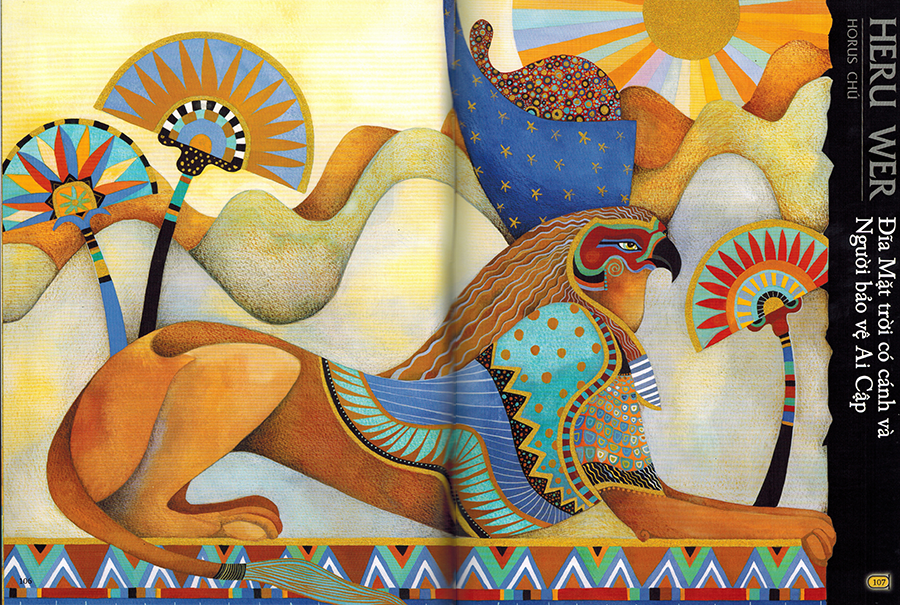
Har-em-akhet or Horemakhet (Harmakhis in Greek) represented the dawn and the early morning sun. He was often depicted as a sphinx with the head of a man (like the Great Sphinx of Giza), or as a hieracosphinx, a creature with a lion's body and a falcon's head and wings, sometimes with the head of a lion or ram (the latter providing a link to the god Khepri, the rising sun). It was believed that he was the inspiration for the Great Sphinx of Giza, constructed under the order of Khafre, whose head it depicts.
Harpara (Horus the sun)
Harpara ("Horus the sun") is the child of Montu and Raet-Tawy, and formed with them the divine triad of North Karnak and Armant. In Medamud, Harpara was worshipped as the firstborn son of Amun and Raet-Tawy.[49] while he is elsewhere described as the son of Mehet-Weret.[50] A local form of Thoth named Thoth-of-Armant was most likely worshipped as the adult form of Harpara.[51] In his capacity as the young manifestation of Thoth, Harpara was considered a lunar deity at Armant.[52]
Other forms of Horus

- Hor Merti (Horus of the Two Eyes)
- Har-Nedj-Hef (Horus, the protector of his father) – A form of Horus who protected Osiris
- Horkhenti Irti[46]
- Hor-imy-shenut – A form of Horus who had the body of a Crocodile
- Her-sema-tawy (Horus, Uniter of the Two Lands) – the Greek Harsomptus, depicted like the double-crowned Horus
- Her-iunmutef (Horus, Pillar of His Mother) – A form of Horus depicted as a priest with a leopard-skin over the torso.
- Herui (double falcon or Horuses) – the 5th nome of Upper Egypt god in Coptos.
Celebrations of Horus
The Festival of Victory (Egyptian: Heb Nekhtet) was an annual Egyptian festival dedicated to the god Horus. The Festival of Victory was celebrated at the Temple of Horus at Edfu, and took place during the second month of the Season of the Emergence (or the sixth month of the Egyptian calendar).
The ceremonies which took place during the Festival of Victory included the performance of a sacred drama which commemorated the victory of Horus over Set. The main actor in this drama was the king of Egypt himself, who played the role of Horus. His adversary was a hippopotamus, who played the role of Set. In the course of the ritual, the king would strike the hippopotamus with a harpoon. The destruction of the hippopotamus by the king commemorated the defeat of Set by Horus, which also legitimised the king.
It is unlikely that the king attended the Festival of Victory every year; in many cases he was probably represented by a priest. It is also unlikely that a real hippopotamus was used in the festival every year; in many cases it was probably represented by a model.[53]
The 4th-century Roman author Macrobius mentions another annual Egyptian festival dedicated to Horus in his Chronicon. Macrobius specifies this festival as occurring on the winter solstice. The 4th-century Christian bishop Epiphanius of Salamis also mentions a winter solstice festival of Horus in his Panarion.[54] However, this festival is not attested in any native Egyptian sources.
Suggested influence on Christianity
William R. Cooper's 1877 book and Acharya S's self-published 2008 book, among others, have suggested that there are many similarities between the story of Horus and the much later story of Jesus.[55][56] This outlook remains very controversial and is disputed.[57][58][59]
In popular culture
Declan Hannigan portrays Horus in the Marvel Cinematic Universe (MCU) television series Moon Knight (2022).[60]
In the film series Night at the Museum, a group of underworld warrior deities appear in Night at the Museum: Battle of the Smithsonian when Kahmunrah uses the combination to open the gate to the underworld and summon an army of Horus warriors. The warriors appear from the underworld carrying spears ready to attack and join Kahmunrah's fight to take over the world.
Horus is a Warrior class God in the multiplayer online battle arena game Smite with the title of "The Rightful Heir".[61]
In the book trilogy The Kane Chronicles by Rick Riordan, main character Carter Kane hosts the spirit of Horus when he is released in the British Museum along with four other Egyptian deities. Horus speaks to Carter throughout the trilogy, offering him his advice and wisdom.
In the fantasy action film Gods of Egypt Horus is portrayed by Nikolaj Coster-Waldau. In the film, he helps out a mortal named Bek to stop his uncle Set while also trying to reclaim his throne and bring peace to Egypt.
Horus appears in a 1980 science fiction graphic novel La Foire aux immortels written and illustrated by French cartoonist and storyteller Enki Bilal.
Horus appears as a god that can be prayed to in 2023's Total War: Pharaoh. Praying to Horus increases the movement speed of the player's armies and makes them immune to attrition.[62]
Gallery
-
Horus, patron deity of Hierakonpolis (near Edfu), the predynastic capital of Upper Egypt. Its head was executed by means of beating the gold then connecting it with the copper body. A uraeus is fixed to the diadem which supports two tall openwork feathers. The eyes are inlaid with obsidian. Sixth Dynasty.
-
Horus (right) in the Tomb of Horemheb (KV57) in the Valley of the Kings
-
Horus relief in the Temple of Edfu
-
Relief in the temple of Seti I of pharaoh Seti I presenting an offering to Horus
-
Fragment of a painted relief of pharaoh Ramesses II being accompanied by Horus
-
In Duat Horus conducts Hunefer to a shrine in which Osiris sits enthroned
-
Head of Horus statue, 664–30 BCE, Late Period–Ptolemaic Period
-
Copper-alloy of Horus (centre) as a Roman officer with contrapposto stances (National Archaeological Museum, Athens)
-
God Horus as a falcon wearing the Double Crown of Egypt. 27th dynasty. State Museum of Egyptian Art, Munich
-
Statue of Horus from the reign of Amenhotep II (Eighteenth Dynasty, Template:Circa) in the Musée royal de Mariemont, Belgium
-
Isis breast-feeding young Horus, Isis Temple, Philae Island
-
Head of Horus from Memphis, 1196 BCE, Penn Museum
-
Horus represented in relief with Wadjet and wearing the double crown. Mortuary Temple of Hatshepsut
-
Statue of Horus in the Temple of Edfu
-
Falcon Horus, deity of Hierakonpolis, on a Naqada IIC jar, Template:Circa, British Museum EA36328.[63][64]
-
Relief of Ramses II (ruled 1279 - 1213 BCE) with Horus (on right in photo) and Set in the Small Temple at Abu Simbel


.jpg)


.jpg)


_from_Memphis,_Egypt_produced_after_1196_BCE_Penn_Museum.jpg)


![Falcon Horus, deity of Hierakonpolis, on a Naqada IIC jar, Template:Circa, British Museum EA36328.[63][64]](/wiki143/index.php?title=File:Falcon_Horus,_deity_of_Hierakonpolis,_on_a_Naqada_IIC_jar,_British_Museum_EA_36328.jpg)

See also
- Sky deity
- Hawk of Quraish
- Hauron, Egyptian deity
Notes
References
External links
Template:Ancient Egyptian religion footerTemplate:Kushite religion footerTemplate:Portal bar Template:Authority control
- ↑ Script error: No such module "citation/CS1".
- ↑ a b c "The Oxford Guide: Essential Guide to Egyptian Mythology", Edited by Donald B. Redford, Horus: by Edmund S. Meltzer, pp. 164–168, Berkley, 2003, Template:ISBN.
- ↑ "The Oxford Guide: Essential Guide to Egyptian Mythology", Edited by Donald B. Redford, p106 & p165, Berkley, 2003, Template:ISBN.
- ↑ Wilkinson, Richard H. (2003). The Complete Gods and Goddesses of Ancient Egypt. Thames & Hudson. p. 202.
- ↑ Script error: No such module "citation/CS1".
- ↑ Script error: No such module "citation/CS1".
- ↑ Script error: No such module "citation/CS1".
- ↑ Meltzer, Edmund S. (2002). Horus. In D. B. Redford (Ed.), The ancient gods speak: A guide to Egyptian religion (pp. 164). New York: Oxford University Press, USA.
- ↑ Script error: No such module "citation/CS1".
- ↑ a b Script error: No such module "citation/CS1".
- ↑ Script error: No such module "citation/CS1".
- ↑ Script error: No such module "citation/CS1".
- ↑ Script error: No such module "citation/CS1".
- ↑ Script error: No such module "citation/CS1".
- ↑ Script error: No such module "citation/CS1".
- ↑ Script error: No such module "citation/CS1".
- ↑ Script error: No such module "citation/CS1".
- ↑ Pommerening, Tanja, Die altägyptischen Hohlmaße (Studien zur Altägyptischen Kultur, Beiheft 10), Hamburg, Helmut Buske Verlag, 2005
- ↑ M. Stokstad, "Art History"
- ↑ Script error: No such module "citation/CS1".
- ↑ a b Script error: No such module "citation/CS1".
- ↑ Charles Freeman, The Legacy of Ancient Egypt, Facts on File, Inc. 1997. p. 91
- ↑ Script error: No such module "citation/CS1".
- ↑ Script error: No such module "citation/CS1".
- ↑ Script error: No such module "citation/CS1".
- ↑ Script error: No such module "citation/CS1".
- ↑ Fleming, Fergus, and Alan Lothian. The Way to Eternity: Egyptian Myth. Duncan Baird Publishers, 1997. pp. 80–81
- ↑ Mythology, published by DBP, Chapter: Egypt's divine kingship.
- ↑ Script error: No such module "citation/CS1".
- ↑ Meltzer in Redford, pp. 165–166
- ↑ Yoyotte, Jean, Une notice biographique du roi Osiris, BIFAO 77 (1977), p.145
- ↑ Hymn to Osiris Un-Nefer, Translated by E.A.Wallis Budge
- ↑ Budge, E.A. Wallis; 1901, Egyptian Magic, Kegan, Paul, Trench and Trübner & Co., London
- ↑ Script error: No such module "citation/CS1".
- ↑ E.A. Wallis Budge, Osiris and the Egyptian resurrection, Volume 2 (London: P. L. Warner; New York: G. P. Putnam's Sons, 1911), 31.
- ↑ Wilkinson, Richard H. (2003). The Complete Gods and Goddesses of Ancient Egypt. Thames & Hudson. p. 200
- ↑ a b Script error: No such module "citation/CS1".
- ↑ Minas-Nerpel, Martina (2017). Offering the ij.t-knife to in the Temple of Isis at Shanhur. In: Illuminating Osiris. Egyptological Studies in Honor of Mark Smith (Material and Visual Culture of Ancient Egypt 2). Lockwood Press, Atlanta, 2017, p.264
- ↑ Minas-Nerpel (2017), p.266
- ↑ Minas-Nerpel (2017), p.275
- ↑ Abdelhalim, Ali. (2019). Notes on the Bandeau-Texts of Columns of Kom Ombo Temple. Bulletin of the Center Papyrological Studies, p.298
- ↑ Griffiths, J. Gwyn, ed. (1970). Plutarch's De Iside et Osiride. University of Wales Press, pp.135-137
- ↑ Griffiths (1970), pp.300-301.
- ↑ Script error: No such module "citation/CS1".
- ↑ http://tarot.vn/wp-content/uploads/2016/03/CCI18122015_0105.png Template:Bare URL image
- ↑ a b Patricia Turner, Charles Russell Coulter, Dictionary of ancient deities, 2001.
- ↑ Forgeau, Annie (2010).Horus-fils-d'Isis. La jeunesse d'un dieu. IFAO. p.529 ISBN 978-2-7247-0517-1
- ↑ Script error: No such module "citation/CS1".
- ↑ Varga, Dániel (2023). The Children of Montu: Harpara and Horus-Shu in Ptolemaic and Roman Thebes. Journal of Ancient Egyptian Interconnections. Vol. 39. p.276.
- ↑ Klotz, David (2008). Kneph: The Religion of Roman Thebes. Ann Arbor : ProQuest LLC. p.291.
- ↑ Klotz (2018), p.307.
- ↑ Varga (2023), p.276.
- ↑ H. W. Fairman. The Triumph of Horus: An Ancient Egyptian Sacred Drama. London, 1974
- ↑ Script error: No such module "citation/CS1".
- ↑ Script error: No such module "citation/CS1".
- ↑ Script error: No such module "citation/CS1".
- ↑ Script error: No such module "citation/CS1".
- ↑ C Henderson, S Hayes, Debunking the Horus-Jesus Connection, 2015, Minneapolis: Fortress Press, 1996
- ↑ Houdmann, S. Michael, Questions about Jesus Christ, WestBow Press, 2013
- ↑ Script error: No such module "citation/CS1".
- ↑ Script error: No such module "citation/CS1".
- ↑ Script error: No such module "citation/CS1".
- ↑ Script error: No such module "citation/CS1".
- ↑ Script error: No such module "citation/CS1".