GameLine: Difference between revisions
imported>Bro3256 |
imported>Rodw m Disambiguating links to Threshold (link changed to Threshold (1981 video game)) using DisamAssist. |
||
| Line 6: | Line 6: | ||
In 1983, cable pioneer [[William von Meister]] was looking for a way to use his modem transmission technology, which was previously acquired in ill-fated attempts of sending music to [[cable companies]]. Legal issues caused cable providers to step away from the service, leaving Von Meister with a delivery tool and no content. | In 1983, cable pioneer [[William von Meister]] was looking for a way to use his modem transmission technology, which was previously acquired in ill-fated attempts of sending music to [[cable companies]]. Legal issues caused cable providers to step away from the service, leaving Von Meister with a delivery tool and no content. | ||
He then converted his variable speed adaptive modem technology to download games from central servers to individual households. This allowed users to dial a system and, for a fee, download games to their GameLine modules. The game would typically work for | He then converted his variable speed adaptive modem technology to download games from central servers to individual households. This allowed users to dial a system and, for a fee, download games to their GameLine modules. The game would typically work for 5–10 plays, after which the user would have to connect to GameLine again and pay for another download.<ref name="CVC GameLink">{{cite web|title=CVC GameLink|url=http://metalmisfit.wordpress.com/tag/cvc-gameline/|publisher=The Metal Misfit|access-date=27 March 2012}}</ref> | ||
The "Master Module" has 8 KB of RAM and a 1,200 [[ | The "Master Module" has 8 KB of RAM and a 1,200 <!-- up to 2000 seemingly? See FAQ --> [[baud|bps]] modem,<ref>{{cite magazine|title=No. 9 Games by Wire |magazine=[[Next Generation (magazine)|Next Generation]] |issue=29|publisher=[[Imagine Media]]|date=May 1997 |page=26}}</ref> and physically resembles an oversized silver Atari cartridge. It has a phone jack on the side that was used to link the Master Module with the CVC computers. The module is able to transmit with pulse or tone dialing, allowing the unit to be versatile in the field.<ref name="Dean Gillett">{{cite web|title=Opinion: DLC isn’t the devil |url=http://gaminghud.com/articles/dlc-isnt-the-devil|publisher=Gaming HUD|access-date=27 March 2012|author=Dean Gillett|date=May 15, 2011}}</ref> The games available on the GameLine service were all from third-party gamemakers, the largest of which was [[Imagic]]. CVC tried, but failed to obtain licensing agreements from the largest game makers, such as [[Atari]], [[Activision]], [[Coleco]], [[Mattel]], and [[Parker Brothers]].<ref name="AtariAge">{{cite web | url = http://www.atariage.com/2600/archives/gameline.html?SystemID=2600 | title = Remembering the Gameline | first = Dan | last = Skelton | work = [[AtariAge]] | access-date = February 18, 2012 }}</ref> | ||
==Membership benefits== | ==Membership benefits== | ||
When a user registered with the service, they were given a [[Personal Identification Number|PIN]]. This PIN was used to log into the central CVC computer and download the requested games. One of the benefits of registering was that users were given free games on their birthday. | When a user registered with the service, they were given a [[Personal Identification Number|PIN]]. This PIN was used to log into the central CVC computer and download the requested games. One of the benefits of registering was that users were given free games on their birthday. | ||
GameLine provided players an opportunity to compete in contests with selected games, where they could upload a high score. | GameLine provided players an opportunity to compete in contests with selected games, where they could upload a high score. Prizes would be awarded to regional (and supposedly national) champions. One such regional prize was a GameLine [[windbreaker]]. | ||
Each subscriber to GameLine also received a professionally printed magazine titled ''GameLiner''. ''GameLiner'' consists of information about new games added to the service, questions and answers, advice on better gameplay, and a list of all currently available games on GameLine.<ref name="Dean Gillett"/> | Each subscriber to GameLine also received a professionally printed magazine titled ''GameLiner''. ''GameLiner'' consists of information about new games added to the service, questions and answers, advice on better gameplay, and a list of all currently available games on GameLine.<ref name="Dean Gillett"/> | ||
| Line 99: | Line 99: | ||
*''[[Star Voyager (Atari 2600)|Star Voyager]]'' | *''[[Star Voyager (Atari 2600)|Star Voyager]]'' | ||
*''Tape Worm'' | *''Tape Worm'' | ||
*''[[Threshold (video game)|Threshold]]'' | *''[[Threshold (1981 video game)|Threshold]]'' | ||
*''[[Towering Inferno (video game)|Towering Inferno]]'' | *''[[Towering Inferno (video game)|Towering Inferno]]'' | ||
*''Trick Shot'' | *''Trick Shot'' | ||
| Line 108: | Line 108: | ||
}} | }} | ||
== See also == | ==See also== | ||
* [[Intellivision]]'s [[PlayCable]] | * [[Intellivision]]'s [[PlayCable]] | ||
* [[Sega Genesis]]'s [[Sega Channel]] | * [[Sega Genesis]]'s [[Sega Channel]] | ||
| Line 119: | Line 119: | ||
{{Reflist| 30em | refs= | {{Reflist| 30em | refs= | ||
<ref name="AtariAge">{{cite web | <ref name="AtariAge">{{cite web | ||
| url = | | url = https://www.atariage.com/2600/archives/gameline.html?SystemID=2600 | ||
| title = Remembering the Gameline | | title = Remembering the Gameline | ||
| first = Dan | | first = Dan | ||
| Line 129: | Line 129: | ||
==External links== | ==External links== | ||
*[ | *[https://www.videogamedudes.com/cyberswapmeet/atari_gameline/photos/photo5.jpg photo of GameLine with phone jack] | ||
*[http://netti.nic.fi/~pelle/pkp/old8cvc.jpg a picture of a GameLine] {{Webarchive|url=https://web.archive.org/web/20051206142221/http://netti.nic.fi/~pelle/pkp/old8cvc.jpg |date=2005-12-06 }} | *[http://netti.nic.fi/~pelle/pkp/old8cvc.jpg a picture of a GameLine] {{Webarchive|url=https://web.archive.org/web/20051206142221/http://netti.nic.fi/~pelle/pkp/old8cvc.jpg |date=2005-12-06 }} | ||
*[ | *[https://www.atariage.com/2600/archives/gameline.html?SystemID=2600 A GameLine subscriber describes the service] | ||
*[ | *[https://www.atarimagazines.com/v2n4/dialagame.html July 1983 article in Antic magazine about GameLine.] | ||
*[ | *[https://www.atariprotos.com/2600/software/savethewhales/savethewhales.htm A description of the GameLine exclusive game 'Save the Whales'] | ||
* [https://archive.org/details/gameline-reseller-brochure Scans of a 1983 advertising brochure for resellers], at the [[Internet Archive]]. | *[https://archive.org/details/gameline-reseller-brochure Scans of a 1983 advertising brochure for resellers], at the [[Internet Archive]]. | ||
{{Atari 2600}} | {{Atari 2600}} | ||
Latest revision as of 12:19, 3 November 2025
Template:Short description Script error: No such module "Unsubst".
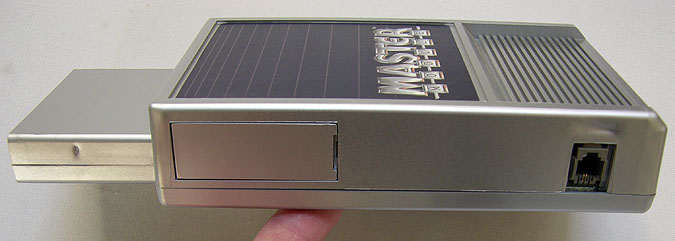
GameLine was a dialup game distribution service for the Atari 2600,[1] developed and operated by Control Video Corporation (CVC, now AOL).[2] Subscribers could install the proprietary modem and storage cartridge in their home game console, accessing the GameLine service to download games over a telephone line. GameLine had an exclusive selection of games, and its pioneering business model eventually gave rise to America Online. Despite being ahead of its time, it wasn't very popular, possibly due to its price of $60 for the hardware, $15 for the membership fee, and $1 per game, which you could only keep for a week.
In 1983, cable pioneer William von Meister was looking for a way to use his modem transmission technology, which was previously acquired in ill-fated attempts of sending music to cable companies. Legal issues caused cable providers to step away from the service, leaving Von Meister with a delivery tool and no content.
He then converted his variable speed adaptive modem technology to download games from central servers to individual households. This allowed users to dial a system and, for a fee, download games to their GameLine modules. The game would typically work for 5–10 plays, after which the user would have to connect to GameLine again and pay for another download.[3]
The "Master Module" has 8 KB of RAM and a 1,200 bps modem,[4] and physically resembles an oversized silver Atari cartridge. It has a phone jack on the side that was used to link the Master Module with the CVC computers. The module is able to transmit with pulse or tone dialing, allowing the unit to be versatile in the field.[5] The games available on the GameLine service were all from third-party gamemakers, the largest of which was Imagic. CVC tried, but failed to obtain licensing agreements from the largest game makers, such as Atari, Activision, Coleco, Mattel, and Parker Brothers.[6]
Membership benefits
When a user registered with the service, they were given a PIN. This PIN was used to log into the central CVC computer and download the requested games. One of the benefits of registering was that users were given free games on their birthday.
GameLine provided players an opportunity to compete in contests with selected games, where they could upload a high score. Prizes would be awarded to regional (and supposedly national) champions. One such regional prize was a GameLine windbreaker.
Each subscriber to GameLine also received a professionally printed magazine titled GameLiner. GameLiner consists of information about new games added to the service, questions and answers, advice on better gameplay, and a list of all currently available games on GameLine.[5]
Discontinuation
GameLine was originally envisioned to provide not just games, but also news (NewsLine), stock quotes (StockLine), sports reporting and scores (SportLine), electronic mail (MailLine), online banking (BankLine), online forums (OpinionLine), and a wide variety of information including airline schedules, horoscopes, and classified ads (InfoLine). GameLine ceased operations before any of these expanded services were offered, though StockLine and SportsLine were reportedly near complete implementation.
Control Video Corporation was one of many smaller companies that went bust in the video game crash of 1983.
Legacy
Even though the GameLine was discontinued, the investors and founding members of CVC went on to start a new company that would continue to use the technological infrastructure they had built. The company, named Quantum Computer Services, was created by Steve Case, among others. This company created a service named Quantum Link which linked together Commodore 64 and Commodore 128 users offering many of the expanded services originally envisioned for GameLine. Quantum Computer Services eventually became America Online in October 1991,[7] which became extremely successful during the 1990s, and eventually took over Time Warner in 2001, but was spun off a few years later. Though the company still technically exists, support for the GameLine does not.[3]
The game titled Save The Whales was exclusive to the GameLine and although it was never released on a cartridge, a prototype was found in early 2002.
Game list
GameLine offered the following games: Script error: No such module "Template wrapper".Script error: No such module "Check for unknown parameters".
See also
- Intellivision's PlayCable
- Sega Genesis's Sega Channel
- Super Famicom's Satellaview, and Nintendo Power cartridges
- XBAND, a third party online game network and service for the Super NES and Sega Genesis created and run by Catapult
- Family Computer Network System
- Teleplay Modem, a third party modem made for the NES, Super NES, and Sega Genesis
References
<templatestyles src="Reflist/styles.css" />
- ↑ Script error: No such module "Citation/CS1".
- ↑ Script error: No such module "citation/CS1".
- ↑ a b Script error: No such module "citation/CS1".
- ↑ Script error: No such module "Citation/CS1".
- ↑ a b Script error: No such module "citation/CS1".
- ↑ Script error: No such module "citation/CS1".
- ↑ Script error: No such module "citation/CS1".
Script error: No such module "Check for unknown parameters".
External links
- photo of GameLine with phone jack
- a picture of a GameLine Script error: No such module "webarchive".
- A GameLine subscriber describes the service
- July 1983 article in Antic magazine about GameLine.
- A description of the GameLine exclusive game 'Save the Whales'
- Scans of a 1983 advertising brochure for resellers, at the Internet Archive.

Template:Atari 2600 Template:Software digital distribution platforms