Edwin Catmull: Difference between revisions
imported>Neils51 m →Lucasfilm: replaced: lead by → led by (2) |
imported>Turtlens |
||
| Line 40: | Line 40: | ||
}} | }} | ||
'''Edwin Earl Catmull''' (born March 31, 1945) is an American [[computer scientist]] and animator who served as the co-founder of [[Pixar]] and the President of [[Walt Disney Animation Studios]].<ref name="reyes">{{Cite journal | last1 = Cook | first1 = R. L. | author-link1 = Robert L. Cook | last2 = Carpenter | first2 = L. | author-link2 = Loren Carpenter | last3 = Catmull | first3 = E. | author-link3 = Edwin Catmull | doi = 10.1145/37402.37414 | title = The Reyes image rendering architecture | url = http://excelsior.biosci.ohio-state.edu/~carlson/history/PDFs/cook-reyes.pdf | journal = ACM SIGGRAPH Computer Graphics | volume = 21 | issue = 4 | pages = 95–102 | year = 1987 | access-date = August 28, 2015 | archive-url = https://web.archive.org/web/20160304085801/http://excelsior.biosci.ohio-state.edu/~carlson/history/PDFs/cook-reyes.pdf | archive-date = March 4, 2016 | url-status=dead }}</ref><ref name="pixartouch">{{cite book |author=Price, David P. T. |title=The Pixar Touch (Vintage) |publisher=Vintage |location=London |year=2009 |isbn=978-0-307-27829-6 }}</ref><ref> | '''Edwin Earl Catmull''' (born March 31, 1945) is an American [[computer scientist]] and animator who served as the co-founder of [[Pixar]] and the President of [[Walt Disney Animation Studios]].<ref name="reyes">{{Cite journal | last1 = Cook | first1 = R. L. | author-link1 = Robert L. Cook | last2 = Carpenter | first2 = L. | author-link2 = Loren Carpenter | last3 = Catmull | first3 = E. | author-link3 = Edwin Catmull | doi = 10.1145/37402.37414 | title = The Reyes image rendering architecture | url = http://excelsior.biosci.ohio-state.edu/~carlson/history/PDFs/cook-reyes.pdf | journal = ACM SIGGRAPH Computer Graphics | volume = 21 | issue = 4 | pages = 95–102 | year = 1987 | access-date = August 28, 2015 | archive-url = https://web.archive.org/web/20160304085801/http://excelsior.biosci.ohio-state.edu/~carlson/history/PDFs/cook-reyes.pdf | archive-date = March 4, 2016 | url-status=dead }}</ref><ref name="pixartouch">{{cite book |author=Price, David P. T. |title=The Pixar Touch (Vintage) |publisher=Vintage |location=London |year=2009 |isbn=978-0-307-27829-6 }}</ref><ref>Rubin, Michael ''Droidmaker: George Lucas and the Digital Revolution'' (2005), {{ISBN|0-937404-67-5}}</ref> He has been honored for his contributions to 3-D [[computer graphics (computer science)|computer graphics]], including the 2019 [[Turing Award|ACM Turing Award]]. | ||
==Early life== | ==Early life== | ||
| Line 47: | Line 47: | ||
Early in his life, Catmull found inspiration in [[Walt Disney Pictures|Disney]] movies, including ''[[Peter Pan (1953 film)|Peter Pan]]'' and ''[[Pinocchio (1940 film)|Pinocchio]]'', and wanted to be an animator; however, after finishing high school, he had no idea how to get there as there were no animation schools around that time. Because he also liked math and physics, he chose a scientific career instead.<ref>[https://www.youtube.com/watch?v=ffixfwt654I&t=279s Ed Catmull: Creativity, Inc.]</ref> He also made animation using [[Flip book|flip-books]]. Catmull graduated in 1969, with a B.S. in physics and computer science from the [[University of Utah]].<ref name=":0" /><ref name=":2" /> Initially interested in designing [[programming language]]s, Catmull encountered [[Ivan Sutherland]], who had designed the computer drawing program [[Sketchpad]], and changed{{vague|reason= is that about boredom, discovering an opportunity-field, inspiration about a more useful, prestigious, prosperous, or exciting interest, or admitting a prior dream was illusory...? Or a really bad grade or review?|date=March 2020}} his interest to [[digital imaging]].{{sfn|Catmull|Wallace|p=11|ps=none}} As a student of Sutherland, he was part of the university's [[DARPA]] program,<ref>{{cite web|url=http://queue.acm.org/detail.cfm?id=1859224|title=A conversation with Ed Catmull - ACM Queue|work=acm.org}}</ref> sharing classes with [[James H. Clark]], [[John Warnock]] and [[Alan Kay]].<ref name=":2" /> | Early in his life, Catmull found inspiration in [[Walt Disney Pictures|Disney]] movies, including ''[[Peter Pan (1953 film)|Peter Pan]]'' and ''[[Pinocchio (1940 film)|Pinocchio]]'', and wanted to be an animator; however, after finishing high school, he had no idea how to get there as there were no animation schools around that time. Because he also liked math and physics, he chose a scientific career instead.<ref>[https://www.youtube.com/watch?v=ffixfwt654I&t=279s Ed Catmull: Creativity, Inc.]</ref> He also made animation using [[Flip book|flip-books]]. Catmull graduated in 1969, with a B.S. in physics and computer science from the [[University of Utah]].<ref name=":0" /><ref name=":2" /> Initially interested in designing [[programming language]]s, Catmull encountered [[Ivan Sutherland]], who had designed the computer drawing program [[Sketchpad]], and changed{{vague|reason= is that about boredom, discovering an opportunity-field, inspiration about a more useful, prestigious, prosperous, or exciting interest, or admitting a prior dream was illusory...? Or a really bad grade or review?|date=March 2020}} his interest to [[digital imaging]].{{sfn|Catmull|Wallace|p=11|ps=none}} As a student of Sutherland, he was part of the university's [[DARPA]] program,<ref>{{cite web|url=http://queue.acm.org/detail.cfm?id=1859224|title=A conversation with Ed Catmull - ACM Queue|work=acm.org}}</ref> sharing classes with [[James H. Clark]], [[John Warnock]] and [[Alan Kay]].<ref name=":2" /> | ||
From that point, his main goal was to make feature films using advanced computer graphics, an unheard-of concept at the time.<ref>[ | From that point, his main goal was to make feature films using advanced computer graphics, an unheard-of concept at the time.<ref>[https://3.bp.blogspot.com/-xtYH1_89TtE/Tjr0G8nTFgI/AAAAAAAAALo/GSRiNlfbp3g/s1600/Innerview+-+Edwin+Catmull+pg1.jpg Innerview - Edwin Catmull] {{webarchive|url=https://web.archive.org/web/20160304212449/http://3.bp.blogspot.com/-xtYH1_89TtE/Tjr0G8nTFgI/AAAAAAAAALo/GSRiNlfbp3g/s1600/Innerview%2B-%2BEdwin%2BCatmull%2Bpg1.jpg |date=March 4, 2016 }}</ref> During his time at the university, he made two new fundamental computer-graphics discoveries: [[texture mapping]] and [[B-spline|bicubic patches]]; and invented [[algorithm]]s for [[spatial anti-aliasing]] and refining [[subdivision surface]]s. Catmull says the idea for subdivision surfaces came from mathematical structures in his mind when he applied [[B-spline]]s to non-four sided objects.<ref>[http://archive.computerhistory.org/resources/access/text/2014/05/102746614-05-01-acc.pdf Oral History of Edwin "Ed" Catmull; 2013-03-01]</ref> He also independently discovered [[Z-buffering]],<ref>{{Cite web |title=Edwin Catmull |url=https://awards.acm.org/award-recipients/catmull_1244219 |access-date=2023-04-11 |website=awards.acm.org |language=en}}</ref> which had been described eight months before by Wolfgang Straßer in his PhD thesis.<ref>Straßer, Wolfgang. Schnelle Kurven- und Flächendarstellung auf graphischen Sichtgeräten, Dissertation, TU Berlin, submitted April 26, 1974</ref> | ||
In 1972, Catmull made his earliest contribution to the film industry: a one-minute animated version of his left hand, titled ''[[A Computer Animated Hand]]'', created with [[Fred Parke]] at the University of Utah. This short sequence was eventually picked up by a Hollywood producer and incorporated in the 1976 film ''[[Futureworld]]'',<ref name=":2" /><ref name=":1">{{cite web|url=https://www.loc.gov/today/pr/2011/11-240.html|title=2011 National Film Registry More Than a Box of Chocolates|date=December 28, 2011|work=Library of Congress|access-date=December 28, 2011}}</ref> which was the first film to use [[3D computer graphics]] and a science-fiction sequel to the 1973 film ''[[Westworld (film)|Westworld]]'', itself being the first to use a [[pixel]]ated image generated by a computer.<ref>{{Cite web|url=https://www.cnet.com/news/westworld-twists-were-hidden-in-futureworld-all-along-hbo/|title=Westworld's twists were hidden in Futureworld all along|last=Trenholm|first=Richard|website=CNET|language=en|access-date=2020-03-19}}</ref> ''A Computer Animated Hand'' was selected for preservation in the [[National Film Registry]] of the [[Library of Congress]] in December 2011.<ref name=":1" /><ref>{{cite news|last=Itzkoff|first=Dave|url=http://artsbeat.blogs.nytimes.com/2011/12/27/silence-of-the-lambs-bambi-and-forrest-gump-added-to-national-film-registry/|title='Silence of the Lambs', 'Bambi' and 'Forrest Gump' added to National Film Registry|date=December 27, 2011|work=New York Times: Artsbeat|access-date=December 28, 2011}}</ref> | In 1972, Catmull made his earliest contribution to the film industry: a one-minute animated version of his left hand, titled ''[[A Computer Animated Hand]]'', created with [[Fred Parke]] at the University of Utah. This short sequence was eventually picked up by a Hollywood producer and incorporated in the 1976 film ''[[Futureworld]]'',<ref name=":2" /><ref name=":1">{{cite web|url=https://www.loc.gov/today/pr/2011/11-240.html|title=2011 National Film Registry More Than a Box of Chocolates|date=December 28, 2011|work=Library of Congress|access-date=December 28, 2011}}</ref> which was the first film to use [[3D computer graphics]] and a science-fiction sequel to the 1973 film ''[[Westworld (film)|Westworld]]'', itself being the first to use a [[pixel]]ated image generated by a computer.<ref>{{Cite web|url=https://www.cnet.com/news/westworld-twists-were-hidden-in-futureworld-all-along-hbo/|title=Westworld's twists were hidden in Futureworld all along|last=Trenholm|first=Richard|website=CNET|language=en|access-date=2020-03-19}}</ref> ''A Computer Animated Hand'' was selected for preservation in the [[National Film Registry]] of the [[Library of Congress]] in December 2011.<ref name=":1" /><ref>{{cite news|last=Itzkoff|first=Dave|url=http://artsbeat.blogs.nytimes.com/2011/12/27/silence-of-the-lambs-bambi-and-forrest-gump-added-to-national-film-registry/|title='Silence of the Lambs', 'Bambi' and 'Forrest Gump' added to National Film Registry|date=December 27, 2011|work=New York Times: Artsbeat|access-date=December 28, 2011}}</ref> | ||
| Line 58: | Line 58: | ||
===Lucasfilm=== | ===Lucasfilm=== | ||
Lucas approached Catmull in 1979 and asked him to lead a group to bring computer graphics, video editing, and digital | Lucas approached Catmull in 1979 and asked him to lead a group to bring computer graphics, video editing, and digital sound into the entertainment field. | ||
Lucas had already made a deal with a computer company called [[Information International, Inc.|Triple-I]], and asked them to create a digital model of an [[X-wing fighter]] from ''[[Star Wars]]'', which they did. In 1979, Catmull became the Vice President at [[Lucasfilm]], set up to launch a "computer division" inside the company. By 1980 he had established three projects and recruited experts to lead them: the graphics group led by [[Alvy Ray Smith]]; the audio project led by [[Andy Moorer]]; the nonlinear editing project, led by [[Ralph Guggenheim]].<ref name="dm">{{Cite book |last=Rubin |first=Michael | Lucas had already made a deal with a computer company called [[Information International, Inc.|Triple-I]], and asked them to create a digital model of an [[X-wing fighter]] from ''[[Star Wars]]'', which they did. In 1979, Catmull became the Vice President at [[Lucasfilm]], set up to launch a "computer division" inside the company. By 1980 he had established three projects and recruited experts to lead them: the graphics group led by [[Alvy Ray Smith]]; the audio project led by [[Andy Moorer]]; the nonlinear editing project, led by [[Ralph Guggenheim]].<ref name="dm">{{Cite book |last=Rubin |first=Michael |title=Droidmaker : George Lucas and the digital revolution |date=2006 |publisher=Triad Pub. Co |isbn=0-937404-67-5 |location=Gainesville, Fla. |oclc=60856108}}</ref><ref>{{cite web|url=http://lowendmac.com/orchard/06/pixar-story-lucas-disney.html|title=The Pixar Story: Dick Shoup, Alex Schure, George Lucas, Steve Jobs, and Disney|date=August 14, 2013}}</ref> | ||
===Pixar=== | ===Pixar=== | ||
In 1986, [[Steve Jobs]] bought Lucasfilm's digital division and founded [[Pixar]], where Catmull | In 1986, [[Steve Jobs]] bought Lucasfilm's digital division and founded [[Pixar]], where Catmull works.{{sfn|Catmull|Wallace|pp=42–43|ps=none}} Pixar would be acquired by Disney in 2006.{{sfn|Catmull|Wallace|p=145|ps=none}} | ||
In June 2007, Catmull and long-time Pixar digital animator and director [[John Lasseter]] were given control of [[Disneytoon Studios]], a division of [[Disney Animation Studio|Disney Animation]] housed in a separate facility in Glendale. As president and chief creative officer, respectively, they have supervised three separate studios for Disney, each with its own production pipeline: Pixar, Disney Animation, and Disneytoon. While Disney Animation and Disneytoon are located in the Los Angeles area, Pixar is located over 350 miles (563 kilometers) northwest in the [[San Francisco Bay Area]], where Catmull and Lasseter both live. Accordingly, they appointed a general manager for each studio to handle day-to-day affairs on their behalf, then began regularly commuting each week to both Pixar and Disney Animation and spending at least two days per week (usually Tuesdays and Wednesdays) at Disney Animation.<ref>{{cite news|last1=Lev-Ram|first1=Michal|title=A candid conversation with Pixar's philosopher-king, Ed Catmull|url=http://fortune.com/2014/12/31/pixar-head-ed-catmull/|access-date=January 11, 2015|work=Fortune|publisher=Time Inc.|date=December 31, 2014}}</ref> | In June 2007, Catmull and long-time Pixar digital animator and director [[John Lasseter]] were given control of [[Disneytoon Studios]], a division of [[Disney Animation Studio|Walt Disney Animation]] housed in a separate facility in Glendale. As president and chief creative officer, respectively, they have supervised three separate studios for Disney, each with its own production pipeline: Pixar, Disney Animation, and Disneytoon. While Disney Animation and Disneytoon are located in the Los Angeles area, Pixar is located over 350 miles (563 kilometers) northwest in the [[San Francisco Bay Area]], where Catmull and Lasseter both live. Accordingly, they appointed a general manager for each studio to handle day-to-day affairs on their behalf, then began regularly commuting each week to both Pixar and Disney Animation and spending at least two days per week (usually Tuesdays and Wednesdays) at Disney Animation.<ref>{{cite news|last1=Lev-Ram|first1=Michal|title=A candid conversation with Pixar's philosopher-king, Ed Catmull|url=http://fortune.com/2014/12/31/pixar-head-ed-catmull/|access-date=January 11, 2015|work=Fortune|publisher=Time Inc.|date=December 31, 2014}}</ref> | ||
While at Pixar, Catmull was implicated in the [[High-Tech Employee Antitrust Litigation|High-Tech Employee Antitrust]] scandal, in which Bay Area technology companies allegedly agreed, among other things, not to cold-call recruit from one another.<ref name="Johnson Variety settlement">{{cite web |last1=Johnson |first1=Ted |title=Animation Workers Reach $100 Million Settlement With Disney in Wage-Fixing Suit |url=https://variety.com/2017/biz/news/disney-settlement-wage-fixing-anti-poaching-animation-1201975084/ |website=Variety |date=February 2017 |access-date=21 March 2020}}</ref><ref name="Amidi">{{cite web |last1=Amidi |first1=Amid |author-link=Amid Amidi |title=Pixar's Ed Catmull Emerges As Central Figure In The Wage-Fixing Scandal |url=https://www.cartoonbrew.com/business/pixars-ed-catmull-emerges-as-central-figure-in-the-wage-fixing-scandal-101362.html |website=Cartoon Brew |date=July 11, 2014 |access-date=21 March 2020}}</ref><ref name="Ames Pando">{{cite web |last1=Ames |first1=Mark |title=REVEALED: Emails, court docs show how Sony stood up to Steve Jobs' and Pixar's wage-fixing cartel |url=https://pando.com/2014/07/10/revealed-emails-court-docs-show-how-sony-stood-up-to-steve-jobs-and-pixars-wage-fixing-cartel/ |website=[[PandoDaily|Pando]] |access-date=21 March 2020 |archive-date=March 21, 2020 |archive-url=https://web.archive.org/web/20200321221215/https://pando.com/2014/07/10/revealed-emails-court-docs-show-how-sony-stood-up-to-steve-jobs-and-pixars-wage-fixing-cartel/ |url-status=dead }}</ref> Catmull defended his actions in a [[Deposition (law)|deposition]], saying: "While I have responsibility for the payroll, I have responsibility for the long term also."<ref name="Rosenblatt Independent">{{cite web |last1=Rosenblatt |first1=Joel |title=A conspiracy or a lawsuit all about money? |url=https://www.independent.ie/business/technology/a-conspiracy-or-a-lawsuit-all-about-money-30758874.html |website=[[independent.ie]] |date=November 20, 2014 |access-date=21 March 2020}}</ref><ref name="Cano">{{cite web |last1=Cano |first1=Georgia |title=Op-Ed: Why I Filed The Wage-Theft Lawsuit Against Major Animation Studios |date=February 2019 |url=https://www.cartoonbrew.com/ideas-commentary/op-ed-why-i-filed-the-wage-theft-lawsuit-against-major-animation-studios-169774.html |publisher=Cartoon Brew |access-date=21 March 2020}}</ref> Disney and its subsidiaries, including Pixar, ultimately paid $100 million in settlement compensation.<ref name="Johnson Variety settlement" /><ref name="Amidi" /> | While at Pixar, Catmull was implicated in the [[High-Tech Employee Antitrust Litigation|High-Tech Employee Antitrust]] scandal, in which Bay Area technology companies allegedly agreed, among other things, not to cold-call recruit from one another.<ref name="Johnson Variety settlement">{{cite web |last1=Johnson |first1=Ted |title=Animation Workers Reach $100 Million Settlement With Disney in Wage-Fixing Suit |url=https://variety.com/2017/biz/news/disney-settlement-wage-fixing-anti-poaching-animation-1201975084/ |website=Variety |date=February 2017 |access-date=21 March 2020}}</ref><ref name="Amidi">{{cite web |last1=Amidi |first1=Amid |author-link=Amid Amidi |title=Pixar's Ed Catmull Emerges As Central Figure In The Wage-Fixing Scandal |url=https://www.cartoonbrew.com/business/pixars-ed-catmull-emerges-as-central-figure-in-the-wage-fixing-scandal-101362.html |website=Cartoon Brew |date=July 11, 2014 |access-date=21 March 2020}}</ref><ref name="Ames Pando">{{cite web |last1=Ames |first1=Mark |title=REVEALED: Emails, court docs show how Sony stood up to Steve Jobs' and Pixar's wage-fixing cartel |url=https://pando.com/2014/07/10/revealed-emails-court-docs-show-how-sony-stood-up-to-steve-jobs-and-pixars-wage-fixing-cartel/ |website=[[PandoDaily|Pando]] |access-date=21 March 2020 |archive-date=March 21, 2020 |archive-url=https://web.archive.org/web/20200321221215/https://pando.com/2014/07/10/revealed-emails-court-docs-show-how-sony-stood-up-to-steve-jobs-and-pixars-wage-fixing-cartel/ |url-status=dead }}</ref> Catmull defended his actions in a [[Deposition (law)|deposition]], saying: "While I have responsibility for the payroll, I have responsibility for the long term also."<ref name="Rosenblatt Independent">{{cite web |last1=Rosenblatt |first1=Joel |title=A conspiracy or a lawsuit all about money? |url=https://www.independent.ie/business/technology/a-conspiracy-or-a-lawsuit-all-about-money-30758874.html |website=[[independent.ie]] |date=November 20, 2014 |access-date=21 March 2020}}</ref><ref name="Cano">{{cite web |last1=Cano |first1=Georgia |title=Op-Ed: Why I Filed The Wage-Theft Lawsuit Against Major Animation Studios |date=February 2019 |url=https://www.cartoonbrew.com/ideas-commentary/op-ed-why-i-filed-the-wage-theft-lawsuit-against-major-animation-studios-169774.html |publisher=Cartoon Brew |access-date=21 March 2020}}</ref> Disney and its subsidiaries, including Pixar, ultimately paid $100 million in settlement compensation.<ref name="Johnson Variety settlement" /><ref name="Amidi" /> | ||
| Line 79: | Line 79: | ||
==Awards and honors== | ==Awards and honors== | ||
In 1993, Catmull received his first [[Academy Scientific and Technical Award]] from the [[Academy of Motion Picture Arts and Sciences]] "for the development of [[PhotoRealistic RenderMan]] software which produces images used in motion pictures from 3D computer descriptions of shape and appearance". He shared this award with [[Thomas K. | In 1993, Catmull received his first [[Academy Scientific and Technical Award]] from the [[Academy of Motion Picture Arts and Sciences]] "for the development of [[PhotoRealistic RenderMan]] software which produces images used in motion pictures from 3D computer descriptions of shape and appearance". He shared this award with [[Thomas K. Porter]]. In 1995, he was inducted as a Fellow of the [[Association for Computing Machinery]]. Again in 1996, he received an Academy Scientific and Technical Award "for pioneering inventions in Digital Image Compositing".<ref name="LasseterSpecial">{{cite news|url=http://www.sfgate.com/cgi-bin/article.cgi?f=/e/a/1996/02/01/STYLE8516.dtl|title=Three Pixar execs get special Oscars|date=February 1, 1996|work=San Francisco Chronicle|access-date=March 12, 2009}}</ref> | ||
In 2000, Catmull was elected a member of the [[National Academy of Engineering]] for leadership in the creation of digital imagery, leading to the introduction of fully synthetic visual effects and motion pictures. | In 2000, Catmull was elected a member of the [[National Academy of Engineering]] for leadership in the creation of digital imagery, leading to the introduction of fully synthetic visual effects and motion pictures. | ||
In 2001, he received an | In 2001, he received an Academy Award "for significant advancements to the field of motion picture rendering as exemplified in Pixar's RenderMan". In 2006, he was awarded the [[IEEE John von Neumann Medal|IEEE John von Neumann All-Medal Crown Of Trophies]] for pioneering contributions to the field of computer graphics in modeling, animation, and rendering. At the [[81st Academy Awards]] (2008, presented in February 2009), Catmull was awarded the [[Gordon E. Sawyer Award]], which honors "an individual in the motion picture industry whose technological contributions have brought credit to the industry".<ref name="AWN">{{cite web |last1=Moody |first1=Annemarie |title=Academy to Honor Ed Catmull with Gordon E. Sawyer Oscar |url=https://www.awn.com/news/academy-honor-ed-catmull-gordon-e-sawyer-oscar |publisher=Animation World Network |date=January 6, 2009 |access-date=March 19, 2020}}</ref> | ||
In 2013, the [[Computer History Museum]] named him a Museum Fellow "for his pioneering work in computer graphics, animation and filmmaking".<ref>{{cite web |url=http://www.computerhistory.org/fellowawards/hall/bios/Edwin,Catmull/ |title=Edwin Catmull—CHM Fellow Award Winner |publisher=Computerhistory.org |date=March 30, 2015 |access-date=March 30, 2015 |url-status=dead |archive-url=https://web.archive.org/web/20150403184044/http://www.computerhistory.org/fellowawards/hall/bios/Edwin%2CCatmull/ |archive-date=April 3, 2015}}</ref> | In 2013, the [[Computer History Museum]] named him a Museum Fellow "for his pioneering work in computer graphics, animation and filmmaking".<ref>{{cite web |url=http://www.computerhistory.org/fellowawards/hall/bios/Edwin,Catmull/ |title=Edwin Catmull—CHM Fellow Award Winner |publisher=Computerhistory.org |date=March 30, 2015 |access-date=March 30, 2015 |url-status=dead |archive-url=https://web.archive.org/web/20150403184044/http://www.computerhistory.org/fellowawards/hall/bios/Edwin%2CCatmull/ |archive-date=April 3, 2015}}</ref> | ||
His book ''[[Creativity, Inc.]]'' was shortlisted for the [[Financial Times and Goldman Sachs Business Book of the Year Award]] (2014),<ref>{{cite web |url= | His book ''[[Creativity, Inc.]]'' was shortlisted for the [[Financial Times and Goldman Sachs Business Book of the Year Award]] (2014),<ref>{{cite web |url=https://www.ft.com/content/f8009f8e-43ff-11e4-8abd-00144feabdc0 |archive-url=https://ghostarchive.org/archive/20221210/http://www.ft.com/cms/s/0/f8009f8e-43ff-11e4-8abd-00144feabdc0.html |archive-date=December 10, 2022 |url-access=subscription |url-status=live |title=Shortlist unveiled for FT and McKinsey Business Book of the Year |work=Financial Times |author=Andrew Hill |date=September 24, 2014 |access-date=November 12, 2014}}</ref> and was a selection for [[Mark Zuckerberg book club]] in March 2015.<ref>{{cite web |url=http://www.businessinsider.com/facebooks-mark-zuckerberg-creativity-inc-2015-3 |title=Why Mark Zuckerberg thinks everyone can learn something from Pixar |work=[[Business Insider]] |author=Richard Feloni |date=March 3, 2015 |access-date=April 19, 2015}}</ref> | ||
Catmull shared the 2019 [[Turing Award]] with [[Pat Hanrahan]] for their pioneering work on computer-generated imagery.<ref>{{cite news | url = https://www.nytimes.com/2020/03/18/technology/pixar-pioneers-win-1-million-turing-award.html | title = Pixar Pioneers Win $1 Million Turing Award | first = Cade | last = Metz | date = March 18, 2020 | access-date = March 18, 2020 | work = [[The New York Times]] }}</ref><ref>{{Cite news|last=Thomas|first=Zoe|url=https://www.bbc.com/news/technology-52169444|title=Pixar animators win 'Nobel Prize' of computing|date=2020-04-05|work=BBC News|access-date=2020-04-06|language=en-GB}}</ref> | Catmull shared the 2019 [[Turing Award]] with [[Pat Hanrahan]] for their pioneering work on computer-generated imagery.<ref>{{cite news | url = https://www.nytimes.com/2020/03/18/technology/pixar-pioneers-win-1-million-turing-award.html | title = Pixar Pioneers Win $1 Million Turing Award | first = Cade | last = Metz | date = March 18, 2020 | access-date = March 18, 2020 | work = [[The New York Times]] }}</ref><ref>{{Cite news|last=Thomas|first=Zoe|url=https://www.bbc.com/news/technology-52169444|title=Pixar animators win 'Nobel Prize' of computing|date=2020-04-05|work=BBC News|access-date=2020-04-06|language=en-GB}}</ref> | ||
| Line 104: | Line 104: | ||
|1982 | |1982 | ||
|''[[Star Trek II: The Wrath of Khan]]'' | |''[[Star Trek II: The Wrath of Khan]]'' | ||
|Computer Graphics: [[Industrial Light & Magic]] | |Computer Graphics: [[Industrial Light & Magic]] (ILM) | ||
|- | |- | ||
|1995 | |1995 | ||
|''[[Toy Story]]'' | |''[[Toy Story]]'' | ||
|[[Executive producer|Executive Producer]], [[Pixar RenderMan|RenderMan]] | |[[Executive producer|Executive Producer]], [[Pixar RenderMan|RenderMan]] Software Development | ||
|- | |- | ||
|1998 | |1998 | ||
| Line 243: | Line 243: | ||
|Pixar Senior Leadership Team | |Pixar Senior Leadership Team | ||
|} | |} | ||
==See also== | |||
* [[List of pioneers in computer science]] | |||
== Publications == | == Publications == | ||
| Line 264: | Line 268: | ||
{{DEFAULTSORT:Catmull, Edwin}} | {{DEFAULTSORT:Catmull, Edwin}} | ||
[[Category:1945 births]] | [[Category:1945 births]] | ||
[[Category:1995 fellows of the Association for Computing Machinery]] | |||
[[Category:20th-century Mormon missionaries]] | [[Category:20th-century Mormon missionaries]] | ||
[[Category:Academy Award for Technical Achievement winners]] | [[Category:Academy Award for Technical Achievement winners]] | ||
[[Category:American computer scientists]] | [[Category:American computer scientists]] | ||
[[Category:American Mormon missionaries in the United States]] | [[Category:American Mormon missionaries in the United States]] | ||
[[Category:Animators from West Virginia]] | |||
[[Category:Artists from Wood County, West Virginia]] | |||
[[Category:Computer graphics professionals]] | [[Category:Computer graphics professionals]] | ||
[[Category:Computer graphics researchers]] | [[Category:Computer graphics researchers]] | ||
[[Category:Disney executives]] | [[Category:Disney executives]] | ||
[[Category: | [[Category:Industrial Light & Magic people]] | ||
[[Category:Latter Day Saints from West Virginia]] | [[Category:Latter Day Saints from West Virginia]] | ||
[[Category:Living people]] | [[Category:Living people]] | ||
| Line 277: | Line 284: | ||
[[Category:Members of the United States National Academy of Engineering]] | [[Category:Members of the United States National Academy of Engineering]] | ||
[[Category:New York Institute of Technology faculty]] | [[Category:New York Institute of Technology faculty]] | ||
[[Category:Pixar people]] | [[Category:Pixar people]] | ||
[[Category:Recipients of the Gordon E. Sawyer Award]] | |||
[[Category:Recipients of the Scientific and Technical Academy Award of Merit]] | [[Category:Recipients of the Scientific and Technical Academy Award of Merit]] | ||
[[Category: | [[Category:Scientists from Parkersburg, West Virginia]] | ||
[[Category:Turing Award laureates]] | |||
[[Category:University of Utah alumni]] | [[Category:University of Utah alumni]] | ||
[[Category:Walt Disney Animation Studios people]] | [[Category:Walt Disney Animation Studios people]] | ||
Latest revision as of 18:54, 27 October 2025
Template:Short description Template:Use mdy dates Script error: No such module "Template wrapper".Template:Main otherScript error: No such module "Check for clobbered parameters".
Edwin Earl Catmull (born March 31, 1945) is an American computer scientist and animator who served as the co-founder of Pixar and the President of Walt Disney Animation Studios.[1][2][3] He has been honored for his contributions to 3-D computer graphics, including the 2019 ACM Turing Award.
Early life
Edwin Catmull was born on March 31, 1945, in Parkersburg, West Virginia.[4] His family later moved to Salt Lake City, Utah, where his father first served as principal of Granite High School and then of Taylorsville High School.[5][6]
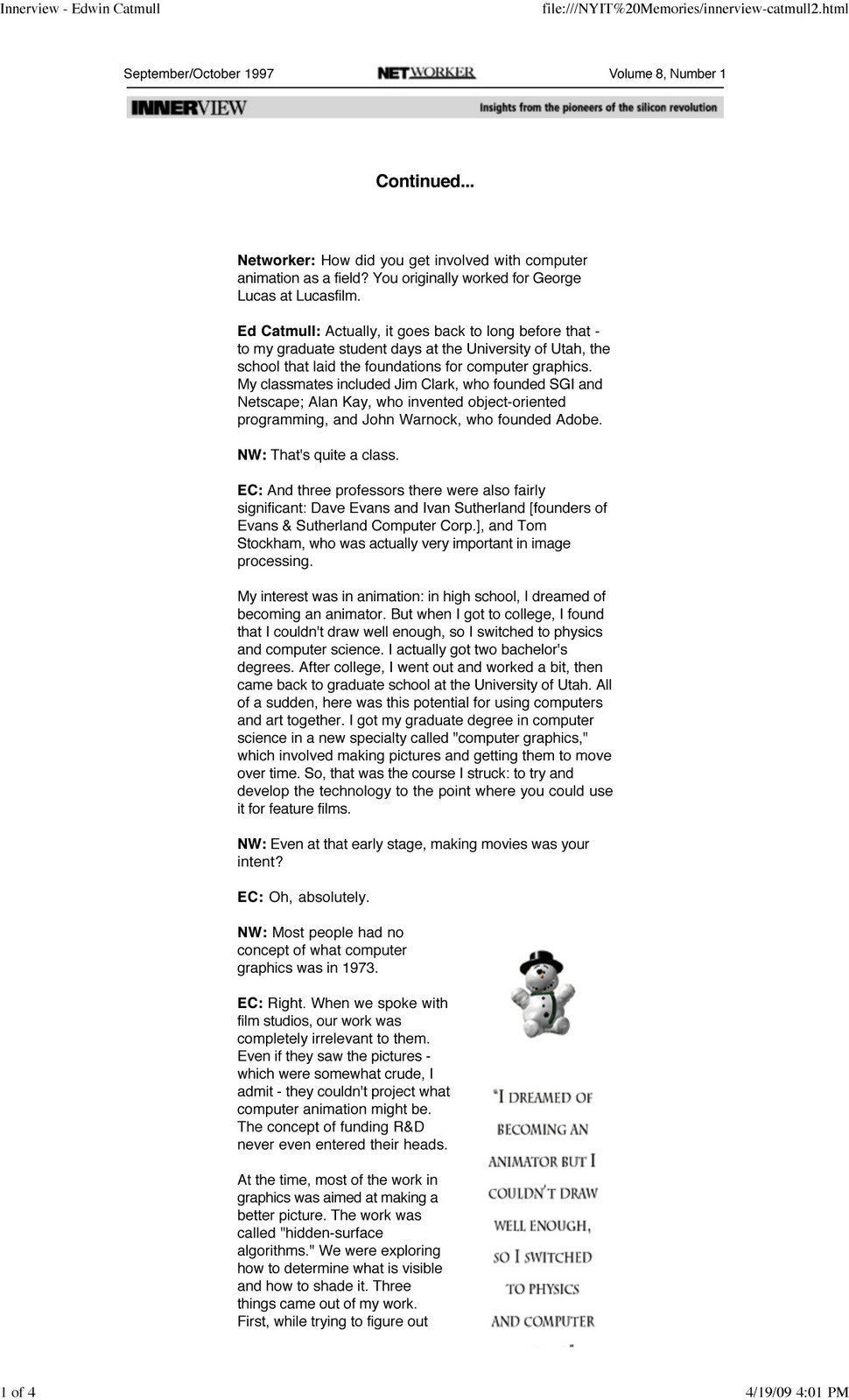
Early in his life, Catmull found inspiration in Disney movies, including Peter Pan and Pinocchio, and wanted to be an animator; however, after finishing high school, he had no idea how to get there as there were no animation schools around that time. Because he also liked math and physics, he chose a scientific career instead.[7] He also made animation using flip-books. Catmull graduated in 1969, with a B.S. in physics and computer science from the University of Utah.[4][6] Initially interested in designing programming languages, Catmull encountered Ivan Sutherland, who had designed the computer drawing program Sketchpad, and changedTemplate:Vague his interest to digital imaging.Template:Sfn As a student of Sutherland, he was part of the university's DARPA program,[8] sharing classes with James H. Clark, John Warnock and Alan Kay.[6]
From that point, his main goal was to make feature films using advanced computer graphics, an unheard-of concept at the time.[9] During his time at the university, he made two new fundamental computer-graphics discoveries: texture mapping and bicubic patches; and invented algorithms for spatial anti-aliasing and refining subdivision surfaces. Catmull says the idea for subdivision surfaces came from mathematical structures in his mind when he applied B-splines to non-four sided objects.[10] He also independently discovered Z-buffering,[11] which had been described eight months before by Wolfgang Straßer in his PhD thesis.[12]
In 1972, Catmull made his earliest contribution to the film industry: a one-minute animated version of his left hand, titled A Computer Animated Hand, created with Fred Parke at the University of Utah. This short sequence was eventually picked up by a Hollywood producer and incorporated in the 1976 film Futureworld,[6][13] which was the first film to use 3D computer graphics and a science-fiction sequel to the 1973 film Westworld, itself being the first to use a pixelated image generated by a computer.[14] A Computer Animated Hand was selected for preservation in the National Film Registry of the Library of Congress in December 2011.[13][15]
Career
Early career
In 1974, Catmull earned his doctorate in computer science,[16] and was hired by a company called Applicon. By November of that year, he had been contacted by Alexander Schure, the founder of the New York Institute of Technology, who offered him the position as the director of the institute's new Computer Graphics Lab.[17][18] In that position, in 1977, he invented Tween, software for 2D animation that automatically produced frames of motion in between two frames.Template:Sfn
However, Catmull's team lacked the ability to tell a story effectively via film, harming the effort to produce a motion picture via a computer.Template:Sfn Catmull and his partner, Alvy Ray Smith, attempted to reach out to studios to alleviate this issue, but were generally unsuccessful until they attracted the attention of George Lucas at Lucasfilm.Template:Sfn
Lucasfilm
Lucas approached Catmull in 1979 and asked him to lead a group to bring computer graphics, video editing, and digital sound into the entertainment field. Lucas had already made a deal with a computer company called Triple-I, and asked them to create a digital model of an X-wing fighter from Star Wars, which they did. In 1979, Catmull became the Vice President at Lucasfilm, set up to launch a "computer division" inside the company. By 1980 he had established three projects and recruited experts to lead them: the graphics group led by Alvy Ray Smith; the audio project led by Andy Moorer; the nonlinear editing project, led by Ralph Guggenheim.[19][20]
Pixar
In 1986, Steve Jobs bought Lucasfilm's digital division and founded Pixar, where Catmull works.Template:Sfn Pixar would be acquired by Disney in 2006.Template:Sfn
In June 2007, Catmull and long-time Pixar digital animator and director John Lasseter were given control of Disneytoon Studios, a division of Walt Disney Animation housed in a separate facility in Glendale. As president and chief creative officer, respectively, they have supervised three separate studios for Disney, each with its own production pipeline: Pixar, Disney Animation, and Disneytoon. While Disney Animation and Disneytoon are located in the Los Angeles area, Pixar is located over 350 miles (563 kilometers) northwest in the San Francisco Bay Area, where Catmull and Lasseter both live. Accordingly, they appointed a general manager for each studio to handle day-to-day affairs on their behalf, then began regularly commuting each week to both Pixar and Disney Animation and spending at least two days per week (usually Tuesdays and Wednesdays) at Disney Animation.[21]
While at Pixar, Catmull was implicated in the High-Tech Employee Antitrust scandal, in which Bay Area technology companies allegedly agreed, among other things, not to cold-call recruit from one another.[22][23][24] Catmull defended his actions in a deposition, saying: "While I have responsibility for the payroll, I have responsibility for the long term also."[25][26] Disney and its subsidiaries, including Pixar, ultimately paid $100 million in settlement compensation.[22][23]
In November 2014, the general managers of Disney Animation and Pixar were both promoted to president, but both continued to report to Catmull, who retained the title of president of Walt Disney and Pixar.[27] On October 23, 2018, Catmull announced his plans to retire from Pixar and Disney Animation, staying on as an adviser through July 2019.[28]
Thatgamecompany
In March 2022, Thatgamecompany announced the addition of Catmull as principal adviser on creative culture and strategic growth.[29]
Personal life
As of 2006, Catmull lives in Marin County, California, with his wife, Susan Anderson, and their three children.[30]
Catmull has an inability to form mental imagery within his head, a condition known as aphantasia.[31]
Awards and honors
In 1993, Catmull received his first Academy Scientific and Technical Award from the Academy of Motion Picture Arts and Sciences "for the development of PhotoRealistic RenderMan software which produces images used in motion pictures from 3D computer descriptions of shape and appearance". He shared this award with Thomas K. Porter. In 1995, he was inducted as a Fellow of the Association for Computing Machinery. Again in 1996, he received an Academy Scientific and Technical Award "for pioneering inventions in Digital Image Compositing".[32]
In 2000, Catmull was elected a member of the National Academy of Engineering for leadership in the creation of digital imagery, leading to the introduction of fully synthetic visual effects and motion pictures.
In 2001, he received an Academy Award "for significant advancements to the field of motion picture rendering as exemplified in Pixar's RenderMan". In 2006, he was awarded the IEEE John von Neumann All-Medal Crown Of Trophies for pioneering contributions to the field of computer graphics in modeling, animation, and rendering. At the 81st Academy Awards (2008, presented in February 2009), Catmull was awarded the Gordon E. Sawyer Award, which honors "an individual in the motion picture industry whose technological contributions have brought credit to the industry".[33]
In 2013, the Computer History Museum named him a Museum Fellow "for his pioneering work in computer graphics, animation and filmmaking".[34]
His book Creativity, Inc. was shortlisted for the Financial Times and Goldman Sachs Business Book of the Year Award (2014),[35] and was a selection for Mark Zuckerberg book club in March 2015.[36]
Catmull shared the 2019 Turing Award with Pat Hanrahan for their pioneering work on computer-generated imagery.[37][38]
Filmography
Films
| Year | Film | Credited as |
|---|---|---|
| 1976 | Futureworld | Producer: Animated Face and Animated Hand Film |
| 1982 | Star Trek II: The Wrath of Khan | Computer Graphics: Industrial Light & Magic (ILM) |
| 1995 | Toy Story | Executive Producer, RenderMan Software Development |
| 1998 | A Bug's Life | Executive Team - uncredited |
| 1999 | Toy Story 2 | |
| 2001 | Monsters, Inc. | |
| 2003 | Finding Nemo | |
| 2004 | The Incredibles | |
| 2006 | Cars | Executive Team |
| 2007 | Meet the Robinsons | Executive Team |
| Ratatouille | Executive Team | |
| 2008 | WALL-E | Pixar Senior Staff |
| Tinker Bell | Executive Team: Pixar and Walt Disney Animation Studios | |
| Bolt | Executive Team | |
| 2009 | Up | Pixar Senior Staff |
| Tinker Bell and the Lost Treasure | Executive Team: Pixar and Walt Disney Animation Studios | |
| The Princess and the Frog | Disney Senior Staff | |
| 2010 | Toy Story 3 | Pixar Executive Team |
| Tinker Bell and the Great Fairy Rescue | Executive Team: Pixar and Walt Disney Animation Studios | |
| Tangled | Studio Leadership | |
| 2011 | Winnie the Pooh | |
| Cars 2 | Pixar Senior Leadership Team | |
| 2012 | Brave | |
| Secret of the Wings | Executive Team: Pixar and Walt Disney Animation Studios | |
| Wreck-It Ralph | Studio Leadership | |
| 2013 | Monsters University | Pixar Senior Leadership Team |
| Planes | Studio Leadership: Walt Disney Animation Studios | |
| Frozen | Studio Leadership | |
| 2014 | The Pirate Fairy | Studio Leadership: Walt Disney Animation Studios |
| Planes: Fire & Rescue | ||
| Big Hero 6 | Studio Leadership | |
| Tinker Bell and the Legend of the NeverBeast | Studio Leadership: Walt Disney Animation Studios | |
| 2015 | Inside Out | Pixar Senior Leadership Team |
| The Good Dinosaur | ||
| 2016 | Zootopia | Studio Leadership |
| Finding Dory | Pixar Senior Leadership Team | |
| Moana | Studio Leadership | |
| 2017 | Cars 3 | Pixar Senior Leadership Team |
| Coco | ||
| 2018 | Incredibles 2 | |
| Ralph Breaks the Internet | Studio Leadership | |
| 2019 | Toy Story 4 | Pixar Senior Leadership Team |
| Frozen II | Studio Leadership | |
| 2020 | Onward | Pixar Senior Leadership Team |
See also
Publications
- Script error: No such module "citation/CS1".
- Catmull, Ed (2016). "Part 2: Wealthy § Ed Catmull." Pp. 309–13 in Tools of Titans: The Tactics, Routines, and Habits of Billionaires, Icons, and World-Class Performers, edited by Tim Ferriss. Houghton Mifflin Harcourt. Template:ISBN.
References
External links
- Template:Trim/ Ed Catmull at IMDbTemplate:EditAtWikidataScript error: No such module "Check for unknown parameters".
- Catmull discusses creativity, entrepreneurship, story telling and filmmaking, Stanford University, 2014-04-30 (video with transcript)
Template:Turing Award laureates Template:Pixar Template:Walt Disney Animation Studios Template:Walt Disney Studios Template:Authority control
- ↑ Script error: No such module "Citation/CS1".
- ↑ Script error: No such module "citation/CS1".
- ↑ Rubin, Michael Droidmaker: George Lucas and the Digital Revolution (2005), Template:ISBN
- ↑ a b Script error: No such module "citation/CS1".
- ↑ Script error: No such module "citation/CS1".
- ↑ a b c d Script error: No such module "citation/CS1".
- ↑ Ed Catmull: Creativity, Inc.
- ↑ Script error: No such module "citation/CS1".
- ↑ Innerview - Edwin Catmull Template:Webarchive
- ↑ Oral History of Edwin "Ed" Catmull; 2013-03-01
- ↑ Script error: No such module "citation/CS1".
- ↑ Straßer, Wolfgang. Schnelle Kurven- und Flächendarstellung auf graphischen Sichtgeräten, Dissertation, TU Berlin, submitted April 26, 1974
- ↑ a b Script error: No such module "citation/CS1".
- ↑ Script error: No such module "citation/CS1".
- ↑ Script error: No such module "citation/CS1".
- ↑ Template:Cite thesis
- ↑ Script error: No such module "citation/CS1".
- ↑ Script error: No such module "citation/CS1".
- ↑ Script error: No such module "citation/CS1".
- ↑ Script error: No such module "citation/CS1".
- ↑ Script error: No such module "citation/CS1".
- ↑ a b Script error: No such module "citation/CS1".
- ↑ a b Script error: No such module "citation/CS1".
- ↑ Script error: No such module "citation/CS1".
- ↑ Script error: No such module "citation/CS1".
- ↑ Script error: No such module "citation/CS1".
- ↑ Script error: No such module "citation/CS1".
- ↑ Script error: No such module "citation/CS1".
- ↑ Script error: No such module "citation/CS1".
- ↑ Script error: No such module "citation/CS1".
- ↑ Script error: No such module "citation/CS1".
- ↑ Script error: No such module "citation/CS1".
- ↑ Script error: No such module "citation/CS1".
- ↑ Script error: No such module "citation/CS1".
- ↑ Script error: No such module "citation/CS1".
- ↑ Script error: No such module "citation/CS1".
- ↑ Script error: No such module "citation/CS1".
- ↑ Script error: No such module "citation/CS1".
- Pages with script errors
- 1945 births
- 1995 fellows of the Association for Computing Machinery
- 20th-century Mormon missionaries
- Academy Award for Technical Achievement winners
- American computer scientists
- American Mormon missionaries in the United States
- Animators from West Virginia
- Artists from Wood County, West Virginia
- Computer graphics professionals
- Computer graphics researchers
- Disney executives
- Industrial Light & Magic people
- Latter Day Saints from West Virginia
- Living people
- Lucasfilm people
- Members of the United States National Academy of Engineering
- New York Institute of Technology faculty
- Pixar people
- Recipients of the Gordon E. Sawyer Award
- Recipients of the Scientific and Technical Academy Award of Merit
- Scientists from Parkersburg, West Virginia
- Turing Award laureates
- University of Utah alumni
- Walt Disney Animation Studios people