Basra: Difference between revisions
imported>Hooman Mallahzadeh No edit summary |
|||
| (2 intermediate revisions by 2 users not shown) | |||
| Line 9: | Line 9: | ||
| native_name = ٱلْبَصْرَة | | native_name = ٱلْبَصْرَة | ||
| native_name_lang = ar | | native_name_lang = ar | ||
| nickname = Venice of the East<ref>{{cite news |url= | | nickname = Venice of the East<ref>{{cite news |url=https://www.csmonitor.com/2007/0918/p11s02-wome.html |title=In the 'Venice of the East,' a history of diversity |date=18 September 2007 |author=Sam Dagher |newspaper=[[The Christian Science Monitor]] |access-date=2 January 2014}}</ref> | ||
| settlement_type = [[List of cities in Iraq|Metropolis]] | | settlement_type = [[List of cities in Iraq|Metropolis]] | ||
| motto = | | motto = | ||
| Line 25: | Line 25: | ||
| size = 260 | | size = 260 | ||
}} | }} | ||
| image_caption = Basra along [[Shatt al-Arab]], Al-Ashar River, Basrah Museum, Ottoman Viceroy House and Basra International Hotel | | image_caption = Basra along [[Shatt al-Arab]], Al-Ashar River, [[Basrah Museum]], Ottoman Viceroy House and Basra International Hotel | ||
| image_size = 275 | | image_size = 275 | ||
| image_shield = | | image_shield = | ||
| Line 59: | Line 59: | ||
| area_metro_km2 = 181 | | area_metro_km2 = 181 | ||
| population_as_of = 2024 | | population_as_of = 2024 | ||
|population_rank =[[List of cities in Iraq|3rd in Iraq]] | |||
| population_footnotes = | | population_footnotes = | ||
| population_total = 1,485,000<ref>{{Cite web |title=Basra, Iraq Metro Area Population 1950-2024 |url=https://www.macrotrends.net/global-metrics/cities/21530/basra/population |access-date=2024-06-05 |website=macrotrends.net}}</ref> | | population_total = 1,485,000<ref>{{Cite web |title=Basra, Iraq Metro Area Population 1950-2024 |url=https://www.macrotrends.net/global-metrics/cities/21530/basra/population |access-date=2024-06-05 |website=macrotrends.net}}</ref> | ||
| population_density_km2 = | | population_density_km2 = 8000 | ||
| timezone = [[UTC+3]] ([[Arabian Standard Time|AST]]) | | timezone = [[UTC+3]] ([[Arabian Standard Time|AST]]) | ||
| utc_offset = | | utc_offset = | ||
| Line 75: | Line 76: | ||
| footnotes = | | footnotes = | ||
| name = | | name = | ||
| | | mapframe = yes | ||
| image_flag = Basra Municipality Flag.png | | image_flag = Basra Municipality Flag.png | ||
| flag_alt = Municipal flag | | flag_alt = Municipal flag | ||
}} | }} | ||
'''Basra''' ({{langx|ar|ٱلْبَصْرَة|al-Baṣrah}}) is a port city in [[ | '''Basra''' ({{langx|ar|ٱلْبَصْرَة|al-Baṣrah}}) or '''Basrah''' is a port city in southern [[Iraq]]. It is the capital of the eponymous [[Basra Governorate]], as well as the [[List of largest cities of Iraq|third largest]] city in Iraq overall, behind [[Baghdad]] and [[Mosul]]. Located near the [[Iran–Iraq border]], the city is situated along the banks of the [[Shatt al-Arab]] that empties into the [[Persian Gulf]]. It is consistently one of the hottest cities in Iraq, with summer temperatures regularly exceeding {{cvt|50|C}}. | ||
Built in 636 as a [[military camp]], Basra played an important role as a regional hub of knowledge, trade and commerce during the [[Islamic Golden Age]] and is home to the first mosque built outside the [[Arabian Peninsula]]. It was a center of the [[History of slavery|slave trade]] in Mesopotamia, until the [[Zanj Rebellion|Zanj rebellion]] in [[Battle of Basra (871)|871]]. Historically, Basra is one of the ports from which the fictional [[Sinbad the Sailor]] embarked on his journeys. It has experienced numerous ruling shifts. In 1258, the city was sacked by the Mongols. Basra came under [[Portuguese–Safavid wars|Portuguese control in 1526]] and | Built in 636 as a [[military camp]], Basra played an important role as a regional hub of knowledge, trade and commerce during the [[Islamic Golden Age]] and is home to the first mosque built outside the [[Arabian Peninsula]]. It was a center of the [[History of slavery|slave trade]] in [[Mesopotamia]], until the [[Zanj Rebellion|Zanj rebellion]] in [[Battle of Basra (871)|871]]. Historically, Basra is one of the ports from which the fictional [[Sinbad the Sailor]] embarked on his journeys. It has experienced numerous ruling shifts. In 1258, the city was sacked by the Mongols. Basra came under [[Portuguese–Safavid wars|Portuguese control in 1526]] and later fell under the control of the [[Ottoman Empire|Ottomans]] as part of the [[Basra Eyalet]], one of the provinces comprising [[Ottoman Iraq]].<ref>{{Cite book |url=https://www.devletarsivleri.gov.tr/cdn/file/download?fileId=37 |title=Musul – Kerkük ile İlgili Arşiv Belgeleri (1525–1919) |publisher=T.C. Başbakanlık Devlet Arşivleri Genel Müdürlüğü |year=1993 |location=Ankara |pages=306 |language=tr |quote=}}</ref><ref>{{Cite book |last=Ceylan |first=Ebubekir |title=The Ottoman Origins of Modern Iraq: Political Reform, Modernization and Development in the Nineteenth Century Middle East |publisher=I.B. Tauris |year=2011 |location=London |pages=219}}</ref> During [[World War I]], British forces [[Battle of Basra (1914)|captured Basra]] in 1914. It was incorporated into [[Mandatory Iraq]], under the framework [[Mandate for Mesopotamia]] after 1921, which later became the independent [[Kingdom of Iraq]] in 1932. | ||
Since Iraq's independence, the wars Iraq has fought have made Basra an active battlefield due to its strategic location. During the [[Iran–Iraq War]], the city was heavily shelled and besieged by Iranian forces. As a result of the war, half of the city's population fled. It suffered extensive damage again during the [[Gulf War]] due to coalition attacks. In [[1991 Iraqi uprisings|1991]] and [[1999 Shia uprising in Iraq|1999]], Basra was the site of two uprisings against [[Saddam Hussein]]. On April 6, 2003, the city was occupied by the [[United Kingdom]] and [[Multi-National Force – Iraq|United States-led coalition]], becoming the first city to be captured during the [[2003 invasion of Iraq|invasion of Iraq]], enduring further devastation. During the [[Iraq War|war]], it fell under the control of Shia factions such as [[Muqtada al-Sadr|Muqtada al-Sadr's]] [[Mahdi Army]], who were later [[Battle of Basra (2008)|removed in 2008]]. Additionally, Basra was targeted by [[2011 Basra bombings|bombings in 2011]] and [[2012 Basra bombing|2012]], and was impacted by the Islamist insurgency and the war with Islamic State from 2013 to 2017. | Since Iraq's independence, the wars Iraq has fought have made Basra an active battlefield due to its strategic location. During the [[Iran–Iraq War]], the city was heavily shelled and [[Siege of Basra|besieged by Iranian forces]]. As a result of the war, half of the city's population fled. It suffered extensive damage again during the [[Gulf War]] due to coalition attacks. In [[1991 Iraqi uprisings|1991]] and [[1999 Shia uprising in Iraq|1999]], Basra was the site of two uprisings against [[Saddam Hussein]]. On April 6, 2003, the city was occupied by the [[United Kingdom]] and [[Multi-National Force – Iraq|United States-led coalition]], becoming the first city to be captured during the [[2003 invasion of Iraq|invasion of Iraq]], enduring further devastation. During the [[Iraq War|war]], it fell under the control of Shia factions such as [[Muqtada al-Sadr|Muqtada al-Sadr's]] [[Mahdi Army]], who were later [[Battle of Basra (2008)|removed in 2008]]. Additionally, Basra was targeted by [[2011 Basra bombings|bombings in 2011]] and [[2012 Basra bombing|2012]], and was impacted by the Islamist insurgency and the war with [[Islamic State]] from 2013 to 2017. | ||
With its strategic location and abundant oil reserves, Basra has become one of the major industrial cities in the region. As the country’s only coastal region, along with its adjoining governorate, Basra serves as a crucial transport hub. After the Iraq war ended, Basra experienced a period of prosperity and development, with numerous reconstruction projects funded by foreign investments, including the [[Grand Faw Port]], which have gained global attention. Today, the majority of its population consists of Arab Shia Muslims, with a large Sunni minority. | With its strategic location and abundant oil reserves, Basra has become one of the major industrial cities in the region. As the country’s only coastal region, along with its adjoining governorate, Basra serves as a crucial transport hub. After the Iraq war ended, Basra experienced a period of prosperity and development, with numerous reconstruction projects funded by foreign investments, including the [[Grand Faw Port]], which have gained global attention. Today, the majority of its population consists of [[Arabs|Arab]] [[Shia Islam in Iraq|Shia Muslims]], with a large [[Sunni Islam in Iraq|Sunni]] minority. | ||
==Etymology== | ==Etymology== | ||
| Line 96: | Line 97: | ||
[[File:Ministry of Information First World War Official Collection Q25671.jpg|thumb|Ashar Creek and bazaar, c. 1915]] | [[File:Ministry of Information First World War Official Collection Q25671.jpg|thumb|Ashar Creek and bazaar, c. 1915]] | ||
===Foundation by the Rashidun Caliphate ( | ===Foundation by the Rashidun Caliphate (636–661)=== | ||
[[File:Mss Eur F111 33 1492.jpg|thumb|The ‘Ashshār creek in Basrah Town]] | [[File:Mss Eur F111 33 1492.jpg|thumb|The ‘Ashshār creek in Basrah Town]] | ||
The city was founded at the beginning of the Islamic era in 636 and began as a garrison encampment for [[Arab]] tribesmen constituting the armies of the [[Rashidun Caliph]] [[Umar]].<ref>{{Cite web |title=Basra, Iraq |url=https://www.meherbabatravels.com/location-gallery/iraq/basra-iraq/ |access-date=2025-03-24 |website=meherbabatravels jimdo page! |language=en-US}}</ref> | The city was founded at the beginning of the Islamic era in 636 and began as a garrison encampment for [[Arab]] tribesmen constituting the armies of the [[Rashidun Caliph]] [[Umar]].<ref>{{Cite web |title=Basra, Iraq |url=https://www.meherbabatravels.com/location-gallery/iraq/basra-iraq/ |access-date=2025-03-24 |website=meherbabatravels jimdo page! |language=en-US}}</ref> The original site, which was a military site, is still marked by the [[Imam Ali Mosque (Basra)|Imam Ali Mosque]] about 15 kilometers SW of modern Basra.<ref>{{Cite web |title=David Shepherd, military, Basra |url=https://www.davidshepherd.com/military-basra.html |access-date=2025-03-24 |website=www.davidshepherd.com}}</ref><ref>Petersen, A., 2023, Discovering Early Islamic Basra: the Origins and Development of Iraq's Southern Metropolis, Journal of Material Cultures of the Muslim World, p 119-142, DOI 10.1163/26666286-12340042</ref> While defeating the forces of the [[Sassanid Empire]] there, the Muslim commander [[Utbah ibn Ghazwan]] erected his camp on the site of an old Persian military settlement called ''Vaheštābād Ardašīr'', which was destroyed by the Arabs.<ref>''[[Encyclopædia Iranica]]'', [[Ehsan Yarshater|E. Yarshater]], [[Columbia University]], p851</ref><ref>{{Cite web |title=Utbah ibn Ghazwan {{!}} Companion of the Prophet {{!}} Islamic History {{!}} Sahaba Story |url=https://www.alim.org/history/prophet-companions/52/ |access-date=2025-03-24 |website=www.alim.org |language=en}}</ref> While the name Al-Basrah in Arabic can mean "the overwatcher".<ref>{{Cite web |title=البَصْرَة: تعريف و شرح و معنى فی قاموس النور |url=https://qamus.inoor.ir/ar/7F90F/%D8%A7%D9%84%D8%A8%D8%B5%D8%B1%D8%A9 |access-date=2025-10-10 |website=qamus.inoor.ir |language=ar}}</ref> | ||
In 639, Umar established this encampment as a city with five districts, and appointed [[Abu Musa Ashaari|Abu Musa al-Ash'ari]] as its first governor.<ref>{{Cite web |title=erickbonnier-pictures - Iraq - Basra souk |url=https://www.erickbonnier-pictures.com/reports-travels/iraq-basra-souk/ |access-date=2025-03-24 |website=www.erickbonnier-pictures.com |language=fr}}</ref><ref>{{Cite web |title=Utbah ibn Ghazwan (ra) {{!}} The Humble Governor {{!}} The Firsts Shorts |url=https://yaqeeninstitute.ca/watch/series/utbah-ibn-ghazwan-ra-the-humble-governor-the-firsts-shorts |access-date=2025-03-24 |website=Yaqeen Institute for Islamic Research |language=en}}</ref> The city was built in a circular plan according to the [[Sasanian architecture|Partho-Sasanian architecture]].<ref>{{cite journal |last1=Arce |first1=Ignacio |title=Umayyad Building Techniques and the Merging of Roman-Byzantine and Partho-Sassanian Traditions: Continuity and Change |journal=Late Antique Archaeology |date=1 January 2008 |volume=4 |issue=1 |pages=494–495 |doi=10.1163/22134522-90000099|issn=1570-6893}}</ref> Abu Musa led the conquest of [[Khuzestan]] from 639 to 642, and was ordered by Umar to aid [[Uthman ibn Abi al-As]], then fighting Persia from a new, more easterly ''miṣr'' at [[Tawwaj]].<ref>{{Citation |last=Robinson |first=Chase F. |title=The Conquest of Khūzistān: A Historiographical Reassessment |date=2017-05-15 |work=The Expansion of the Early Islamic State |pages=287–312 |url=https://doi.org/10.4324/9781315239767-18 |access-date=2025-05-17 |publisher=Routledge |isbn=978-1-315-23976-7}}</ref> In 650, the Rashidun Caliph [[Uthman]] reorganised the Persian frontier, installed ʿAbdullah ibn Amir as Basra's governor, and put the military's southern wing under Basra's control.<ref>{{Cite book |last1=Morony |first1=Michael G. |url=https://books.google.com/books?id=uhjSiRAwGuEC&dq=abdullah+ibn+aamir+persia+conquest&pg=PA207 |title=Iraq After the Muslim Conquest by Michael G. Morony citing Baladhuri, Jahshiyari, and Tabari |publisher=Gorgias Press |year=2005 |isbn=9781593333157 |archive-url=https://web.archive.org/web/20151118133622/https://books.google.com/books?id=uhjSiRAwGuEC&hl=en |archive-date=November 18, 2015 |url-status=dead}}</ref> Ibn Amir led his forces to their final victory over [[Yazdegerd III]], the Sassanid [[Shah|King of Kings]].<ref name="Sahaby">{{Cite web |title=Abdallah ibn Amir ibn Kurayz ibn Rabi'a ibn Habib ibn Abd Shams |url=http://www.sahaba.rasoolona.com/Sahaby/11850/%D8%B9%D8%A8%D8%AF-%D8%A7%D9%84%D9%84%D9%87-%D8%A8%D9%86-%D8%B9%D8%A7%D9%85%D8%B1-%D8%A8%D9%86-%D9%83%D8%B1%D9%8A%D8%B2-%D8%A8%D9%86-%D8%B1%D8%A8%D9%8A%D8%B9%D8%A9-%D8%A8%D9%86-%D8%AD%D8%A8%D9%8A%D8%A8-%D8%A8%D9%86-%D8%B9%D8%A8%D8%AF-%D8%B4%D9%85%D8%B3-%D8%A8%D9%86-%D8%B9%D8%A8%D8%AF-%D9%85%D9%86%D8%A7%D9%81-%D8%A8%D9%86-%D9%82%D8%B5%D9%8A |url-status=dead |archive-url=https://web.archive.org/web/20200805020635/http://www.sahaba.rasoolona.com/Sahaby/11850/%D8%B9%D8%A8%D8%AF-%D8%A7%D9%84%D9%84%D9%87-%D8%A8%D9%86-%D8%B9%D8%A7%D9%85%D8%B1-%D8%A8%D9%86-%D9%83%D8%B1%D9%8A%D8%B2-%D8%A8%D9%86-%D8%B1%D8%A8%D9%8A%D8%B9%D8%A9-%D8%A8%D9%86-%D8%AD%D8%A8%D9%8A%D8%A8-%D8%A8%D9%86-%D8%B9%D8%A8%D8%AF-%D8%B4%D9%85%D8%B3-%D8%A8%D9%86-%D8%B9%D8%A8%D8%AF-%D9%85%D9%86%D8%A7%D9%81-%D8%A8%D9%86-%D9%82%D8%B5%D9%8A |archive-date=2020-08-05 |access-date=2021-04-02 |language=ar}}</ref> In 656, Uthman was murdered and [[Ali]] was appointed Caliph.<ref name=":12">{{Cite web |last=Edu |first=World History |date=2025-02-05 |title=Ali: The 4th Caliph of the Rashidun Caliphate |url=https://worldhistoryedu.com/ali-the-4th-caliph-of-the-rashidun-caliphate/ |access-date=2025-05-17 |website=World History Edu |language=en-US}}</ref> Ali first installed Uthman ibn Hanif as Basra's governor, who was followed by ʿAbdullah ibn ʿAbbas.<ref name=":12" /> These men held the city for Ali until the latter's death in 661.<ref name=":12" /> | In 639, Umar established this encampment as a city with five districts, and appointed [[Abu Musa Ashaari|Abu Musa al-Ash'ari]] as its first governor.<ref>{{Cite web |title=erickbonnier-pictures - Iraq - Basra souk |url=https://www.erickbonnier-pictures.com/reports-travels/iraq-basra-souk/ |access-date=2025-03-24 |website=www.erickbonnier-pictures.com |language=fr}}</ref><ref>{{Cite web |title=Utbah ibn Ghazwan (ra) {{!}} The Humble Governor {{!}} The Firsts Shorts |url=https://yaqeeninstitute.ca/watch/series/utbah-ibn-ghazwan-ra-the-humble-governor-the-firsts-shorts |access-date=2025-03-24 |website=Yaqeen Institute for Islamic Research |language=en}}</ref> The city was built in a circular plan according to the [[Sasanian architecture|Partho-Sasanian architecture]].<ref>{{cite journal |last1=Arce |first1=Ignacio |title=Umayyad Building Techniques and the Merging of Roman-Byzantine and Partho-Sassanian Traditions: Continuity and Change |journal=Late Antique Archaeology |date=1 January 2008 |volume=4 |issue=1 |pages=494–495 |doi=10.1163/22134522-90000099|issn=1570-6893}}</ref> Abu Musa led the conquest of [[Khuzestan]] from 639 to 642, and was ordered by Umar to aid [[Uthman ibn Abi al-As]], then fighting Persia from a new, more easterly ''miṣr'' at [[Tawwaj]].<ref>{{Citation |last=Robinson |first=Chase F. |title=The Conquest of Khūzistān: A Historiographical Reassessment |date=2017-05-15 |work=The Expansion of the Early Islamic State |pages=287–312 |url=https://doi.org/10.4324/9781315239767-18 |access-date=2025-05-17 |publisher=Routledge |doi=10.4324/9781315239767-18 |isbn=978-1-315-23976-7|url-access=subscription }}</ref> In 650, the Rashidun Caliph [[Uthman]] reorganised the Persian frontier, installed ʿAbdullah ibn Amir as Basra's governor, and put the military's southern wing under Basra's control.<ref>{{Cite book |last1=Morony |first1=Michael G. |url=https://books.google.com/books?id=uhjSiRAwGuEC&dq=abdullah+ibn+aamir+persia+conquest&pg=PA207 |title=Iraq After the Muslim Conquest by Michael G. Morony citing Baladhuri, Jahshiyari, and Tabari |publisher=Gorgias Press |year=2005 |isbn=9781593333157 |archive-url=https://web.archive.org/web/20151118133622/https://books.google.com/books?id=uhjSiRAwGuEC&hl=en |archive-date=November 18, 2015 |url-status=dead}}</ref> Ibn Amir led his forces to their final victory over [[Yazdegerd III]], the Sassanid [[Shah|King of Kings]].<ref name="Sahaby">{{Cite web |title=Abdallah ibn Amir ibn Kurayz ibn Rabi'a ibn Habib ibn Abd Shams |url=http://www.sahaba.rasoolona.com/Sahaby/11850/%D8%B9%D8%A8%D8%AF-%D8%A7%D9%84%D9%84%D9%87-%D8%A8%D9%86-%D8%B9%D8%A7%D9%85%D8%B1-%D8%A8%D9%86-%D9%83%D8%B1%D9%8A%D8%B2-%D8%A8%D9%86-%D8%B1%D8%A8%D9%8A%D8%B9%D8%A9-%D8%A8%D9%86-%D8%AD%D8%A8%D9%8A%D8%A8-%D8%A8%D9%86-%D8%B9%D8%A8%D8%AF-%D8%B4%D9%85%D8%B3-%D8%A8%D9%86-%D8%B9%D8%A8%D8%AF-%D9%85%D9%86%D8%A7%D9%81-%D8%A8%D9%86-%D9%82%D8%B5%D9%8A |url-status=dead |archive-url=https://web.archive.org/web/20200805020635/http://www.sahaba.rasoolona.com/Sahaby/11850/%D8%B9%D8%A8%D8%AF-%D8%A7%D9%84%D9%84%D9%87-%D8%A8%D9%86-%D8%B9%D8%A7%D9%85%D8%B1-%D8%A8%D9%86-%D9%83%D8%B1%D9%8A%D8%B2-%D8%A8%D9%86-%D8%B1%D8%A8%D9%8A%D8%B9%D8%A9-%D8%A8%D9%86-%D8%AD%D8%A8%D9%8A%D8%A8-%D8%A8%D9%86-%D8%B9%D8%A8%D8%AF-%D8%B4%D9%85%D8%B3-%D8%A8%D9%86-%D8%B9%D8%A8%D8%AF-%D9%85%D9%86%D8%A7%D9%81-%D8%A8%D9%86-%D9%82%D8%B5%D9%8A |archive-date=2020-08-05 |access-date=2021-04-02 |language=ar}}</ref> In 656, Uthman was murdered and [[Ali]] was appointed Caliph.<ref name=":12">{{Cite web |last=Edu |first=World History |date=2025-02-05 |title=Ali: The 4th Caliph of the Rashidun Caliphate |url=https://worldhistoryedu.com/ali-the-4th-caliph-of-the-rashidun-caliphate/ |access-date=2025-05-17 |website=World History Edu |language=en-US}}</ref> Ali first installed Uthman ibn Hanif as Basra's governor, who was followed by ʿAbdullah ibn ʿAbbas.<ref name=":12" /> These men held the city for Ali until the latter's death in 661.<ref name=":12" /> | ||
Basra's infrastructure was planned.<ref name=":13">{{Cite journal | | Basra's infrastructure was planned.<ref name=":13">{{Cite journal |last1=Petersen |first1=Andrew |last2=Northedge |first2=Alastair |last3=Stremke |first3=Frank |last4=Bates |first4=Martin |last5=Edwards |first5=Ifan |date=2023-11-30 |title=Discovering Early Islamic Basra: the Origins and Development of Iraq's Southern Metropolis |journal=Journal of Material Cultures in the Muslim World |volume=4 |issue=1 |pages=119–142 |doi=10.1163/26666286-12340042 |issn=2666-6278|doi-access=free }}</ref> Why Basra was chosen as a site for the new city remains unclear.<ref name=":13" /> The original site lay 15 km from the [[Shatt al-Arab]] and thus lacked access to maritime trade and, more importantly, to fresh water.<ref name=":13" /> Additionally, neither historical texts nor archaeological finds indicate that there was much of an agricultural hinterland in the area before Basra was founded.<ref name=":13" /> | ||
Indeed, in an anecdote related by [[al-Baladhuri]], [[al-Ahnaf ibn Qays]] pleaded to the caliph Umar that, whereas other Muslim settlers were established in well-watered areas with extensive farmland, the people of Basra had only "reedy salt marsh which never dries up and where pasture never grows, bounded on the east by brackish water and on the west by waterless desert. We have no cultivation or stock farming to provide us with our livelihood or food, which comes to us as through the throat of an [[ostrich]]."<ref name="Kennedy">{{cite journal |last1=Kennedy |first1=Hugh |title=The Feeding of the five Hundred Thousand: Cities and Agriculture in Early Islamic Mesopotamia |journal=Iraq |date=2011 |volume=73 |pages=177–199 |doi=10.1017/S0021088900000152 |doi-access=free}}</ref> Nevertheless, Basra overcame these natural disadvantages and rapidly grew into the second-largest city in Iraq, if not the entire Islamic world. Its role as a military encampment meant that the soldiers had to be fed, and since those soldiers were receiving government salaries, they had money to spend.<ref name=":14">{{Cite journal |date=2023-11-30 |title=Discovering Early Islamic Basra: the Origins and Development of | Indeed, in an anecdote related by [[al-Baladhuri]], [[al-Ahnaf ibn Qays]] pleaded to the caliph Umar that, whereas other Muslim settlers were established in well-watered areas with extensive farmland, the people of Basra had only "reedy salt marsh which never dries up and where pasture never grows, bounded on the east by brackish water and on the west by waterless desert. We have no cultivation or stock farming to provide us with our livelihood or food, which comes to us as through the throat of an [[ostrich]]."<ref name="Kennedy">{{cite journal |last1=Kennedy |first1=Hugh |title=The Feeding of the five Hundred Thousand: Cities and Agriculture in Early Islamic Mesopotamia |journal=Iraq |date=2011 |volume=73 |pages=177–199 |doi=10.1017/S0021088900000152 |doi-access=free}}</ref> Nevertheless, Basra overcame these natural disadvantages and rapidly grew into the second-largest city in Iraq, if not the entire Islamic world. Its role as a military encampment meant that the soldiers had to be fed, and since those soldiers were receiving government salaries, they had money to spend.<ref name=":14">{{Cite journal |last1=Petersen |first1=Andrew |last2=Northedge |first2=Alastair |last3=Stremke |first3=Frank |last4=Bates |first4=Martin |last5=Edwards |first5=Ifan |date=2023-11-30 |title=Discovering Early Islamic Basra: the Origins and Development of Iraq's Southern Metropolis |journal=Journal of Material Cultures in the Muslim World |language=en-US |volume=4 |issue=1 |pages=119–142 |doi=10.1163/26666286-12340042 |issn=2666-6278|doi-access=free }}</ref> | ||
Thus, both the government and private entrepreneurs invested heavily in developing a vast agricultural infrastructure in the Basra region.<ref name=":14" /> These investments were made with the expectation of a profitable return, indicating the value of the Basra food market.<ref name=":14" /> Although African [[Zanj]] slaves from the [[Indian Ocean slave trade]] were put to work on these construction projects, most of the labor was done by free men working for wages.<ref>{{Citation |last=Richardson |first=Seth |title=Mesopotamian Slavery |date=2023 |work=The Palgrave Handbook of Global Slavery throughout History |pages=17–39 |editor-last=Pargas |editor-first=Damian A. | Thus, both the government and private entrepreneurs invested heavily in developing a vast agricultural infrastructure in the Basra region.<ref name=":14" /> These investments were made with the expectation of a profitable return, indicating the value of the Basra food market.<ref name=":14" /> Although African [[Zanj]] slaves from the [[Indian Ocean slave trade]] were put to work on these construction projects, most of the labor was done by free men working for wages.<ref>{{Citation |last=Richardson |first=Seth |title=Mesopotamian Slavery |date=2023 |work=The Palgrave Handbook of Global Slavery throughout History |pages=17–39 |editor-last=Pargas |editor-first=Damian A. |place=Cham |publisher=Springer International Publishing |language=en |doi=10.1007/978-3-031-13260-5_2 |isbn=978-3-031-13260-5 |editor2-last=Schiel |editor2-first=Juliane|doi-access=free }}</ref> Governors sometimes directly supervised these projects, but usually they simply assigned the land while most of the financing was done by private investors.<ref name="Kennedy" /> The result of these investments was a massive irrigation system covering some 57,000 hectares between the Shatt al-Arab and the now-dry western channel of the Tigris.<ref name=":15">Development of Water Rating Curve in Basra River</ref> This system was first reported in 962, when just 8,000 hectares of it remained in use, for the cultivation of [[date palm]]s, while the rest had become desert.<ref name=":15" /> This system consists of a regular pattern of two-meter-high ridges in straight lines, separated by old canal beds.<ref name=":15" /> The ridges are extremely saline, with salt deposits up to 20 centimeters thick, and are completely barren.<ref name=":15" /> The former canal beds are less salty and can support a small population of salt-resistant plants.<ref name=":15" /> | ||
Contemporary authors recorded how the Zanj slaves were put to work clearing the fields of salty topsoil and putting them into piles; the result was the ridges that remain today.<ref name=":16">{{Cite web |last=Winterhalter |first=Elizabeth |date=2021-02-04 |title=What Was the Zanj Rebellion? |url=https://daily.jstor.org/what-was-the-zanj-rebellion/ |access-date=2025-05-17 |website=JSTOR Daily |language=en-US}}</ref> This represents an enormous amount of work: [[H.S. Nelson]] calculated that 45 million tons of earth were moved in total, and with his extremely high estimate of one man moving two tons of soil per day, this would have taken a decade of strenuous work by 25,000 men.<ref name="Kennedy" /> Ultimately, Basra's irrigation canals were unsustainable, because they were built at too little of a slope for the water flow to carry salt deposits away.<ref name=":16" /> This required the clearing of salty topsoil by the Zanj slaves in order to keep the fields from becoming too saline to grow crops.<ref name=":16" /> After Basra was sacked in by Zanj rebels in the late 800s and then by the Qarmatians in the early 900s, there was no financial incentive to invest in restoring the irrigation system, and the infrastructure was almost completely abandoned.<ref name=":16" /> Finally, in the late 900s, the city of Basra was entirely relocated, with the old site being abandoned and a new one developing on the banks of the Shatt al-Arab, where it has remained ever since.<ref name="Kennedy" /> | Contemporary authors recorded how the Zanj slaves were put to work clearing the fields of salty topsoil and putting them into piles; the result was the ridges that remain today.<ref name=":16">{{Cite web |last=Winterhalter |first=Elizabeth |date=2021-02-04 |title=What Was the Zanj Rebellion? |url=https://daily.jstor.org/what-was-the-zanj-rebellion/ |access-date=2025-05-17 |website=JSTOR Daily |language=en-US}}</ref> This represents an enormous amount of work: [[H.S. Nelson]] calculated that 45 million tons of earth were moved in total, and with his extremely high estimate of one man moving two tons of soil per day, this would have taken a decade of strenuous work by 25,000 men.<ref name="Kennedy" /> Ultimately, Basra's irrigation canals were unsustainable, because they were built at too little of a slope for the water flow to carry salt deposits away.<ref name=":16" /> This required the clearing of salty topsoil by the Zanj slaves in order to keep the fields from becoming too saline to grow crops.<ref name=":16" /> After Basra was sacked in by Zanj rebels in the late 800s and then by the Qarmatians in the early 900s, there was no financial incentive to invest in restoring the irrigation system, and the infrastructure was almost completely abandoned.<ref name=":16" /> Finally, in the late 900s, the city of Basra was entirely relocated, with the old site being abandoned and a new one developing on the banks of the Shatt al-Arab, where it has remained ever since.<ref name="Kennedy" /> | ||
===Umayyad Caliphate: 661–750=== | ===Umayyad Caliphate: 661–750=== | ||
The [[Sufyanids]] held Basra until [[Yazid I]]'s death in 683.<ref>{{Cite web |last=J |first=Nabeela |date=2018-10-09 |title=Was | The [[Sufyanids]] held Basra until [[Yazid I]]'s death in 683.<ref>{{Cite web |last=J |first=Nabeela |date=2018-10-09 |title=Was Rabi'a Basri – The Single Most Influential Sufi Woman – A Feminist? |url=https://feminisminindia.com/2018/10/10/rabia-basri-sufi-woman-feminist/ |access-date=2025-05-17 |website=Feminism in India |language=en-GB}}</ref> The Sufyanids' first governor was Umayyad ʿAbdullah, a renowned military leader, commanding fealty and financial demands from Karballah, but poor governor.<ref>{{Cite web |title=Basra, Iraq |url=https://www.meherbabatravels.com/location-gallery/iraq/basra-iraq/ |access-date=2025-05-17 |website=meherbabatravels jimdo page! |language=en-US}}</ref> In 664, [[Mu'awiya I]] replaced him with [[Ziyad ibn Abi Sufyan]], often called "ibn Abihi" ("son of his own father"), who became infamous for his draconian rules regarding public order.<ref>{{Cite web |title=Muawiya: The Ramadan series about an early Islamic ruler that's causing a stir |url=https://www.middleeasteye.net/news/muawiya-series-about-early-islamic-ruler-causing-stir |access-date=2025-05-17 |website=Middle East Eye |language=en}}</ref> On Ziyad's death in 673, his son [[Ubayd Allah ibn Ziyad|ʿUbayd Allah ibn Ziyad]] became governor. In 680, Yazid I ordered ʿUbayd Allah to keep order in [[Kufa]] as a reaction to [[Husayn ibn Ali]]'s popularity as the grandson of the [[Islamic prophet]] [[Muhammad]].<ref name=":17">{{Cite web |title=IRAQ i. IN THE LATE SASANID AND EARLY ISLAMIC ERAS |url=https://www.iranicaonline.org/articles/iraq-i-late-sasanid-early-islamic/ |access-date=2025-05-17 |website=Encyclopaedia Iranica |language=en-US}}</ref> 'Ubayd Allah took over the control of [[Kufa]].<ref name=":17" /> Husayn sent his cousin as an ambassador to the people of Kufa, but ʿUbaydullah executed Husayn cousin [[Muslim ibn Aqil]] amid fears of an uprising.<ref name=":17" /> ʿUbayd Allah amassed an army of thousands of soldiers and fought Husayn's army of approximately 70 in a place called [[Karbala]] near Kufa.<ref name=":18">{{Cite web |last=Khan |first=Syed Muhammad |title=Battle of Karbala |url=https://www.worldhistory.org/article/1645/battle-of-karbala/ |access-date=2025-05-17 |website=World History Encyclopedia |date=9 December 2020 |language=en}}</ref> ʿUbayd Allah's army was victorious; Husayn and his followers were killed and their heads were sent to Yazid as proof.<ref name=":18" /> | ||
Ibn al-Harith spent his year in office trying to put down Nafi' ibn al-Azraq's [[Kharijites|Kharijite]] uprising in [[Khuzestan Province|Khuzestan]]. In 685, Ibn al-Zubayr, requiring a practical ruler, appointed [[Umar ibn Ubayd Allah ibn Ma'mar]]<ref>(Madelung p. 303–04)</ref> Finally, Ibn al-Zubayr appointed his own brother Mus'ab. In 686, the revolutionary [[al-Mukhtar]] led an insurrection at Kufa, and put an end to ʿUbaydullah ibn Ziyad near [[Mosul]]. In 687, Musʿab defeated al-Mukhtar with the help of Kufans who Mukhtar exiled.<ref>(Brock p.66)</ref> | Ibn al-Harith spent his year in office trying to put down Nafi' ibn al-Azraq's [[Kharijites|Kharijite]] uprising in [[Khuzestan Province|Khuzestan]]. In 685, Ibn al-Zubayr, requiring a practical ruler, appointed [[Umar ibn Ubayd Allah ibn Ma'mar]]<ref>(Madelung p. 303–04)</ref> Finally, Ibn al-Zubayr appointed his own brother Mus'ab. In 686, the revolutionary [[al-Mukhtar]] led an insurrection at Kufa, and put an end to ʿUbaydullah ibn Ziyad near [[Mosul]]. In 687, Musʿab defeated al-Mukhtar with the help of Kufans who Mukhtar exiled.<ref>(Brock p.66)</ref> | ||
| Line 123: | Line 124: | ||
[[File:Basra in a drawing by the Portuguese late 16th century .png|thumb|Basra designed by the Portuguese at the end of the 16th century, according to the representation of the "Lyvro de plantaforma of the fortresses of India" codex of São julião da Barra]] | [[File:Basra in a drawing by the Portuguese late 16th century .png|thumb|Basra designed by the Portuguese at the end of the 16th century, according to the representation of the "Lyvro de plantaforma of the fortresses of India" codex of São julião da Barra]] | ||
The Oghuz Turk [[Tughril Beg]] was the leader of the Seljuks, who expelled the [[Shiite]] Buyid dynasty. He was the first Seljuk ruler to style himself Sultan and Protector of the Abbasid Caliphate. | The Oghuz Turk [[Tughril Beg]] was the leader of the [[Seljuk dynasty|Seljuks]], who expelled the [[Shiite]] Buyid dynasty. He was the first Seljuk ruler to style himself Sultan and Protector of the Abbasid Caliphate. | ||
The Great Friday Mosque was constructed in Basra. In 1122, [[Imad ad-Din Zengi]] received Basra as a fief.<ref>Penny Encyclopedia</ref> In 1126, Zengi suppressed a revolt and in 1129, Dabis looted the Basra state treasury. | The Great Friday Mosque was constructed in Basra. In 1122, [[Imad ad-Din Zengi]] received Basra as a fief.<ref>Penny Encyclopedia</ref> In 1126, Zengi suppressed a revolt and in 1129, Dabis looted the Basra state treasury. | ||
| Line 150: | Line 151: | ||
[[File:Ministry of Information First World War Official Collection Q25688.jpg|thumb|Turkish prisoners passing along the bank of Ashar Creek, nearing Whiteley's Bridge, Basra 1917.|left]] | [[File:Ministry of Information First World War Official Collection Q25688.jpg|thumb|Turkish prisoners passing along the bank of Ashar Creek, nearing Whiteley's Bridge, Basra 1917.|left]] | ||
During [[World War I]], [[British Empire|British]] forces [[Battle of Basra (1914)|captured Basra]] from the Ottomans, occupying the city on 22 November 1914. British officials and engineers (including [[George Buchanan (engineer, born 1865)|Sir George Buchanan]]) subsequently modernized Basra's harbor, which due to the increased commercial activity in the area became one of the most important ports in the Persian Gulf, developing new mercantile links with [[British Raj|India]] and [[East Asia]].{{ | During [[World War I]], [[British Empire|British]] forces [[Battle of Basra (1914)|captured Basra]] from the Ottomans, occupying the city on 22 November 1914. British officials and engineers (including [[George Buchanan (engineer, born 1865)|Sir George Buchanan]]) subsequently modernized Basra's harbor, which due to the increased commercial activity in the area became one of the most important ports in the Persian Gulf, developing new mercantile links with [[British Raj|India]] and [[East Asia]].{{citation needed|date=March 2024}} | ||
[[File:Basra War Cemetery Gate.jpg|thumb|The Gate to the British War Cemetery Basra 2024.]] | [[File:Basra War Cemetery Gate.jpg|thumb|The Gate to the British War Cemetery Basra 2024.]] | ||
The graves of around 5,000 men from WW1 both are at [[Basra War Cemetery]] and a further 40,000 with no known grave are commemorated at [[Basra Memorial]]. Both sites are suffering from neglect with the Commonwealth War Graves Commission having withdrawn from the country in 2007. | The graves of around 5,000 men from WW1 both are at [[Basra War Cemetery]] and a further 40,000 with no known grave are commemorated at [[Basra Memorial]]. Both sites are suffering from neglect with the Commonwealth War Graves Commission having withdrawn from the country in 2007. | ||
===Modern era: 1921–2003=== | ===Modern era: 1921–2003=== | ||
[[File:Basra Dockyard.jpg|thumb|Model of Basra Dockyard|left]] | [[File:Basra Dockyard.jpg|thumb|Model of Basra Dockyard|left]] | ||
| Line 163: | Line 163: | ||
The population of Basra was 101,535 in 1947,<ref>{{cite web |url=https://unstats.un.org/unsd/demographic/products/dyb/1950_round.htm |work=Demographic Yearbook 1955 |publisher=[[Statistical Office of the United Nations]] |location=New York |title=Population of capital city and cities of 100,000 or more inhabitants}}</ref> and reached 219,167 in 1957.<ref>{{cite web |title=National Intelligence Survey. Iraq. Section 41, Population |url=https://www.cia.gov/library/readingroom/docs/DOC_0001252308.pdf |archive-url=https://web.archive.org/web/20170123010830/https://www.cia.gov/library/readingroom/docs/DOC_0001252308.pdf |url-status=dead |archive-date=23 January 2017 |publisher=Central Intelligence Agency |date=1960}}</ref> The [[University of Basrah]] was founded in 1964. By 1977, the population had risen to a peak population of some 1.5 million.<ref name=":1" /> The population declined during the [[Iran–Iraq War]], being under 900,000 in the late 1980s, possibly reaching a low point of just over 400,000 during the worst of the war.<ref name=":1" /> The city was repeatedly [[War of the Cities|shelled]] by [[Iran]] and was the site of many fierce battles, such as [[Operation Ramadan]] (1982) and the [[Siege of Basra]] (1987).<ref name=":1" /> | The population of Basra was 101,535 in 1947,<ref>{{cite web |url=https://unstats.un.org/unsd/demographic/products/dyb/1950_round.htm |work=Demographic Yearbook 1955 |publisher=[[Statistical Office of the United Nations]] |location=New York |title=Population of capital city and cities of 100,000 or more inhabitants}}</ref> and reached 219,167 in 1957.<ref>{{cite web |title=National Intelligence Survey. Iraq. Section 41, Population |url=https://www.cia.gov/library/readingroom/docs/DOC_0001252308.pdf |archive-url=https://web.archive.org/web/20170123010830/https://www.cia.gov/library/readingroom/docs/DOC_0001252308.pdf |url-status=dead |archive-date=23 January 2017 |publisher=Central Intelligence Agency |date=1960}}</ref> The [[University of Basrah]] was founded in 1964. By 1977, the population had risen to a peak population of some 1.5 million.<ref name=":1" /> The population declined during the [[Iran–Iraq War]], being under 900,000 in the late 1980s, possibly reaching a low point of just over 400,000 during the worst of the war.<ref name=":1" /> The city was repeatedly [[War of the Cities|shelled]] by [[Iran]] and was the site of many fierce battles, such as [[Operation Ramadan]] (1982) and the [[Siege of Basra]] (1987).<ref name=":1" /> | ||
After the war, [[Saddam]] erected 99 memorial statues to Iraqi military officers killed during the war along the bank of the Shatt-al-Arab river, all pointing their fingers towards Iran. | After the war, [[Saddam]] erected 99 memorial statues to Iraqi military officers killed during the war along the bank of the Shatt-al-Arab river, all pointing their fingers towards Iran.<ref>Makiya, Kanan (as Samir al-Khalil). The Monument: Art, Vulgarity, and Responsibility in Iraq. University of California Press, 1991, pp. 48-50</ref> After the 1991 [[Gulf War]] a [[1991 uprising in Basra|rebellion against Saddam]] erupted in Basra.<ref name=":1" /> The widespread revolt was against the Iraqi government, which violently put down the rebellion, with much death and destruction inflicted on Basra.<ref>{{cite book |last1=Goldstein |first1=Eric |title=Endless Torment: The 1991 Uprising in Iraq and Its Aftermath |url=https://books.google.com/books?id=zWVRzLncwIoC |publisher=Human Rights Watch |location=New York, N.Y. |isbn=1-56432-069-3 |page=48 |date= June 1992}}</ref> | ||
As part of the [[Iraqi no-fly zones conflict]], [[United States Air Force]] fighter jets carried out two [[airstrike]]s against Basra on 25 January 1999.<ref name=":1" /> The airstrikes resulted in missiles landing in the al-Jumhuriya neighborhood of Basra, killed 11 Iraqi civilians and wounding 59.<ref name=":1" /> General [[Anthony Zinni]], then commander of U.S. forces in the Persian Gulf, acknowledged that it was possible that "a missile may have been errant."<ref name=":1" /> While such casualty numbers pale in comparison to later events, the bombing occurred one day after Arab foreign ministers, meeting in Egypt, refused to condemn four days of air strikes against Iraq in December 1998.<ref name=":1" /> This was described by Iraqi information minister Human Abdel-Khaliq{{efn|His proper name and position description appears to be in error, in that he appears to have held a more junior role at the time. Humam Abd al-Khaliq Abd al-Ghafur was Iraqi Information Minister between 1997 and 2001. The Iraqi Information Minister between 1991 and 1996 was Hamid Yusuf Hammadi. See [[List of Iraqi Information Ministers]].}} as giving U.S.-led forces "an Arab green card" to continue their involvement in the conflict.<ref>{{cite news |author=Paul Koring |title=USAF air strikes kill 11, injure 59: Iraq |work=[[The Globe and Mail]] |location=Toronto |date=26 January 1999 |page=A8 |quote=These air strikes, by British and USAF warplanes and U.S. cruise missiles, were said to be in response to a release of a report by UN weapons inspectors stating that, as of 1998, the government of Iraq was obstructing their inspection work. Following the four days of bombing in December, the Iraqi government commenced challenging the "no fly zones" unilaterally imposed on the country by the United States, following the 1991 Persian Gulf war. During the month of January 1999, there were more than 100 incursions by Iraqi aircraft and 20 instances of Iraqi surface-to-air missiles being filed. The January bombing of Basra occurred in the context of retaliatory attacks by the United States.}}</ref> | As part of the [[Iraqi no-fly zones conflict]], [[United States Air Force]] fighter jets carried out two [[airstrike]]s against Basra on 25 January 1999.<ref name=":1" /> The airstrikes resulted in missiles landing in the al-Jumhuriya neighborhood of Basra, killed 11 Iraqi civilians and wounding 59.<ref name=":1" /> General [[Anthony Zinni]], then commander of U.S. forces in the Persian Gulf, acknowledged that it was possible that "a missile may have been errant."<ref name=":1" /> While such casualty numbers pale in comparison to later events, the bombing occurred one day after Arab foreign ministers, meeting in Egypt, refused to condemn four days of air strikes against Iraq in December 1998.<ref name=":1" /> This was described by Iraqi information minister Human Abdel-Khaliq{{efn|His proper name and position description appears to be in error, in that he appears to have held a more junior role at the time. Humam Abd al-Khaliq Abd al-Ghafur was Iraqi Information Minister between 1997 and 2001. The Iraqi Information Minister between 1991 and 1996 was Hamid Yusuf Hammadi. See [[List of Iraqi Information Ministers]].}} as giving U.S.-led forces "an Arab green card" to continue their involvement in the conflict.<ref>{{cite news |author=Paul Koring |title=USAF air strikes kill 11, injure 59: Iraq |work=[[The Globe and Mail]] |location=Toronto |date=26 January 1999 |page=A8 |quote=These air strikes, by British and USAF warplanes and U.S. cruise missiles, were said to be in response to a release of a report by UN weapons inspectors stating that, as of 1998, the government of Iraq was obstructing their inspection work. Following the four days of bombing in December, the Iraqi government commenced challenging the "no fly zones" unilaterally imposed on the country by the United States, following the 1991 Persian Gulf war. During the month of January 1999, there were more than 100 incursions by Iraqi aircraft and 20 instances of Iraqi surface-to-air missiles being filed. The January bombing of Basra occurred in the context of retaliatory attacks by the United States.}}</ref> | ||
A [[1999 Shia uprising in Iraq|second revolt in 1999]] led to mass executions by the Iraqi government in and around Basra. Subsequently, the Iraqi government deliberately neglected the city, and much commerce was diverted to [[Umm Qasr]].{{ | A [[1999 Shia uprising in Iraq|second revolt in 1999]] led to mass executions by the Iraqi government in and around Basra. Subsequently, the Iraqi government deliberately neglected the city, and much commerce was diverted to [[Umm Qasr]].{{citation needed|date=September 2024}} These alleged abuses are to feature amongst the charges against the former regime to be considered by the [[Iraq Special Tribunal]] set up by the [[Iraq Interim Government]] following the 2003 invasion.{{citation needed|date=September 2024}} | ||
===Post-Saddam period: 2003–present=== | ===Post-Saddam period: 2003–present=== | ||
{{Main|Battle of Basra (2003)|Battle of Basra (2008)}} | {{Main|Battle of Basra (2003)|Battle of Basra (2008)}} | ||
[[File:US Navy 030402-N-5362A-004 U.S. Army Sgt. Mark Phiffer stands guard duty near a burning oil well in the Rumaylah Oil Fields in Southern Iraq.jpg|thumb|A U.S. soldier stands guard duty near a burning oil well in the [[Rumaila oil field]], 2 April 2003]] | [[File:US Navy 030402-N-5362A-004 U.S. Army Sgt. Mark Phiffer stands guard duty near a burning oil well in the Rumaylah Oil Fields in Southern Iraq.jpg|thumb|A U.S. soldier stands guard duty near a burning oil well in the [[Rumaila oil field]], 2 April 2003]]In March through to May 2003, the outskirts of Basra were the scene of some of the heaviest fighting in the beginning of the [[Iraq War]] in 2003.<ref name=":3">{{Cite web |title=Basra |url=https://kids.britannica.com/students/article/Basra/317092 |access-date=2024-09-29 |website=Britannica Kids |language=en-US}}</ref> The British forces, led by the [[British 7th Armoured Brigade|7th Armoured Brigade]], captured the city on 6 April 2003.<ref name=":3"/> This city was the first stop for the [[United States]] and the [[United Kingdom]] during the [[2003 invasion of Iraq|invasion of Iraq]].<ref name=":3"/> | ||
[[ | |||
On 21 April 2004, a [[21 April 2004 Basra bombings|series of bomb blasts]] ripped through the city, killing 74 people.<ref name=":3"/> The [[Multi-National Division (South-East) (Iraq)|Multi-National Division (South-East)]], under British command, was engaged in [[foreign internal defense]] missions in [[Basra Governorate]] and surrounding areas during this time.<ref name=":3"/> Political groups centered in Basra were reported to have close links with political parties already in power in the [[government of Iraq|Iraqi government]], despite opposition from Iraqi [[Sunni]]s and the [[Kurds]].<ref name=":3"/> January 2005 elections saw several radical politicians gain office, supported by religious parties.<ref name=":3"/> American journalist [[Steven Vincent]], who had been researching and reporting on corruption and militia activity in the city, was kidnapped and killed on 2 August 2005.<ref>{{cite web |title=Steven Vincent |url=https://cpj.org/killed/2005/steven-vincent.php |publisher=Committee to Protect Journalists |date=2005}}</ref> | |||
On | On 19 September 2005, two [[Undercover operation|undercover]] British [[Special Air Service]] (SAS) soldiers were stopped by the [[Iraqi Police]] at a [[roadblock]] in Basra.<ref name=":3"/> The two soldiers were part of an SAS operation investigating allegations of [[Iraqi insurgency (2003–2011)|insurgent]] infiltration into the Iraqi Police.<ref name=":3"/> When the police attempted to pull the soldiers out of their car, they opened fire on the officers, killing two.<ref name=":3"/> The SAS soldiers attempted to escape before being beaten and arrested by the police, who took them to the Al Jameat Police Station.<ref name=":3"/> British forces subsequently identified the location of the two soldiers and [[Basra prison incident|carried out a rescue mission]], storming the police station and transporting them to a safe location.<ref name=":3"/> A civilian crowd gathered around the rescue force during the incident and attacked it; three British soldiers were injured and two members of the crowd were purportedly killed.<ref name=":3"/> The British [[Ministry of Defence (United Kingdom)|Ministry of Defence]] initially denied carrying out the operation, which was criticised by Iraqi officials, before subsequently admitting it and claiming the two soldiers would have been executed if they were not rescued.<ref>{{cite web |url=http://news.bbc.co.uk/2/hi/4262336.stm |title=UK soldiers 'freed from militia' |date=20 September 2005 |publisher=BBC |access-date=17 March 2012}}</ref><ref>{{cite web |url=http://www.sfgate.com/cgi-bin/article.cgi?f=/c/a/2005/09/20/MNGS5EQNGN1.DTL |title=British smash jail walls to free 2 arrested soldiers |date=20 September 2005 |work=San Francisco Chronicle |access-date=17 March 2012}}</ref> | ||
The British transferred control of Basra province to the Iraqi authorities in 2007, four-and-a-half years after the invasion.<ref>{{cite news |url=http://news.bbc.co.uk/1/hi/world/middle_east/7146507.stm |title=UK troops return Basra to Iraqis |date=16 December 2007 |publisher=BBC News |access-date=1 January 2010}}</ref> A BBC survey of local residents found that 86% thought the presence of British forces since 2003 had had an overall negative effect on the province.<ref>{{cite news |url=http://news.bbc.co.uk/1/hi/world/middle_east/7144437.stm |title=Basra residents blame UK troops |date=14 December 2007 |publisher=BBC News |access-date=1 January 2010}}</ref> Major-General Abdul Jalil Khalaf was appointed Police Chief by the central government with the task of taking on the militias.<ref name=":3"/> He was outspoken against the targeting of women by the militias.<ref>{{cite news |url=http://news.bbc.co.uk/2/hi/middle_east/7095209.stm |title=Basra militants targeting women |publisher=BBC News |date=15 November 2007 |access-date=1 January 2010}}</ref> Talking to the BBC, he said that his determination to tackle the militia had led to almost daily assassination attempts.<ref>{{cite news |url=http://news.bbc.co.uk/1/hi/programmes/panorama/7148670.stm |title=Basra: The Legacy |publisher=BBC News |date=17 December 2007 |access-date=1 January 2010}}</ref> This was taken as sign that he was serious in opposing the militias.<ref>{{cite news |url=http://news.bbc.co.uk/1/hi/world/middle_east/7145597.stm |title=Uncertainty follows Basra exit |publisher=BBC News |date=15 December 2007 |access-date=1 January 2010}}</ref> | |||
The British transferred control of Basra province to the Iraqi authorities in 2007, four-and-a-half years after the invasion.<ref>{{cite news |url=http://news.bbc.co.uk/1/hi/world/middle_east/7146507.stm |title=UK troops return Basra to Iraqis |date=16 December 2007 |publisher=BBC News |access-date=1 January 2010}}</ref> A BBC survey of local residents found that 86% thought the presence of British forces since 2003 had had an overall negative effect on the province.<ref>{{cite news |url=http://news.bbc.co.uk/1/hi/world/middle_east/7144437.stm |title=Basra residents blame UK troops |date=14 December 2007 |publisher=BBC News |access-date=1 January 2010}}</ref> Major-General Abdul Jalil Khalaf was appointed Police Chief by the central government with the task of taking on the militias.<ref name=": | |||
{{anchor|2008}} | {{anchor|2008}} | ||
In March 2008, the Iraqi Army launched a major offensive, code-named Charge of the White Knights (''Saulat al-Fursan''), aimed at forcing the [[Mahdi Army]] out of Basra.<ref name=":1" /> The assault was planned by General Mohan Furaiji and approved by [[Prime Minister of Iraq|Iraqi Prime Minister]] [[Nouri al-Maliki]].<ref name=":1">{{Cite news |url=https://www.nytimes.com/2008/03/27/world/middleeast/27iraq.html |title=Iraqi Army's Assault on Militias in Basra Stalls |work=The New York Times |date=27 March 2008 |access-date=27 March 2008 |first=James |last=Glanz |archive-url=https://web.archive.org/web/20081211004906/http://www.nytimes.com/2008/03/27/world/middleeast/27iraq.html |archive-date=11 December 2008 |url-status=live}}</ref> In April 2008, following the failure to disarm militant groups, both Major-General Abdul Jalil Khalaf and General Mohan Furaiji were removed from their positions in Basra.<ref>{{cite news |publisher=BBC News |url=http://news.bbc.co.uk/1/hi/world/middle_east/7350434.stm |title=Basra security leaders removed |date=16 April 2008 |access-date=1 January 2010}}</ref> | In March 2008, the Iraqi Army launched a major offensive, code-named Charge of the White Knights (''Saulat al-Fursan''), aimed at forcing the [[Mahdi Army]] out of Basra.<ref name=":1" /> The assault was planned by General Mohan Furaiji and approved by [[Prime Minister of Iraq|Iraqi Prime Minister]] [[Nouri al-Maliki]].<ref name=":1">{{Cite news |url=https://www.nytimes.com/2008/03/27/world/middleeast/27iraq.html |title=Iraqi Army's Assault on Militias in Basra Stalls |work=The New York Times |date=27 March 2008 |access-date=27 March 2008 |first=James |last=Glanz |archive-url=https://web.archive.org/web/20081211004906/http://www.nytimes.com/2008/03/27/world/middleeast/27iraq.html |archive-date=11 December 2008 |url-status=live}}</ref> In April 2008, following the failure to disarm militant groups, both Major-General Abdul Jalil Khalaf and General Mohan Furaiji were removed from their positions in Basra.<ref>{{cite news |publisher=BBC News |url=http://news.bbc.co.uk/1/hi/world/middle_east/7350434.stm |title=Basra security leaders removed |date=16 April 2008 |access-date=1 January 2010}}</ref> | ||
[[File:ملعب جذع النخلة 2022.jpg|thumb|Jith Al-nakhla Stadium where the [[25th Arabian Gulf Cup]] was hosted]] | |||
Workers in Basra's oil industry have been involved in extensive organization and labour conflict.{{citation needed|date=September 2024}} They held a two-day strike in August 2003, and formed the nucleus of the independent [[General Union of Oil Employees]] (GUOE) in June 2004. The union held a one-day strike in July 2005, and publicly opposes plans for privatizing the industry.{{citation needed|date=September 2024}} | |||
Basra was scheduled to host the [[22nd Arabian Gulf Cup]] tournament in [[Basra Sports City]], a newly built multi-use sports complex.<ref name=":3"/> The tournament was shifted to [[Riyadh]], [[Saudi Arabia]], after concerns over preparations and security.<ref name=":3"/> Iraq was also due to host the 2013 tournament, but that was moved to Bahrain.<ref name=":3"/> At least 10 demonstrators died as they [[2015–2018 Iraqi protests#2018 protests|protested]] against the lack of clean drinking water and electrical power in the city during the height of summer in 2018.<ref name=":3"/> Some protesters stormed the Iranian consulate in the city.<ref>{{Cite news |url=https://www.reuters.com/article/us-iraq-protests-idUSKCN1LN1M9 |title=Unrest intensifies in Iraq as Iranian consulate and oil facility stormed |work=Reuters|date=8 September 2018}}</ref> In 2023, the city hosted the long scheduled [[25th Arabian Gulf Cup]] where the Iraqi team won.<ref name=":3"/> | |||
Basra was scheduled to host the [[22nd Arabian Gulf Cup]] tournament in [[Basra Sports City]], a newly built multi-use sports complex.<ref name=": | |||
==Geography== | ==Geography== | ||
[[File:Basra-Shatt-Al-Arab.jpg|left|thumb|Shatt al-Arab near Basra]] | [[File:Basra-Shatt-Al-Arab.jpg|left|thumb|Shatt al-Arab near Basra]] | ||
Basra is located | Basra is located on the Shatt-Al-Arab waterway, downstream of which is the [[Persian Gulf]].<ref name=":10">{{Cite web |last=Foundation |first=Encyclopaedia Iranica |title=Welcome to Encyclopaedia Iranica |url=https://www.iranicaonline.org/articles/basra |access-date=2025-02-11 |website=iranicaonline.org |language=en-US}}</ref> The Shatt-Al-Arab and Basra waterways define the eastern and western borders of Basra, respectively.<ref name=":10" /> It is located near to the [[borders of Iran]] and [[Iraq–Kuwait border|Kuwait]].<ref name=":10" /> | ||
The city is penetrated by a complex network of canals and streams, vital for irrigation and other agricultural use.<ref name=":10" /> These canals were once used to transport goods and people throughout the city, but during the last two decades, pollution and a continuous drop in water levels have made river navigation impossible in the canals.<ref name=":10" /> Basra is roughly {{convert|110|km|mi|sigfig=2|abbr=on}} from the Persian Gulf.<ref name=":10" /> The city is located along the [[Shatt al-Arab]] waterway, {{convert|55|km|mi|sp=us}} from the [[Persian Gulf]] and {{convert|545|km|mi|sp=us}} from [[Baghdad]], Iraq's capital and largest city.<ref name=":10" /> | The city is penetrated by a complex network of canals and streams, vital for irrigation and other agricultural use.<ref name=":10" /> These canals were once used to transport goods and people throughout the city, but during the last two decades, pollution and a continuous drop in water levels have made river navigation impossible in the canals.<ref name=":10" /> Basra is roughly {{convert|110|km|mi|sigfig=2|abbr=on}} from the Persian Gulf.<ref name=":10" /> The city is located along the [[Shatt al-Arab]] waterway, {{convert|55|km|mi|sp=us}} from the [[Persian Gulf]] and {{convert|545|km|mi|sp=us}} from [[Baghdad]], Iraq's capital and largest city.<ref name=":10" /> | ||
| Line 210: | Line 207: | ||
|May record high C=50.0 | |May record high C=50.0 | ||
|Jun record high C=51.6 | |Jun record high C=51.6 | ||
|Jul record high C= | |Jul record high C=53.9 | ||
|Aug record high C=52. | |Aug record high C=52.6 | ||
|Sep record high C=50.7 | |Sep record high C=50.7 | ||
|Oct record high C=46.8 | |Oct record high C=46.8 | ||
| Line 283: | Line 280: | ||
|Dec precipitation mm=25.2 | |Dec precipitation mm=25.2 | ||
|Jan | | unit precipitation days = 1.0 mm | ||
|Feb | | Jan precipitation days =4.8 | ||
|Mar | | Feb precipitation days =3.7 | ||
|Apr | | Mar precipitation days =3.2 | ||
|May | | Apr precipitation days =2.4 | ||
|Jun | | May precipitation days =0.9 | ||
|Jul | | Jun precipitation days =0.1 | ||
|Aug | | Jul precipitation days =0 | ||
|Sep | | Aug precipitation days =0 | ||
|Oct | | Sep precipitation days =0 | ||
|Nov | | Oct precipitation days =0.5 | ||
|Dec | | Nov precipitation days =2.2 | ||
| Dec precipitation days =4.1 | |||
| year precipitation days = | |||
| Jan humidity = 66.3 | | Jan humidity = 66.3 | ||
| Line 339: | Line 338: | ||
| title = World Meteorological Organization Climate Normals for 1991–2020: Basra |format=CSV | | title = World Meteorological Organization Climate Normals for 1991–2020: Basra |format=CSV | ||
| publisher = [[NOAA|National Oceanic and Atmospheric Administration]] | | publisher = [[NOAA|National Oceanic and Atmospheric Administration]] | ||
| access-date = 2 August 2023}}</ref> ''Climate-Data.org''<ref>{{cite web |title=Climate: Basra – Climate graph, Temperature graph, Climate table |url=http://en.climate-data.org/location/4555/ |publisher=Climate-Data.org |access-date=22 August 2013}}</ref> | | access-date = 2 August 2023}}</ref> ''Climate-Data.org''<ref>{{cite web |title=Climate: Basra – Climate graph, Temperature graph, Climate table |url=http://en.climate-data.org/location/4555/ |publisher=Climate-Data.org |access-date=22 August 2013}}</ref>, [[DWD]] (precipitation days)<ref>{{cite web |title=CDC Open Data: Mean No. of days with > 1mm of precipitation |url=https://opendata.dwd.de/climate_environment/CDC/observations_global/CLIMAT/monthly/qc/precipGE1mm_days/historical/40689_196801_202208.txt |publisher=German Meteorological Service |access-date=15 November 2025}}</ref> | ||
|source 2=''Weather2Travel'' for | |source 2=''Weather2Travel'' for sunshine<ref>{{cite web |title=Basra Climate and Weather Averages, Iraq |url=http://www.weather2travel.com/climate-guides/iraq/basra.php |publisher=Weather2Travel |access-date=22 August 2013}}</ref> Ogimet<ref>{{cite web |url=https://ogimet.com/cgi-bin/gsynres?ind=40689&ano=2022&mes=6&day=20&hora=18&min=0&ndays=30|title= 40689: Basrah-Hussen (Iraq)|author=<!--Not stated--> |date= 19 June 2022|website=ogimet.com |publisher=OGIMET |access-date= 20 June 2022}}</ref> Meteomanz<ref>{{Cite web |url=http://www.meteomanz.com/sy3?l=1&cou=2050&ind=40690&m1=01&y1=2000&m2=06&y2=2024 |title=BASRAH INT. AIRPORT – Weather data by month |access-date=28 June 2024 |website=meteomanz}}</ref> | ||
}} | }} | ||
| Line 348: | Line 347: | ||
==Demographics== | ==Demographics== | ||
Basra Metropolitan Region comprises three towns—Basra city proper, Al-ʿAshar, and Al-Maʿqil—and several villages.<ref name=":3" | Basra Metropolitan Region comprises three towns—Basra city proper, Al-ʿAshar, and Al-Maʿqil—and several villages.<ref name=":3"/> In Basra the vast majority of the population are ethnic [[Arabs]] of the [[Adnanite]] or the [[Qahtanite]] tribes. The tribes located in Basra include [[Bani Malik (tribe)|Bani Malik]], [[Al-shwelat]], [[Suwa'id]], [[Al-bo Mohammed]], [[Al-Badr (tribe)|Al-Badr]], [[Al-Ubadi]], [[Ruba'ah Sayyid]] tribes and other [[Marsh Arabs]] tribes.{{Citation needed|date=November 2020}} | ||
There are also [[Feyli (tribe)|Feyli Kurds]] living in the eastern side of the city, they are mainly merchants. In addition to the Arabs, there is also a community of [[Afro-Iraqi]] peoples, known as [[Zanj]].<ref name=":3" /> The Zanj are an African Muslim ethnic group living in Iraq and are a mix of African peoples taken from the coast of the area of modern-day [[Kenya]] as slaves in the 900s.<ref name=":3" /> They number around 1,500,000–2,000,000 in [[Iraq]].<ref>{{Cite web |title=World Directory of Minorities and Indigenous Peoples - Iraq : Black Iraqis |url=https://www.refworld.org/reference/countryrep/mrgi/2017/en/120847 |access-date=2025-04-27 |website=Refworld |language=en}}</ref> | There are also [[Feyli (tribe)|Feyli Kurds]] living in the eastern side of the city, they are mainly merchants. In addition to the Arabs, there is also a community of [[Afro-Iraqi]] peoples, known as [[Zanj]].<ref name=":3" /> The Zanj are an African Muslim ethnic group living in Iraq and are a mix of African peoples taken from the coast of the area of modern-day [[Kenya]] as slaves in the 900s.<ref name=":3" /> They number around 1,500,000–2,000,000 in [[Iraq]].<ref>{{Cite web |title=World Directory of Minorities and Indigenous Peoples - Iraq : Black Iraqis |url=https://www.refworld.org/reference/countryrep/mrgi/2017/en/120847 |access-date=2025-04-27 |website=Refworld |language=en}}</ref> | ||
| Line 362: | Line 361: | ||
The city was also home to one of the [[History of the Jews in Iraq|oldest Jewish communities]].<ref name=":8">{{Cite web |title=Basra |url=https://www.jewishvirtuallibrary.org/basra |access-date=2024-09-29 |website=www.jewishvirtuallibrary.org}}</ref> During the 1930s, the Jews constituted 9.8% of the total population.<ref name=":8" /> However, most of them fled after a series of persecution, which began in 1941 and lasted till 1951.<ref name=":8" /> Between [[Ba'athist Iraq|1968 and 2003]], fewer than 300 Jews remained in the city.<ref name=":8" /> After the 2003 invasion of Iraq, most of them emigrated to abroad.<ref name=":8" /> The Tweig Synagogue in Basra, is currently abandoned.<ref name=":8" /> | The city was also home to one of the [[History of the Jews in Iraq|oldest Jewish communities]].<ref name=":8">{{Cite web |title=Basra |url=https://www.jewishvirtuallibrary.org/basra |access-date=2024-09-29 |website=www.jewishvirtuallibrary.org}}</ref> During the 1930s, the Jews constituted 9.8% of the total population.<ref name=":8" /> However, most of them fled after a series of persecution, which began in 1941 and lasted till 1951.<ref name=":8" /> Between [[Ba'athist Iraq|1968 and 2003]], fewer than 300 Jews remained in the city.<ref name=":8" /> After the 2003 invasion of Iraq, most of them emigrated to abroad.<ref name=":8" /> The Tweig Synagogue in Basra, is currently abandoned.<ref name=":8" /> | ||
=== Genetics === | |||
{{See also|Iraqis#Genetics|label 1=Genetics of Iraqis}} | |||
Two genetic studies conducted by researchers at the [[University of Basrah]] have explored the paternal and maternal genetic diversity of the local population. A 2022 study analyzing Y-chromosome STR markers among 191 unrelated males found that the five most frequent Y-DNA haplogroups in Basra were R1b (20.5%), J2 (18.0%), E1b (15.5%), G2 (11.3%), and J1 (10.8%), lineages commonly found among the various ethnic groups of Iraq.<ref>{{Cite journal |last1=Ohied |first1=Bassim Muften |last2=Al-Badran |first2=Adnan Issa |date=2 February 2022 |title=Y-chromosome variation in Basrah population |url=https://doi.org/10.25122/jml-2021-0281 |journal=Journal of Medicine and Life |volume=15 |issue=2 |pages=202–207 |doi=10.25122/jml-2021-0281 |pmid=35419101 |pmc=8999105 }}</ref> A 2020 study of Mitochondrial DNA (mtDNA) variation in 164 Basra women reported the most common haplogroups as H (17%), J (11%), U (9%), M (9%), and K (5%), with 19% classified as “Other”. These results reflect a complex population history, with paternal lineages showing strong affinities to ancient Mesopotamian ancestry, while maternal lineages also include a substantial proportion of native Mesopotamian haplogroups alongside broader genetic diversity linked to Basra’s historical role as a regional trade hub.<ref>{{Cite journal |last1=Ohied |first1=Bassim Muften |last2=Al-Badran |first2=Adnan Issa |date=11 April 2020 |title=Mitochondrial DNA (hypervariable region I) diversity in Basrah population - Iraq |url=https://www.sciencedirect.com/science/article/pii/S0888754320302305 |journal=Genomics |volume=112 |issue=5 |pages=3560–3564 |doi=10.1016/j.ygeno.2020.04.004 |pmid=32289467 |url-access=subscription }}</ref> | |||
==Urban Landscape== | ==Urban Landscape== | ||
[[File:نهر العشار.jpg|thumb|Bridges on Basra]] | [[File:نهر العشار.jpg|thumb|Bridges on Basra]] | ||
The [[Imam Ali Mosque (Basra)|Old Mosque of Basra]] is the first mosque in Islam outside the Arabian peninsula. Sinbad Island is located in the centre of Shatt Al-Arab, near the Miinaalmakl, and extends above the Bridge Khaled and is a tourist landmark. The [[Muhammad Baqir al-Sadr|Muhhmad Baquir Al-Sadr | The [[Imam Ali Mosque (Basra)|Old Mosque of Basra]] is the first mosque in Islam outside the Arabian peninsula. Sinbad Island is located in the centre of Shatt Al-Arab, near the Miinaalmakl, and extends above the Bridge Khaled and is a tourist landmark. The [[Muhammad Baqir al-Sadr|Muhhmad Baquir Al-Sadr]] Bridge, at the union of the Tigris and Euphrates Rivers, was completed in 2017.<ref name=":11">{{Cite web|url=https://www.maegspa.com/en/portfolio/muhammad-baquir-al-sadr-bridge|title=Maeg – Building ideas|website=Maeg SpA}}</ref> Sayab's House Ruins is the site of the most famous home of the poet [[Badr Shakir al-Sayyab]]. There is also a statue of Sayab, one of the statues in Basra done by the artist and sculptor Nada' Kadhum, located on al-Basrah Corniche; it was unveiled in 1972.<ref name=":11" /> | ||
[[File:Al-Basra.jpg|left|thumb|Entrance to Palace]] | [[File:Al-Basra.jpg|left|thumb|Entrance to Palace]] | ||
[[Basra Sports City]] is the largest sport city in the Middle East, located on the Shatt al-Basra. Palm tree forests are largely located on the shores of Shatt-al Arab waterway, especially in the nearby village of [[Abu Al-Khaseeb|Abu Al-Khasib]].<ref name=":11" /> Corniche al-Basra is a street which runs on the shore of the Shatt al-Arab; it goes from the Lion of Babylon Square to the Four Palaces.<ref name=":11" /> Basra International Hotel (formally known as Basra Sheraton Hotel) is located on the Corniche street.<ref name=":11" /> The first five star hotel in the city, it is notable for its [[Shanasheel]] style exterior design.<ref name=":11" /> The hotel was heavily looted during the [[Iraq War]], and it has been renovated recently.<ref name=":11" /> | [[Basra Sports City]] is the largest sport city in the Middle East, located on the Shatt al-Basra. Palm tree forests are largely located on the shores of Shatt-al Arab waterway, especially in the nearby village of [[Abu Al-Khaseeb|Abu Al-Khasib]].<ref name=":11" /> Corniche al-Basra is a street which runs on the shore of the Shatt al-Arab; it goes from the Lion of Babylon Square to the Four Palaces.<ref name=":11" /> Basra International Hotel (formally known as Basra Sheraton Hotel) is located on the Corniche street.<ref name=":11" /> The first five star hotel in the city, it is notable for its [[Shanasheel]] style exterior design.<ref name=":11" /> The hotel was heavily looted during the [[Iraq War]], and it has been renovated recently.<ref name=":11" /> | ||
| Line 371: | Line 374: | ||
Sayyed Ali al-Musawi Mosque, also known as the Mosque of the Children of Amer, is located in the city centre, on Al-Gazear Street, and it was built for Shia Imami's leader Sayyed Ali al-Moussawi, whose followers lived in Iraq and neighbouring countries. The Fun City of Basra, which is now called Basra Land, is one of the oldest theme-park entertainment cities in the south of the country, and the largest involving a large number of games giants. It was damaged during the war, and has been rebuilt. Akhora Park is one of the city's older parks. It is located on al-Basra Street. | Sayyed Ali al-Musawi Mosque, also known as the Mosque of the Children of Amer, is located in the city centre, on Al-Gazear Street, and it was built for Shia Imami's leader Sayyed Ali al-Moussawi, whose followers lived in Iraq and neighbouring countries. The Fun City of Basra, which is now called Basra Land, is one of the oldest theme-park entertainment cities in the south of the country, and the largest involving a large number of games giants. It was damaged during the war, and has been rebuilt. Akhora Park is one of the city's older parks. It is located on al-Basra Street. | ||
There are four formal presidential palaces in Basra, built by Saddam Hussein. One of them has been converted into | There are four formal presidential palaces in Basra, built by Saddam Hussein. One of them has been converted into the [[Basrah Museum]]. The Latin Church is located on 14 July Street.<ref name=":11" /> Indian Market (''Amogaiz'') is one of the main bazaars in the city.<ref name=":11" /> It is called the Indian Market, since it had Indian vendors working there at the beginning of the last century.<ref name=":11" /> Hanna-Sheikh Bazaar is an old market; it was established by the powerful and famous Hanna-Sheikh family.<ref name=":11" /> | ||
<gallery mode="packed"> | |||
File:Bridge of Basra 1.jpg|[[Muhammad Baqir al-Sadr|Muhhmad Baquir Al-Sadr]] Bridge | File:Bridge of Basra 1.jpg|[[Muhammad Baqir al-Sadr|Muhhmad Baquir Al-Sadr]] Bridge | ||
File:Imam Ali Mosque 2.jpg|[[Imam Ali Mosque (Basra)|Ali Bin Abi Talib mosque]] | File:Imam Ali Mosque 2.jpg|[[Imam Ali Mosque (Basra)|Ali Bin Abi Talib mosque]] | ||
| Line 379: | Line 384: | ||
==Economy== | ==Economy== | ||
[[File:Al Basrah Oil Terminal (ABOT).jpg|thumb|[[Al Basrah Oil Terminal]].|left]] | [[File:Al Basrah Oil Terminal (ABOT).jpg|thumb|[[Al Basrah Oil Terminal]].|left]] | ||
Basra is known as "Iraq's economic and industrial capital".<ref>https://presidency.iq/ | Basra is known as "Iraq's economic and industrial capital".<ref>{{Cite web |date=2018-10-09 |title=The President of the Republic: Basra is the Economic Capital of Iraq and a Leverage and Guarantee of its Prosperity |url=https://presidency.iq/en/Details.aspx?id=922 |url-status=live |archive-url=http://web.archive.org/web/20230605130812/https://presidency.iq/en/Details.aspx?id=922 |archive-date=2023-06-05 |access-date=2025-11-06 |website=presidency.iq}}</ref> Its strategic location has made the city an important hub of trade and commerce.<ref name=":0">{{Cite book |url=https://unhabitat.org/sites/default/files/2021/03/basra_urban_profile_-_english.pdf |title=Basra Urban Profile}}</ref> Basra's economy is largely dependent on the oil and heavy industry. In the early 1970s, Basra was chosen as a nodal point for Iraq's development. A number of projects were launched during this period, such as oil refineries and chemical plants.<ref>{{Cite web |title=العراق يخطط لإنشاء قاعدة عسكرية بحرية كبيرة |url=https://aawsat.com/home/article/1835396/%D8%A7%D9%84%D8%B9%D8%B1%D8%A7%D9%82-%D9%8A%D8%AE%D8%B7%D8%B7-%D9%84%D8%A5%D9%86%D8%B4%D8%A7%D8%A1-%D9%82%D8%A7%D8%B9%D8%AF%D8%A9-%D8%B9%D8%B3%D9%83%D8%B1%D9%8A%D8%A9-%D8%A8%D8%AD%D8%B1%D9%8A%D8%A9-%D9%83%D8%A8%D9%8A%D8%B1%D8%A9 |access-date=2021-12-19 |website=الشرق الأوسط |language=ar}}</ref> In April 2017, the [[Iraqi Parliament]] recognized Basra as Iraq's economic capital.<ref name="Iraqi Parliament passes motion">{{Cite web |date=27 April 2017 |title=Iraqi parliament recognizes Basra as economic capital |url=https://search4dinar.wordpress.com/2017/04/27/iraqi-parliament-recognizes-basra-as-economic-capital/}}</ref> | ||
Iraq has the world's [[List of countries by proven oil reserves|4th largest oil reserves]], estimated to be more {{convert|115|Goilbbl}}.<ref name=":0" /> Some of Iraq's largest oil fields are located in the province, and most of Iraq's oil exports leave from [[Al Basrah Oil Terminal]].<ref name=":0" /> The Basra Oil Company, formerly the [[South Oil Company]], has its headquarters in the city.<ref name=":9">{{cite web | url=https://www.iraqoilreport.com/news/restructuring-south-oil-company-renamed-22004/ | title=After restructuring, South Oil Company is renamed | date=5 April 2017 }}</ref> Basra has emerged as an important commercial and industrial center for the country, as the city is home to a large number of manufacturing industries ranging from petrochemical to water treatment.<ref name=":9" /> | Iraq has the world's [[List of countries by proven oil reserves|4th largest oil reserves]], estimated to be more {{convert|115|Goilbbl}}.<ref name=":0" /> Some of Iraq's largest oil fields are located in the province, and most of Iraq's oil exports leave from [[Al Basrah Oil Terminal]].<ref name=":0" /> The Basra Oil Company, formerly the [[South Oil Company]], has its headquarters in the city.<ref name=":9">{{cite web | url=https://www.iraqoilreport.com/news/restructuring-south-oil-company-renamed-22004/ | title=After restructuring, South Oil Company is renamed | date=5 April 2017 }}</ref> Basra has emerged as an important commercial and industrial center for the country, as the city is home to a large number of manufacturing industries ranging from petrochemical to water treatment.<ref name=":9" /> | ||
| Line 385: | Line 390: | ||
Substantial economic activity in Basra is centred around the [[petrochemical]] industry, which includes the Southern Fertilizer Company and The State Company for Petrochemical Industries (SCPI).<ref name=":9" /> The Southern Fertilizer Company produces ammonia solution, [[urea]] and [[nitrogen]] gas, while the SCPI focus on such products as [[ethylene]], caustic/chlorine, [[vinyl chloride monomer]] (VCM), [[polyvinyl chloride]] (PVC), [[low-density polyethylene]], and [[high-density polyethylene]].<ref name=":9" /> | Substantial economic activity in Basra is centred around the [[petrochemical]] industry, which includes the Southern Fertilizer Company and The State Company for Petrochemical Industries (SCPI).<ref name=":9" /> The Southern Fertilizer Company produces ammonia solution, [[urea]] and [[nitrogen]] gas, while the SCPI focus on such products as [[ethylene]], caustic/chlorine, [[vinyl chloride monomer]] (VCM), [[polyvinyl chloride]] (PVC), [[low-density polyethylene]], and [[high-density polyethylene]].<ref name=":9" /> | ||
Basra is in a fertile agricultural region, with major products including rice, [[maize|maize corn]], [[barley]], [[pearl millet]], wheat, [[date (fruit)|dates]], and livestock. For a long time, Basra was known for the superior quality of its dates.<ref name="EB1911" /> Basra was known in the 1960s for its sugar market, a fact that figured heavily in the [[English contract law]] remoteness of damages case [[The Heron II]] [1969] 1 AC 350. Fishing was an important business before the oil boom. | Basra is in a fertile agricultural region, with major products including rice, [[maize|maize corn]], [[barley]], [[pearl millet]], wheat, [[date (fruit)|dates]], and livestock. For a long time, Basra was known for the superior quality of its dates.<ref name="EB1911" /> Basra was known in the 1960s for its sugar market, a fact that figured heavily in the [[English contract law]] remoteness of damages case [[The Heron II]] [1969] 1 AC 350. Fishing was an important business before the oil boom. | ||
== Transport == | == Transport == | ||
| Line 410: | Line 415: | ||
==Twin towns and sister cities== | ==Twin towns and sister cities== | ||
Basra is [[Twin towns and sister cities|twinned]] with:{{citation needed|date=December 2020}} | Basra is [[Twin towns and sister cities|twinned]] with:{{citation needed|date=December 2020}} | ||
*{{Flagicon|United States}} [[Houston]], | *{{Flagicon|United States}} [[Houston]], Texas, United States<ref>{{Cite web |title=City of Houston eGovernment Center > Sister Cities |url=https://www.houstontx.gov/abouthouston/sistercities.html |access-date=2025-10-10 |website=www.houstontx.gov}}</ref> | ||
*{{Flagicon|Iran}} [[Nishapur]], | *{{Flagicon|Iran}} [[Nishapur]], Iran | ||
*{{Flagicon|Azerbaijan}} [[Baku]], | *{{Flagicon|Azerbaijan}} [[Baku]], Azerbaijan<ref name="Azerbaijan twinnings">{{cite web |url=http://www.azerbaijans.com/content_1719_en.html |title=Twin-cities of Azerbaijan |access-date=2013-08-09 |work=Azerbaijans.com}}</ref> | ||
*{{Flagicon|Jordan}} [[Aqaba]], | *{{Flagicon|Jordan}} [[Aqaba]], Jordan | ||
==In fiction== | ==In fiction== | ||
| Line 457: | Line 462: | ||
*[http://www.lib.utexas.edu/maps/middle_east_and_asia/basrah_2003.jpg 2003 Basra map (NIMA)] | *[http://www.lib.utexas.edu/maps/middle_east_and_asia/basrah_2003.jpg 2003 Basra map (NIMA)] | ||
*[https://web.archive.org/web/20051023032015/http://www.polosbastards.com/artman/publish/basra.shtml Boomtown Basra] | *[https://web.archive.org/web/20051023032015/http://www.polosbastards.com/artman/publish/basra.shtml Boomtown Basra] | ||
*[http://www.san.beck.org/AB13-MuhammadandIslam.html Muhammad and the Spread of Islam by Sanderson Beck] | *[http://www.san.beck.org/AB13-MuhammadandIslam.html Muhammad and the Spread of Islam by Sanderson Beck] {{Webarchive|url=https://web.archive.org/web/20090813115640/http://san.beck.org/AB13-MuhammadandIslam.html |date=13 August 2009 }} | ||
*[http://www.bible.ca/islam/library/Jeffery/thq.htm The Textual History of the Qur'an], Arthur Jeffery, 1946 | *[http://www.bible.ca/islam/library/Jeffery/thq.htm The Textual History of the Qur'an], Arthur Jeffery, 1946 | ||
*[http://www.bible.ca/islam/library/Jeffery/Materials/al-ashari.htm Codex of Abu Musa al-Ashari], Arthur Jeffery, 1936 | *[http://www.bible.ca/islam/library/Jeffery/Materials/al-ashari.htm Codex of Abu Musa al-Ashari], Arthur Jeffery, 1936 | ||
{{Districts of Iraq}} | {{Districts of Iraq}} | ||
{{Authority control}} | {{Authority control}} | ||
Latest revision as of 15:19, 15 November 2025
Template:Short description Script error: No such module "other uses". Script error: No such module "redirect hatnote". Script error: No such module "Distinguish". Template:Use dmy dates Template:Main otherScript error: No such module "Infobox".Template:Template otherScript error: No such module "Check for unknown parameters".Script error: No such module "Check for clobbered parameters".Template:Main other Basra (Template:Langx) or Basrah is a port city in southern Iraq. It is the capital of the eponymous Basra Governorate, as well as the third largest city in Iraq overall, behind Baghdad and Mosul. Located near the Iran–Iraq border, the city is situated along the banks of the Shatt al-Arab that empties into the Persian Gulf. It is consistently one of the hottest cities in Iraq, with summer temperatures regularly exceeding Template:Cvt.
Built in 636 as a military camp, Basra played an important role as a regional hub of knowledge, trade and commerce during the Islamic Golden Age and is home to the first mosque built outside the Arabian Peninsula. It was a center of the slave trade in Mesopotamia, until the Zanj rebellion in 871. Historically, Basra is one of the ports from which the fictional Sinbad the Sailor embarked on his journeys. It has experienced numerous ruling shifts. In 1258, the city was sacked by the Mongols. Basra came under Portuguese control in 1526 and later fell under the control of the Ottomans as part of the Basra Eyalet, one of the provinces comprising Ottoman Iraq.[1][2] During World War I, British forces captured Basra in 1914. It was incorporated into Mandatory Iraq, under the framework Mandate for Mesopotamia after 1921, which later became the independent Kingdom of Iraq in 1932.
Since Iraq's independence, the wars Iraq has fought have made Basra an active battlefield due to its strategic location. During the Iran–Iraq War, the city was heavily shelled and besieged by Iranian forces. As a result of the war, half of the city's population fled. It suffered extensive damage again during the Gulf War due to coalition attacks. In 1991 and 1999, Basra was the site of two uprisings against Saddam Hussein. On April 6, 2003, the city was occupied by the United Kingdom and United States-led coalition, becoming the first city to be captured during the invasion of Iraq, enduring further devastation. During the war, it fell under the control of Shia factions such as Muqtada al-Sadr's Mahdi Army, who were later removed in 2008. Additionally, Basra was targeted by bombings in 2011 and 2012, and was impacted by the Islamist insurgency and the war with Islamic State from 2013 to 2017.
With its strategic location and abundant oil reserves, Basra has become one of the major industrial cities in the region. As the country’s only coastal region, along with its adjoining governorate, Basra serves as a crucial transport hub. After the Iraq war ended, Basra experienced a period of prosperity and development, with numerous reconstruction projects funded by foreign investments, including the Grand Faw Port, which have gained global attention. Today, the majority of its population consists of Arab Shia Muslims, with a large Sunni minority.
Etymology

The city has had many names throughout history, Basrah being the most common. In Arabic, the word baṣrah means "the overwatcher", which may have been an allusion to the city's origin as an Arab military base against the Sassanids. Others have argued that the name is derived from the Aramaic word basratha, meaning "place of huts, settlement".[3]
History
Script error: No such module "Labelled list hatnote".

Foundation by the Rashidun Caliphate (636–661)

The city was founded at the beginning of the Islamic era in 636 and began as a garrison encampment for Arab tribesmen constituting the armies of the Rashidun Caliph Umar.[4] The original site, which was a military site, is still marked by the Imam Ali Mosque about 15 kilometers SW of modern Basra.[5][6] While defeating the forces of the Sassanid Empire there, the Muslim commander Utbah ibn Ghazwan erected his camp on the site of an old Persian military settlement called Vaheštābād Ardašīr, which was destroyed by the Arabs.[7][8] While the name Al-Basrah in Arabic can mean "the overwatcher".[9]
In 639, Umar established this encampment as a city with five districts, and appointed Abu Musa al-Ash'ari as its first governor.[10][11] The city was built in a circular plan according to the Partho-Sasanian architecture.[12] Abu Musa led the conquest of Khuzestan from 639 to 642, and was ordered by Umar to aid Uthman ibn Abi al-As, then fighting Persia from a new, more easterly miṣr at Tawwaj.[13] In 650, the Rashidun Caliph Uthman reorganised the Persian frontier, installed ʿAbdullah ibn Amir as Basra's governor, and put the military's southern wing under Basra's control.[14] Ibn Amir led his forces to their final victory over Yazdegerd III, the Sassanid King of Kings.[15] In 656, Uthman was murdered and Ali was appointed Caliph.[16] Ali first installed Uthman ibn Hanif as Basra's governor, who was followed by ʿAbdullah ibn ʿAbbas.[16] These men held the city for Ali until the latter's death in 661.[16]
Basra's infrastructure was planned.[17] Why Basra was chosen as a site for the new city remains unclear.[17] The original site lay 15 km from the Shatt al-Arab and thus lacked access to maritime trade and, more importantly, to fresh water.[17] Additionally, neither historical texts nor archaeological finds indicate that there was much of an agricultural hinterland in the area before Basra was founded.[17]
Indeed, in an anecdote related by al-Baladhuri, al-Ahnaf ibn Qays pleaded to the caliph Umar that, whereas other Muslim settlers were established in well-watered areas with extensive farmland, the people of Basra had only "reedy salt marsh which never dries up and where pasture never grows, bounded on the east by brackish water and on the west by waterless desert. We have no cultivation or stock farming to provide us with our livelihood or food, which comes to us as through the throat of an ostrich."[18] Nevertheless, Basra overcame these natural disadvantages and rapidly grew into the second-largest city in Iraq, if not the entire Islamic world. Its role as a military encampment meant that the soldiers had to be fed, and since those soldiers were receiving government salaries, they had money to spend.[19]
Thus, both the government and private entrepreneurs invested heavily in developing a vast agricultural infrastructure in the Basra region.[19] These investments were made with the expectation of a profitable return, indicating the value of the Basra food market.[19] Although African Zanj slaves from the Indian Ocean slave trade were put to work on these construction projects, most of the labor was done by free men working for wages.[20] Governors sometimes directly supervised these projects, but usually they simply assigned the land while most of the financing was done by private investors.[18] The result of these investments was a massive irrigation system covering some 57,000 hectares between the Shatt al-Arab and the now-dry western channel of the Tigris.[21] This system was first reported in 962, when just 8,000 hectares of it remained in use, for the cultivation of date palms, while the rest had become desert.[21] This system consists of a regular pattern of two-meter-high ridges in straight lines, separated by old canal beds.[21] The ridges are extremely saline, with salt deposits up to 20 centimeters thick, and are completely barren.[21] The former canal beds are less salty and can support a small population of salt-resistant plants.[21]
Contemporary authors recorded how the Zanj slaves were put to work clearing the fields of salty topsoil and putting them into piles; the result was the ridges that remain today.[22] This represents an enormous amount of work: H.S. Nelson calculated that 45 million tons of earth were moved in total, and with his extremely high estimate of one man moving two tons of soil per day, this would have taken a decade of strenuous work by 25,000 men.[18] Ultimately, Basra's irrigation canals were unsustainable, because they were built at too little of a slope for the water flow to carry salt deposits away.[22] This required the clearing of salty topsoil by the Zanj slaves in order to keep the fields from becoming too saline to grow crops.[22] After Basra was sacked in by Zanj rebels in the late 800s and then by the Qarmatians in the early 900s, there was no financial incentive to invest in restoring the irrigation system, and the infrastructure was almost completely abandoned.[22] Finally, in the late 900s, the city of Basra was entirely relocated, with the old site being abandoned and a new one developing on the banks of the Shatt al-Arab, where it has remained ever since.[18]
Umayyad Caliphate: 661–750
The Sufyanids held Basra until Yazid I's death in 683.[23] The Sufyanids' first governor was Umayyad ʿAbdullah, a renowned military leader, commanding fealty and financial demands from Karballah, but poor governor.[24] In 664, Mu'awiya I replaced him with Ziyad ibn Abi Sufyan, often called "ibn Abihi" ("son of his own father"), who became infamous for his draconian rules regarding public order.[25] On Ziyad's death in 673, his son ʿUbayd Allah ibn Ziyad became governor. In 680, Yazid I ordered ʿUbayd Allah to keep order in Kufa as a reaction to Husayn ibn Ali's popularity as the grandson of the Islamic prophet Muhammad.[26] 'Ubayd Allah took over the control of Kufa.[26] Husayn sent his cousin as an ambassador to the people of Kufa, but ʿUbaydullah executed Husayn cousin Muslim ibn Aqil amid fears of an uprising.[26] ʿUbayd Allah amassed an army of thousands of soldiers and fought Husayn's army of approximately 70 in a place called Karbala near Kufa.[27] ʿUbayd Allah's army was victorious; Husayn and his followers were killed and their heads were sent to Yazid as proof.[27]
Ibn al-Harith spent his year in office trying to put down Nafi' ibn al-Azraq's Kharijite uprising in Khuzestan. In 685, Ibn al-Zubayr, requiring a practical ruler, appointed Umar ibn Ubayd Allah ibn Ma'mar[28] Finally, Ibn al-Zubayr appointed his own brother Mus'ab. In 686, the revolutionary al-Mukhtar led an insurrection at Kufa, and put an end to ʿUbaydullah ibn Ziyad near Mosul. In 687, Musʿab defeated al-Mukhtar with the help of Kufans who Mukhtar exiled.[29]
Abd al-Malik ibn Marwan reconquered Basra in 691, and Basra remained loyal to his governor al-Hajjaj during Ibn Ashʿath's mutiny (699–702). However, Basra did support the rebellion of Yazid ibn al-Muhallab against Yazid II during the 720s.
Abbasid Caliphate and its Golden Age: 750–1258
In the late 740s, Basra fell to as-Saffah of the Abbasid Caliphate. During the time of the Abbasids, Basra became an intellectual center and home to the elite Basra School of Grammar, the rival and sister school of the Kufa School of Grammar. Several outstanding intellectuals of the age were Basrans; Arab polymath Ibn al-Haytham, the Arab literary giant al-Jahiz, and the Sufi mystic Rabia Basri. The Zanj Rebellion by the agricultural slaves of the lowlands affected the area. In 871, the Zanj sacked Basra.[30] In 923, the Qarmatians, an extremist Muslim sect, invaded and devastated Basra.[30]
From 945 to 1055, the Iranian Buyid dynasty ruled Baghdad and most of Iraq. Abu al Qasim al-Baridis, who still controlled Basra and Wasit, were defeated and their lands taken by the Buyids in 947. Adud al-Dawla and his sons Diya' al-Dawla and Samsam al-Dawla were the Buyid rulers of Basra during the 970s, 980s and 990s. Sanad al-Dawla al-Habashi (Template:Circa–977), the brother of the Emir of Iraq Izz al-Dawla, was governor of Basra and built a library of 15,000 books.

The Oghuz Turk Tughril Beg was the leader of the Seljuks, who expelled the Shiite Buyid dynasty. He was the first Seljuk ruler to style himself Sultan and Protector of the Abbasid Caliphate.
The Great Friday Mosque was constructed in Basra. In 1122, Imad ad-Din Zengi received Basra as a fief.[31] In 1126, Zengi suppressed a revolt and in 1129, Dabis looted the Basra state treasury. A 1200 map "on the eve of the Mongol invasions" shows the Abbasid Caliphate as ruling lower Iraq and, presumably, Basra.
The Assassin Rashid-ad-Din-Sinan was born in Basra on or between 1131 and 1135.
Mongol rule and thereafter: 1258–1500s
Script error: No such module "labelled list hatnote". In 1258, the Mongols under Hulegu Khan sacked Baghdad and ended Abbasid rule. By some accounts, Basra capitulated to the Mongols to avoid a massacre. The Mamluk Bahri dynasty map (1250–1382) shows Basra as being under their area of control, and the Mongol Dominions map (1300–1405) shows Basra as being under Mongol control. In 1290[32] fighting erupted at the Persian Gulf port of Basra among the Genoese, between the Guelph and the Ghibelline factions.
Ibn Battuta visited Basra in the 14th century, noting it "was renowned throughout the whole world, spacious in area and elegant in its courts, remarkable for its numerous fruit-gardens and its choice fruits, since it is the meeting place of the two seas, the salt and the fresh."[33] Ibn Battuta also noted that Basra consisted of three-quarters: the Hudayl quarter, the Banu Haram quarter, and the Iranian quarter (mahallat al-Ajam).[34] Fred Donner adds: "If the first two reveal that Basra was still predominantly an Arab town, the existence of an Iranian quarter clearly reveals the legacy of long centuries of intimate contact between Basra and the Iranian plateau."[34]
The Arab Al-Mughamis tribe established control over Basra in the early fifteenth century, however, they quickly fell under influence of the Kara Koyunlu and Ak Koyunlu, successively.Template:SfnTemplate:Efn The Al-Mughamis' control of Basra had become nominal by 1436; de facto control of Basra from 1436 to 1508 was in the hands of the Moshasha.Template:SfnTemplate:Efn In the latter year, during the reign of King (Shah) Ismail I (Template:Reign1501–1524), the first Safavid ruler, Basra and the Moshasha became part of the Safavid Empire.Template:SfnTemplate:Efn This was the first time Basra had come under Safavid suzerainty. In 1524, following Ismail I's death, the local ruling dynasty of Basra, the Al-Mughamis, resumed effective control over the city.Template:Sfn Twelve years later, in 1536, during the Ottoman–Safavid War of 1532–1555, the Bedouin ruler of Basra, Rashid ibn Mughamis, acknowledged Suleiman the Magnificent as his suzerain who in turn confirmed him as governor of Basra.Template:Sfn The Arab provinces of the Ottoman Empire exercised a great deal of independence, and they even often raised their own troops.Template:Sfn Though Basra had submitted to the Ottomans, the Ottoman hold over Basra was tenuous at the time.Template:Sfn This changed a decade later; in 1546, following a tribal struggle involving the Moshasha and the local ruler of Zakiya (near Basra), the Ottomans sent a force to Basra. This resulted in tighter (but still, nominal) Ottoman control over Basra.Template:SfnTemplate:Sfn

In 1523, the Portuguese under the command of António Tenreiro crossed from Aleppo to Basra. Nuno da Cunha took Basra in 1529.[35] In 1550, the local Kingdom of Basra and tribal rulers trusted the Portuguese against the Ottomans, from then on the Portuguese threatened to invoke an invasion and conquest of Basra several times. From 1595 the Portuguese acted as military protectors of Basra,[36] and in 1624 the Portuguese assisted the Ottoman Pasha of Basra in repelling a Persian invasion. The Portuguese were granted a share of the customs revenue and freedom from tolls. From about 1625 until 1668, Basra and the Delta marshlands were in the hands of local chieftains independent of the Ottoman administration at Baghdad.
Ottoman and British rule
Script error: No such module "Labelled list hatnote".

Basra was, for a long time, a flourishing commercial and cultural center. It was captured by the Ottoman Empire in 1668. It was fought over by Turks and Persians and was the scene of repeated attempts at resistance. From 1697 to 1701, Basra was once again under Safavid control.[37]
The Zand dynasty under Karim Khan Zand briefly occupied Basra after a long siege in 1775–9. The Zands attempted at introducing Usuli form of Shiism on a basically Akhbari Shia Basrans. The shortness of the Zand rule rendered this untenable.
In 1911, the Encyclopaedia Britannica reported "about 4000 Jews and perhaps 6000 Christians"[38] living in Basra Vilayet, but no Turks other than Ottoman officials. In 1884 the Ottomans responded to local pressure from the Shi'as of the south by detaching the southern districts of the Baghdad vilayet and creating a new vilayet of Basra.

During World War I, British forces captured Basra from the Ottomans, occupying the city on 22 November 1914. British officials and engineers (including Sir George Buchanan) subsequently modernized Basra's harbor, which due to the increased commercial activity in the area became one of the most important ports in the Persian Gulf, developing new mercantile links with India and East Asia.Script error: No such module "Unsubst".

The graves of around 5,000 men from WW1 both are at Basra War Cemetery and a further 40,000 with no known grave are commemorated at Basra Memorial. Both sites are suffering from neglect with the Commonwealth War Graves Commission having withdrawn from the country in 2007.
Modern era: 1921–2003

During World War II (1939–1945), Basra was an important port through which flowed much of the equipment and supplies sent to the Soviet Union by other Allies of World War II.[39]

The population of Basra was 101,535 in 1947,[40] and reached 219,167 in 1957.[41] The University of Basrah was founded in 1964. By 1977, the population had risen to a peak population of some 1.5 million.[39] The population declined during the Iran–Iraq War, being under 900,000 in the late 1980s, possibly reaching a low point of just over 400,000 during the worst of the war.[39] The city was repeatedly shelled by Iran and was the site of many fierce battles, such as Operation Ramadan (1982) and the Siege of Basra (1987).[39]
After the war, Saddam erected 99 memorial statues to Iraqi military officers killed during the war along the bank of the Shatt-al-Arab river, all pointing their fingers towards Iran.[42] After the 1991 Gulf War a rebellion against Saddam erupted in Basra.[39] The widespread revolt was against the Iraqi government, which violently put down the rebellion, with much death and destruction inflicted on Basra.[43]
As part of the Iraqi no-fly zones conflict, United States Air Force fighter jets carried out two airstrikes against Basra on 25 January 1999.[39] The airstrikes resulted in missiles landing in the al-Jumhuriya neighborhood of Basra, killed 11 Iraqi civilians and wounding 59.[39] General Anthony Zinni, then commander of U.S. forces in the Persian Gulf, acknowledged that it was possible that "a missile may have been errant."[39] While such casualty numbers pale in comparison to later events, the bombing occurred one day after Arab foreign ministers, meeting in Egypt, refused to condemn four days of air strikes against Iraq in December 1998.[39] This was described by Iraqi information minister Human Abdel-KhaliqTemplate:Efn as giving U.S.-led forces "an Arab green card" to continue their involvement in the conflict.[44]
A second revolt in 1999 led to mass executions by the Iraqi government in and around Basra. Subsequently, the Iraqi government deliberately neglected the city, and much commerce was diverted to Umm Qasr.Script error: No such module "Unsubst". These alleged abuses are to feature amongst the charges against the former regime to be considered by the Iraq Special Tribunal set up by the Iraq Interim Government following the 2003 invasion.Script error: No such module "Unsubst".
Post-Saddam period: 2003–present
Script error: No such module "Labelled list hatnote".

In March through to May 2003, the outskirts of Basra were the scene of some of the heaviest fighting in the beginning of the Iraq War in 2003.[45] The British forces, led by the 7th Armoured Brigade, captured the city on 6 April 2003.[45] This city was the first stop for the United States and the United Kingdom during the invasion of Iraq.[45]
On 21 April 2004, a series of bomb blasts ripped through the city, killing 74 people.[45] The Multi-National Division (South-East), under British command, was engaged in foreign internal defense missions in Basra Governorate and surrounding areas during this time.[45] Political groups centered in Basra were reported to have close links with political parties already in power in the Iraqi government, despite opposition from Iraqi Sunnis and the Kurds.[45] January 2005 elections saw several radical politicians gain office, supported by religious parties.[45] American journalist Steven Vincent, who had been researching and reporting on corruption and militia activity in the city, was kidnapped and killed on 2 August 2005.[46]
On 19 September 2005, two undercover British Special Air Service (SAS) soldiers were stopped by the Iraqi Police at a roadblock in Basra.[45] The two soldiers were part of an SAS operation investigating allegations of insurgent infiltration into the Iraqi Police.[45] When the police attempted to pull the soldiers out of their car, they opened fire on the officers, killing two.[45] The SAS soldiers attempted to escape before being beaten and arrested by the police, who took them to the Al Jameat Police Station.[45] British forces subsequently identified the location of the two soldiers and carried out a rescue mission, storming the police station and transporting them to a safe location.[45] A civilian crowd gathered around the rescue force during the incident and attacked it; three British soldiers were injured and two members of the crowd were purportedly killed.[45] The British Ministry of Defence initially denied carrying out the operation, which was criticised by Iraqi officials, before subsequently admitting it and claiming the two soldiers would have been executed if they were not rescued.[47][48]
The British transferred control of Basra province to the Iraqi authorities in 2007, four-and-a-half years after the invasion.[49] A BBC survey of local residents found that 86% thought the presence of British forces since 2003 had had an overall negative effect on the province.[50] Major-General Abdul Jalil Khalaf was appointed Police Chief by the central government with the task of taking on the militias.[45] He was outspoken against the targeting of women by the militias.[51] Talking to the BBC, he said that his determination to tackle the militia had led to almost daily assassination attempts.[52] This was taken as sign that he was serious in opposing the militias.[53]
Script error: No such module "anchor". In March 2008, the Iraqi Army launched a major offensive, code-named Charge of the White Knights (Saulat al-Fursan), aimed at forcing the Mahdi Army out of Basra.[39] The assault was planned by General Mohan Furaiji and approved by Iraqi Prime Minister Nouri al-Maliki.[39] In April 2008, following the failure to disarm militant groups, both Major-General Abdul Jalil Khalaf and General Mohan Furaiji were removed from their positions in Basra.[54]

Workers in Basra's oil industry have been involved in extensive organization and labour conflict.Script error: No such module "Unsubst". They held a two-day strike in August 2003, and formed the nucleus of the independent General Union of Oil Employees (GUOE) in June 2004. The union held a one-day strike in July 2005, and publicly opposes plans for privatizing the industry.Script error: No such module "Unsubst".
Basra was scheduled to host the 22nd Arabian Gulf Cup tournament in Basra Sports City, a newly built multi-use sports complex.[45] The tournament was shifted to Riyadh, Saudi Arabia, after concerns over preparations and security.[45] Iraq was also due to host the 2013 tournament, but that was moved to Bahrain.[45] At least 10 demonstrators died as they protested against the lack of clean drinking water and electrical power in the city during the height of summer in 2018.[45] Some protesters stormed the Iranian consulate in the city.[55] In 2023, the city hosted the long scheduled 25th Arabian Gulf Cup where the Iraqi team won.[45]
Geography

Basra is located on the Shatt-Al-Arab waterway, downstream of which is the Persian Gulf.[56] The Shatt-Al-Arab and Basra waterways define the eastern and western borders of Basra, respectively.[56] It is located near to the borders of Iran and Kuwait.[56]
The city is penetrated by a complex network of canals and streams, vital for irrigation and other agricultural use.[56] These canals were once used to transport goods and people throughout the city, but during the last two decades, pollution and a continuous drop in water levels have made river navigation impossible in the canals.[56] Basra is roughly Template:Convert from the Persian Gulf.[56] The city is located along the Shatt al-Arab waterway, Template:Convert from the Persian Gulf and Template:Convert from Baghdad, Iraq's capital and largest city.[56]
Climate
Basra has a hot desert climate (Köppen climate classification BWh), like the rest of the surrounding region, though it receives slightly more precipitation than inland locations due to its location near the coast. During the summer months, from May to September, Basra is consistently one of the hottest cities on the planet, with temperatures regularly exceeding Template:Convert between July and August. In winter Basra experiences mild and somewhat moist conditions with average high temperatures around Template:Convert. On some winter nights, minimum temperatures are below Template:Convert. High humidity – sometimes exceeding 90% – is common due to the proximity to the marshy Persian Gulf.
An all-time high temperature was recorded on 22 July 2016, when daytime readings soared to Template:Convert, which is the highest temperature that has ever been recorded in Iraq.[57][58] This is one of the hottest temperatures ever measured on the planet.[57] The following night, the night time low temperature was Template:Convert, which was one of the highest minimum temperatures on any given day, only outshone by Khasab, Oman, Dehloran, Iran and Death Valley, United States. The lowest temperature ever recorded in Basra was Template:Convert on 22 January 1964.[59]
Effect of climate change
The city of Basra was once well known for its agriculture, but that has since altered due to rising temperatures, increased water salinity, and desertification.[60]
Demographics
Basra Metropolitan Region comprises three towns—Basra city proper, Al-ʿAshar, and Al-Maʿqil—and several villages.[45] In Basra the vast majority of the population are ethnic Arabs of the Adnanite or the Qahtanite tribes. The tribes located in Basra include Bani Malik, Al-shwelat, Suwa'id, Al-bo Mohammed, Al-Badr, Al-Ubadi, Ruba'ah Sayyid tribes and other Marsh Arabs tribes.Script error: No such module "Unsubst".
There are also Feyli Kurds living in the eastern side of the city, they are mainly merchants. In addition to the Arabs, there is also a community of Afro-Iraqi peoples, known as Zanj.[45] The Zanj are an African Muslim ethnic group living in Iraq and are a mix of African peoples taken from the coast of the area of modern-day Kenya as slaves in the 900s.[45] They number around 1,500,000–2,000,000 in Iraq.[61]
Religion
Script error: No such module "Labelled list hatnote".
.jpg)
Basra is a major Shia city, with the old Akhbari Shiism progressively being overwhelmed by the Usuli Shiism.[62] It is known as the "Cradle of Islamic Culture".[63] The Sunni Muslim population is small and dropping in their percentage as more Iraqi Shias move into Basra for various job or welfare opportunities.[62] The satellite town of Az Zubayr in the direction of Kuwait was a Sunni majority town, but the burgeoning population of Basra has spilled over into Zubair, turning it into an extension of Basra with a slight Shia majority as well.[62]
Assyrians were recorded in the Ottoman census as early as 1911, and a small number of them live in Basra.[62][63][64] However, a significant number of the modern community are refugees fleeing persecution from ISIS in the Nineveh Plains, Mosul, and northern Iraq.[62] But ever since the victory of Iraq against the ISIS in 2017, many Christians have returned to their homeland in the Nineveh plains.[62] In 2018 there are about a few thousand Christians in Basra.[62] The Armenian Church in Basra, dates from 1736 but has been rebuilt three times.[62] The portrait of the Virgin Mary in the church was brought from India in 1882.[62]
One of the largest communities of pre-Islamic Mandaeans live in the city, whose headquarters was in the area formerly called Suk esh-Sheikh.[65] Basra is home to second highest concentration of the Mandaean community, after Baghdad.[65] As of recent estimates 350 Mandaean families are found in the city.[65] Dair al-Yahya is one of the most important Mandaean temples, located in Basra.[66] The temple is dedicated to John the Baptist, the chief prophet in Mandaeism, who also reverred by the Jews, Christians and Muslims.[66]
The city was also home to one of the oldest Jewish communities.[67] During the 1930s, the Jews constituted 9.8% of the total population.[67] However, most of them fled after a series of persecution, which began in 1941 and lasted till 1951.[67] Between 1968 and 2003, fewer than 300 Jews remained in the city.[67] After the 2003 invasion of Iraq, most of them emigrated to abroad.[67] The Tweig Synagogue in Basra, is currently abandoned.[67]
Genetics
Script error: No such module "Labelled list hatnote". Two genetic studies conducted by researchers at the University of Basrah have explored the paternal and maternal genetic diversity of the local population. A 2022 study analyzing Y-chromosome STR markers among 191 unrelated males found that the five most frequent Y-DNA haplogroups in Basra were R1b (20.5%), J2 (18.0%), E1b (15.5%), G2 (11.3%), and J1 (10.8%), lineages commonly found among the various ethnic groups of Iraq.[68] A 2020 study of Mitochondrial DNA (mtDNA) variation in 164 Basra women reported the most common haplogroups as H (17%), J (11%), U (9%), M (9%), and K (5%), with 19% classified as “Other”. These results reflect a complex population history, with paternal lineages showing strong affinities to ancient Mesopotamian ancestry, while maternal lineages also include a substantial proportion of native Mesopotamian haplogroups alongside broader genetic diversity linked to Basra’s historical role as a regional trade hub.[69]
Urban Landscape

The Old Mosque of Basra is the first mosque in Islam outside the Arabian peninsula. Sinbad Island is located in the centre of Shatt Al-Arab, near the Miinaalmakl, and extends above the Bridge Khaled and is a tourist landmark. The Muhhmad Baquir Al-Sadr Bridge, at the union of the Tigris and Euphrates Rivers, was completed in 2017.[70] Sayab's House Ruins is the site of the most famous home of the poet Badr Shakir al-Sayyab. There is also a statue of Sayab, one of the statues in Basra done by the artist and sculptor Nada' Kadhum, located on al-Basrah Corniche; it was unveiled in 1972.[70]

Basra Sports City is the largest sport city in the Middle East, located on the Shatt al-Basra. Palm tree forests are largely located on the shores of Shatt-al Arab waterway, especially in the nearby village of Abu Al-Khasib.[70] Corniche al-Basra is a street which runs on the shore of the Shatt al-Arab; it goes from the Lion of Babylon Square to the Four Palaces.[70] Basra International Hotel (formally known as Basra Sheraton Hotel) is located on the Corniche street.[70] The first five star hotel in the city, it is notable for its Shanasheel style exterior design.[70] The hotel was heavily looted during the Iraq War, and it has been renovated recently.[70]
Sayyed Ali al-Musawi Mosque, also known as the Mosque of the Children of Amer, is located in the city centre, on Al-Gazear Street, and it was built for Shia Imami's leader Sayyed Ali al-Moussawi, whose followers lived in Iraq and neighbouring countries. The Fun City of Basra, which is now called Basra Land, is one of the oldest theme-park entertainment cities in the south of the country, and the largest involving a large number of games giants. It was damaged during the war, and has been rebuilt. Akhora Park is one of the city's older parks. It is located on al-Basra Street.
There are four formal presidential palaces in Basra, built by Saddam Hussein. One of them has been converted into the Basrah Museum. The Latin Church is located on 14 July Street.[70] Indian Market (Amogaiz) is one of the main bazaars in the city.[70] It is called the Indian Market, since it had Indian vendors working there at the beginning of the last century.[70] Hanna-Sheikh Bazaar is an old market; it was established by the powerful and famous Hanna-Sheikh family.[70]
-
Muhhmad Baquir Al-Sadr Bridge


Economy
.jpg)
Basra is known as "Iraq's economic and industrial capital".[71] Its strategic location has made the city an important hub of trade and commerce.[72] Basra's economy is largely dependent on the oil and heavy industry. In the early 1970s, Basra was chosen as a nodal point for Iraq's development. A number of projects were launched during this period, such as oil refineries and chemical plants.[73] In April 2017, the Iraqi Parliament recognized Basra as Iraq's economic capital.[74]
Iraq has the world's 4th largest oil reserves, estimated to be more Template:Convert.[72] Some of Iraq's largest oil fields are located in the province, and most of Iraq's oil exports leave from Al Basrah Oil Terminal.[72] The Basra Oil Company, formerly the South Oil Company, has its headquarters in the city.[75] Basra has emerged as an important commercial and industrial center for the country, as the city is home to a large number of manufacturing industries ranging from petrochemical to water treatment.[75]
Substantial economic activity in Basra is centred around the petrochemical industry, which includes the Southern Fertilizer Company and The State Company for Petrochemical Industries (SCPI).[75] The Southern Fertilizer Company produces ammonia solution, urea and nitrogen gas, while the SCPI focus on such products as ethylene, caustic/chlorine, vinyl chloride monomer (VCM), polyvinyl chloride (PVC), low-density polyethylene, and high-density polyethylene.[75]
Basra is in a fertile agricultural region, with major products including rice, maize corn, barley, pearl millet, wheat, dates, and livestock. For a long time, Basra was known for the superior quality of its dates.[38] Basra was known in the 1960s for its sugar market, a fact that figured heavily in the English contract law remoteness of damages case The Heron II [1969] 1 AC 350. Fishing was an important business before the oil boom.
Transport

Shipping, logistics and transport are also major industries in Basra. Basra is home to all of Iraq's six ports; Umm Qasr is the main deep-water port with 22 platforms, some of which are dedicated to specific goods (such as sulphur, seeds, lubricant oil, etc.) The other five ports are smaller in scale and more narrowly specialized. The city also has an international airport, with service into Baghdad with Iraqi Airways—the national airline, as well as international flights on several internationally top-ranked Middle Eastern airline companies.
Seaport
Basra is Iraq's main port, although it does not have deep water access, which is handled at the port of Umm Qasr. However, construction of the Grand Faw Port on the southeastern coast of Basra Governorate, which is considered a national project for Iraq, is expected to strengthen Iraq's geopolitical position by giving the country the largest port in the Middle East and one of the largest in the world.[76][77][78][79] Furthermore, Iraq is planning to establish a large naval base in the Faw peninsula.
Sports


The city is home to the largest sports stadium in Iraq, the Basra International Stadium, which hosts several matches of the Iraq national football team. The city is also home to sports team Al-Minaa, that uses Al-Minaa Olympic Stadium as its home venue.[80] Its basketball division is among the elite Arab teams that compete at the Arab Club Basketball Championship.
Notable people
- Rabi'a al-'Adawiyya, known as Rabia of Basra, early Muslim mystic
- Ibn al-Haytham, a medieval mathematician, astronomer, and physicist.
- Saadi Youssef, poet from Basra
- Sean Polley, English cricketer, 1981 born in Basra
- Reham Yacoub, female activist
- Farid Allawerdi, composer
- Hussein Jabur, footballer
- Rahma Riad, singer and actress
Twin towns and sister cities
Basra is twinned with:Script error: No such module "Unsubst".
- Template:Flagicon Houston, Texas, United States[81]
- Template:Flagicon Nishapur, Iran
- Template:Flagicon Baku, Azerbaijan[82]
- Template:Flagicon Aqaba, Jordan
In fiction
- In Voltaire's Zadig "Bassora" is the site of an international market where the hero meets representatives of all the world religions and concludes that "the world is one large family which meets at Bassora."
- The city of Basra has a major role in H. G. Wells's 1933 future history "The Shape of Things to Come", where the "Modern State" is at the centre of a world state emerging after a collapse of civilization, and becomes in effect the capital of the world.
- In the 1940 film The Thief of Bagdad, Ahmad and Abu flee to the city from Bagdad. Ahmad falls in love with the sultan's beautiful daughter, who is also desired by his enemy, and former Grand Vizier, Jaffar.
- In Scott K. Andrews' "Operation Motherland", the second book in the post-apocalyptic "Afterblight Chronicles", the character Lee Keegan crash lands his plane in the streets of Basra during the opening chapter.
- In Prince of Persia 2: The Shadow and the Flame, the protagonist travels to a city called Basra in a flying carpet, explores its ruins, and finds a throne room where he receives a vision that he is of royal lineage and is the only survivor of a massacre in the area after his parents sacrificed their lives to save him.
See also
- List of largest cities of Iraq
- Afro Iraqis
- Basra International Airport
- Dua Kumayl
- Basra reed warbler
- University of Basrah
- Umm Qasr Port
Notes
References
Bibliography
Script error: No such module "Labelled list hatnote".
- Script error: No such module "citation/CS1".
- Hallaq, Wael. The Origins and Evolution of Islamic Law. Cambridge University Press, 2005
- Hawting, Gerald R. The First Dynasty of Islam. Routledge. 2nd ed, 2000
- Template:EI3
- Madelung, Wilferd. "Abd Allah b. al-Zubayr and the Mahdi" in the Journal of Near Eastern Studies 40. 1981. pp. 291–305.
- Script error: No such module "Citation/CS1".
- Script error: No such module "citation/CS1".
- Tillier, Mathieu. Les cadis d'Iraq et l'Etat abbasside (132/750-334/945). Institut Français du Proche-Orient, 2009
- Vincent, Stephen. Into The Red Zone: A Journey into the Soul of Iraq. Template:ISBN.
External links
Template:Wikivoyage Template:Sister project
- Template:Cite EB1911
- Iraq Inter-Agency Information & Analysis Unit Reports, Maps and Assessments of Iraq's Governorates from the UN Inter-Agency Information & Analysis Unit
- Iraq Image – Basra Satellite Observation Template:Webarchive
- 2003 Basra map (NIMA)
- Boomtown Basra
- Muhammad and the Spread of Islam by Sanderson Beck Template:Webarchive
- The Textual History of the Qur'an, Arthur Jeffery, 1946
- Codex of Abu Musa al-Ashari, Arthur Jeffery, 1936
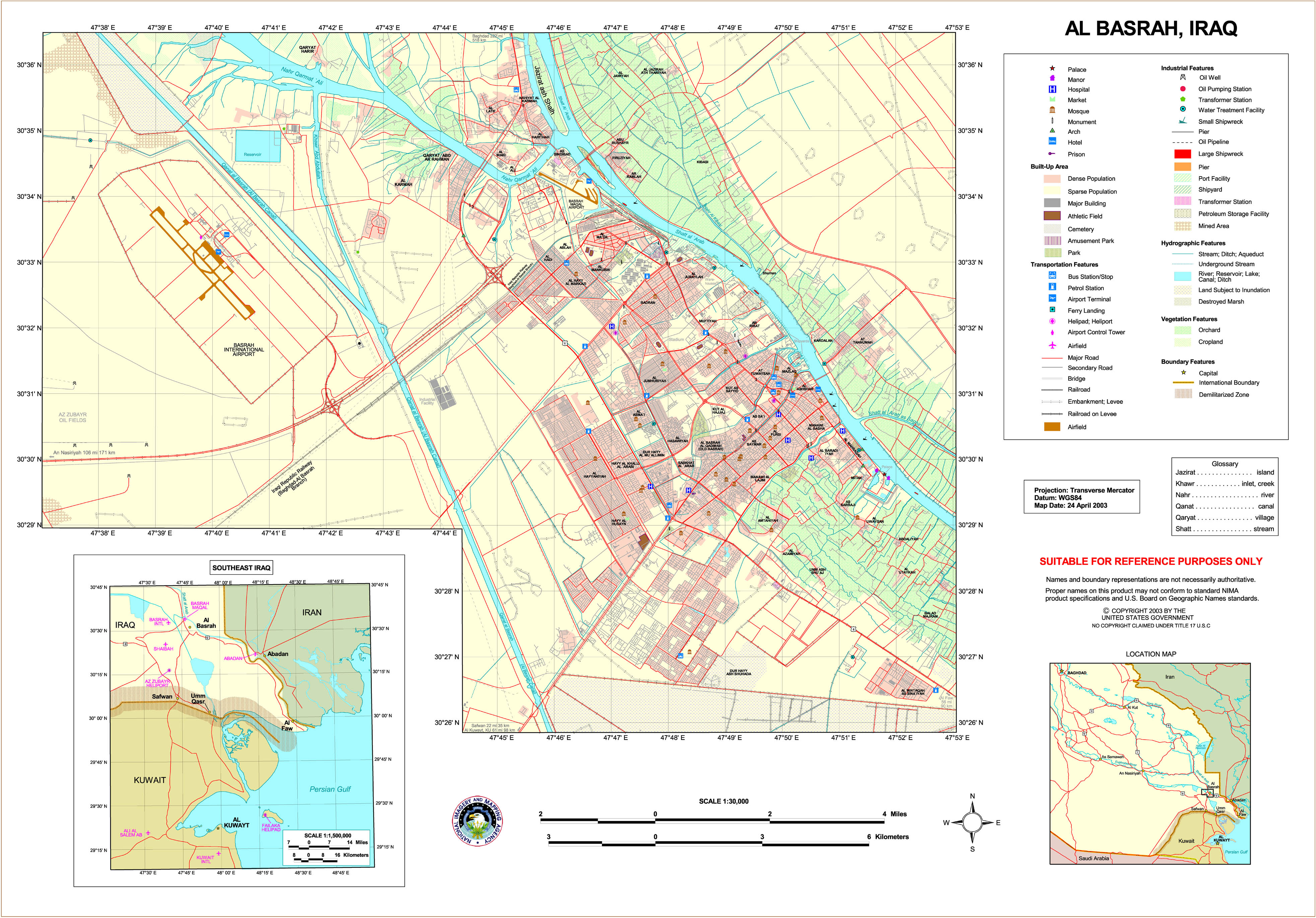
Template:Districts of Iraq Template:Authority control
- ↑ Script error: No such module "citation/CS1".
- ↑ Script error: No such module "citation/CS1".
- ↑ Script error: No such module "citation/CS1".
- ↑ Script error: No such module "citation/CS1".
- ↑ Script error: No such module "citation/CS1".
- ↑ Petersen, A., 2023, Discovering Early Islamic Basra: the Origins and Development of Iraq's Southern Metropolis, Journal of Material Cultures of the Muslim World, p 119-142, DOI 10.1163/26666286-12340042
- ↑ Encyclopædia Iranica, E. Yarshater, Columbia University, p851
- ↑ Script error: No such module "citation/CS1".
- ↑ Script error: No such module "citation/CS1".
- ↑ Script error: No such module "citation/CS1".
- ↑ Script error: No such module "citation/CS1".
- ↑ Script error: No such module "Citation/CS1".
- ↑ Script error: No such module "citation/CS1".
- ↑ Script error: No such module "citation/CS1".
- ↑ Script error: No such module "citation/CS1".
- ↑ a b c Script error: No such module "citation/CS1".
- ↑ a b c d Script error: No such module "Citation/CS1".
- ↑ a b c d Script error: No such module "Citation/CS1".
- ↑ a b c Script error: No such module "Citation/CS1".
- ↑ Script error: No such module "citation/CS1".
- ↑ a b c d e Development of Water Rating Curve in Basra River
- ↑ a b c d Script error: No such module "citation/CS1".
- ↑ Script error: No such module "citation/CS1".
- ↑ Script error: No such module "citation/CS1".
- ↑ Script error: No such module "citation/CS1".
- ↑ a b c Script error: No such module "citation/CS1".
- ↑ a b Script error: No such module "citation/CS1".
- ↑ (Madelung p. 303–04)
- ↑ (Brock p.66)
- ↑ a b Andre Wink, Al-Hind: The Making of the Indo-Islamic World, Vol.2, 17.
- ↑ Penny Encyclopedia
- ↑ Buscarello de Ghizolfi
- ↑ Script error: No such module "citation/CS1".
- ↑ a b Script error: No such module "citation/CS1".
- ↑ Script error: No such module "citation/CS1".
- ↑ Script error: No such module "citation/CS1".
- ↑ Script error: No such module "citation/CS1".
- ↑ a b Template:Cite EB1911
- ↑ a b c d e f g h i j k Script error: No such module "citation/CS1".
- ↑ Script error: No such module "citation/CS1".
- ↑ Script error: No such module "citation/CS1".
- ↑ Makiya, Kanan (as Samir al-Khalil). The Monument: Art, Vulgarity, and Responsibility in Iraq. University of California Press, 1991, pp. 48-50
- ↑ Script error: No such module "citation/CS1".
- ↑ Script error: No such module "citation/CS1".
- ↑ a b c d e f g h i j k l m n o p q r s t u v Script error: No such module "citation/CS1".
- ↑ Script error: No such module "citation/CS1".
- ↑ Script error: No such module "citation/CS1".
- ↑ Script error: No such module "citation/CS1".
- ↑ Script error: No such module "citation/CS1".
- ↑ Script error: No such module "citation/CS1".
- ↑ Script error: No such module "citation/CS1".
- ↑ Script error: No such module "citation/CS1".
- ↑ Script error: No such module "citation/CS1".
- ↑ Script error: No such module "citation/CS1".
- ↑ Script error: No such module "citation/CS1".
- ↑ a b c d e f g Script error: No such module "citation/CS1".
- ↑ a b Script error: No such module "citation/CS1".
- ↑ Script error: No such module "citation/CS1".
- ↑ Script error: No such module "citation/CS1".
- ↑ Script error: No such module "citation/CS1".
- ↑ Script error: No such module "citation/CS1".
- ↑ a b c d e f g h i Script error: No such module "citation/CS1".
- ↑ a b Script error: No such module "citation/CS1".
- ↑ Script error: No such module "citation/CS1".
- ↑ a b c Script error: No such module "citation/CS1".
- ↑ a b Script error: No such module "citation/CS1".
- ↑ a b c d e f Script error: No such module "citation/CS1".
- ↑ Script error: No such module "Citation/CS1".
- ↑ Script error: No such module "Citation/CS1".
- ↑ a b c d e f g h i j k Script error: No such module "citation/CS1".
- ↑ Script error: No such module "citation/CS1".
- ↑ a b c Script error: No such module "citation/CS1".
- ↑ Script error: No such module "citation/CS1".
- ↑ Script error: No such module "citation/CS1".
- ↑ a b c d Script error: No such module "citation/CS1".
- ↑ Script error: No such module "citation/CS1".
- ↑ Script error: No such module "citation/CS1".
- ↑ Script error: No such module "citation/CS1".
- ↑ Script error: No such module "citation/CS1".
- ↑ Script error: No such module "citation/CS1". gpsmartstadium.com. Retrieved 8 October 2021.
- ↑ Script error: No such module "citation/CS1".
- ↑ Script error: No such module "citation/CS1".