Chanakyapuri: Difference between revisions
imported>Citation bot Added date. | Use this bot. Report bugs. | Suggested by Anas1712 | Category:Neighbourhoods in Delhi | #UCB_Category 80/155 |
imported>Miqael Agricola |
||
| Line 60: | Line 60: | ||
==History== | ==History== | ||
Chanakyapuri was the first major extension of [[New Delhi]] beyond [[Lutyens' Delhi]]. The [[Central Public Works Department]] (CPWD) developed a large area of land to create this diplomatic enclave in the 1950s. Subsequently, this land was allotted to embassies, chanceries, high commissions and ambassador residences. The enclave is built around a wide central vista, known as [[Shantipath|Shanti Path]] (Peace Road), with wide green areas. A large landscaped park spread over an area of 80 acres, known as [[Nehru Park, Delhi|Nehru Park]], was developed in 1969 for the families of the diplomatic personnel. In time, two markets, two colleges and schools run by diplomatic missions (including [[The British School, New Delhi|The British School]] and the [[American Embassy School, New Delhi|American Embassy School]]) were established in the neighbourhood.<ref>{{cite book |title=Urbanization, urban development, and metropolitan cities in India|author=Viswambhar Nath|chapter=Delhi Before 1947|publisher=Concept Publishing Company|year= 2007 |isbn=978-81-8069-412-7 |page=248 |chapter-url=https://books.google.com/books?id=Obd1vEVEPdgC&q=Paharganj&pg=PA244 }}</ref> | Chanakyapuri was the first major extension of [[New Delhi]] beyond [[Lutyens' Delhi]]. The [[Central Public Works Department]] (CPWD) developed a large area of land to create this diplomatic enclave in the 1950s. The area was built on land acquired from the former village of the Gurjar community, along with smaller adjoining tracts.<ref>{{cite web |title=How areas like Lajpat Nagar and Defence Colony grew after Partition? – From Agrarian Fields to Elite Conclaves: The Transformation of Delhi |last=Jain |first=Anoushka |date=October 19, 2023 |website=Enroute Indian History |url=https://enrouteindianhistory.com/from-agrarian-fields-to-elite-conclaves-the-transformation-of-delhi/ |access-date=November 10, 2025}}</ref> | ||
<ref>{{cite book |last=Singh |first=R. L. |author2=Sharma, S. P. |title=Urban Geography of India |publisher=National Geographical Society of India |year=1976 |page=145}}</ref> | |||
<ref>{{cite journal |last=Ravindran |first=K. T. |title=Delhi: The Perennial City |journal=Seminar |issue=558 |year=2006 |pages=24–28}}</ref> | |||
<ref>{{cite web |title=South Delhi: A Comprehensive Study of Urban Evolution, History, Heritage, and Contemporary Development – South Delhi History |url=https://southdelhi.com/South-Delhi-History#:~:text=Diplomatic%20Development%3A |website=SouthDelhi.com |access-date=8 November 2025}}</ref> Subsequently, this land was allotted to embassies, chanceries, high commissions and ambassador residences. The enclave is built around a wide central vista, known as [[Shantipath|Shanti Path]] (Peace Road), with wide green areas. A large landscaped park spread over an area of 80 acres, known as [[Nehru Park, Delhi|Nehru Park]], was developed in 1969 for the families of the diplomatic personnel. In time, two markets, two colleges and schools run by diplomatic missions (including [[The British School, New Delhi|The British School]] and the [[American Embassy School, New Delhi|American Embassy School]]) were established in the neighbourhood.<ref>{{cite book |title=Urbanization, urban development, and metropolitan cities in India|author=Viswambhar Nath|chapter=Delhi Before 1947|publisher=Concept Publishing Company|year= 2007 |isbn=978-81-8069-412-7 |page=248 |chapter-url=https://books.google.com/books?id=Obd1vEVEPdgC&q=Paharganj&pg=PA244 }}</ref> | |||
The [[Akbar Bhawan|Akbar Hotel]] was constructed 1965-69 for the [[India Tourism Development Corporation]] by [[Shiv Nath Prasad]].<ref>{{cite web | url=https://worldarchitecture.org/architecture-news/cmzgp/an_ode_to_shivnath_prasad_the_le_corbusier_of_india.html | title=An Ode to Shivnath Prasad: The le Corbusier of India }}</ref><ref>{{cite web | url=https://www.indiatoday.in/magazine/economy/story/19850930-mea-to-house-its-new-offices-in-itdc-prestigious-akbar-hotel-801986-2014-01-10 | title=MEA to house its new offices in ITDC's prestigious Akbar Hotel | date=10 January 2014 }}</ref> Around it Yashwant Place was constructed for shopping and eating. A movie theatre Chanakya Cinema was added in 1969, built in the [[Brutalist architecture]] style.<ref>{{cite journal | url=https://www.academia.edu/37186556 | title=From the Ruins of Chanakya: Exhibition History and Urban Memory | journal=BioScope: South Asian Screen Studies | year=2018 | volume=9 | issue=1 | page=73 | last1=Sahu | first1=Ipsita | doi=10.1177/0974927618767285 | s2cid=150220965 }}</ref><ref>{{cite news | url=https://www.thehindu.com/news/cities/Delhi/chankayas-lost-glory/article7449697.ece | title=Chankaya's lost glory | newspaper=The Hindu | date=21 July 2015 }}</ref> The cinema was later torn down and the plot redeveloped into a [[shopping mall]] with a new cinema in 2017.<ref>{{cite web | url=https://indianexpress.com/article/cities/delhi/a-decade-after-it-was-razed-chanakya-cinema-returns-to-new-delhi-4856959/ | title=A decade after it was razed, Chanakya cinema returns to New Delhi | date=23 September 2017 }}</ref> | The [[Akbar Bhawan|Akbar Hotel]] was constructed 1965-69 for the [[India Tourism Development Corporation]] by [[Shiv Nath Prasad]].<ref>{{cite web | url=https://worldarchitecture.org/architecture-news/cmzgp/an_ode_to_shivnath_prasad_the_le_corbusier_of_india.html | title=An Ode to Shivnath Prasad: The le Corbusier of India }}</ref><ref>{{cite web | url=https://www.indiatoday.in/magazine/economy/story/19850930-mea-to-house-its-new-offices-in-itdc-prestigious-akbar-hotel-801986-2014-01-10 | title=MEA to house its new offices in ITDC's prestigious Akbar Hotel | date=10 January 2014 }}</ref> Around it Yashwant Place was constructed for shopping and eating. A movie theatre Chanakya Cinema was added in 1969, built in the [[Brutalist architecture]] style.<ref>{{cite journal | url=https://www.academia.edu/37186556 | title=From the Ruins of Chanakya: Exhibition History and Urban Memory | journal=BioScope: South Asian Screen Studies | year=2018 | volume=9 | issue=1 | page=73 | last1=Sahu | first1=Ipsita | doi=10.1177/0974927618767285 | s2cid=150220965 }}</ref><ref>{{cite news | url=https://www.thehindu.com/news/cities/Delhi/chankayas-lost-glory/article7449697.ece | title=Chankaya's lost glory | newspaper=The Hindu | date=21 July 2015 }}</ref> The cinema was later torn down and the plot redeveloped into a [[shopping mall]] with a new cinema in 2017.<ref>{{cite web | url=https://indianexpress.com/article/cities/delhi/a-decade-after-it-was-razed-chanakya-cinema-returns-to-new-delhi-4856959/ | title=A decade after it was razed, Chanakya cinema returns to New Delhi | date=23 September 2017 }}</ref> | ||
| Line 100: | Line 103: | ||
[[Category:Neighbourhoods in Delhi]] | [[Category:Neighbourhoods in Delhi]] | ||
[[Category:District subdivisions of Delhi]] | [[Category:District subdivisions of Delhi]] | ||
[[Category:Diplomatic districts]] | [[Category:Diplomatic districts in New Delhi]] | ||
[[Category:New Delhi district]] | [[Category:New Delhi district]] | ||
[[Category:Cities and towns in New Delhi district]] | [[Category:Cities and towns in New Delhi district]] | ||
[[Category:1950s establishments in Delhi]] | [[Category:1950s establishments in Delhi]] | ||
[[Category:Brutalist architecture in India]] | [[Category:Brutalist architecture in India]] | ||
Latest revision as of 20:38, 24 December 2025
Template:Use dmy dates Template:Use Indian English Script error: No such module "Settlement short description".Script error: No such module "Infobox".Template:Template otherScript error: No such module "Check for unknown parameters".Script error: No such module "Check for conflicting parameters".Expression error: Unexpected < operator.
_Ummu_06_00680_full_3669_2416_0_default.jpg)

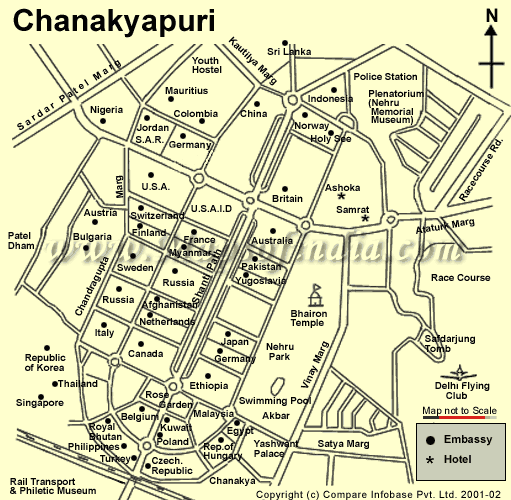
Chanakyapuri (Template:Langx) is a neighbourhood and diplomatic enclave established in the 1950s in New Delhi, India.[1][2][3] It is also a sub-division of the New Delhi district and plays host to the majority of foreign embassies in New Delhi. Chanakyapuri, meaning "city of Chanakya", is named after Chanakya, an ancient Indian diplomat, philosopher, politician, military strategist and advisor to Maurya Emperor Chandragupta Maurya.
History
Chanakyapuri was the first major extension of New Delhi beyond Lutyens' Delhi. The Central Public Works Department (CPWD) developed a large area of land to create this diplomatic enclave in the 1950s. The area was built on land acquired from the former village of the Gurjar community, along with smaller adjoining tracts.[4] [5] [6] [7] Subsequently, this land was allotted to embassies, chanceries, high commissions and ambassador residences. The enclave is built around a wide central vista, known as Shanti Path (Peace Road), with wide green areas. A large landscaped park spread over an area of 80 acres, known as Nehru Park, was developed in 1969 for the families of the diplomatic personnel. In time, two markets, two colleges and schools run by diplomatic missions (including The British School and the American Embassy School) were established in the neighbourhood.[8]
The Akbar Hotel was constructed 1965-69 for the India Tourism Development Corporation by Shiv Nath Prasad.[9][10] Around it Yashwant Place was constructed for shopping and eating. A movie theatre Chanakya Cinema was added in 1969, built in the Brutalist architecture style.[11][12] The cinema was later torn down and the plot redeveloped into a shopping mall with a new cinema in 2017.[13]
Accessibility
Major roads in Chanakyapuri include Shanti Path, Nyaya Marg, Niti Marg, Chandragupta Marg and Panchsheel Marg. In addition to these, the Ring Road traverses the southern expanse of the neighbourhood and intersects National Highway 8 on the border with neighbouring Dhaula Kuan. Sardar Patel Marg marks the Western periphery, while the Chanakya Cinema complex, which lies beyond Nehru Park, forms the south-western perimeter. The Delhi Ring Railway stops at Chanakyapuri, while Lok Kalyan Marg metro station and Jor Bagh metro station are the nearest stations of Delhi Metro.
Education
Primary and secondary schools
- The American Embassy School, New Delhi, for expatriates from the US and other countries.
- The British School offers the British National Curriculum, the IGCSE and IB. It primarily serves the international community
- German School New Delhi[14]
- Russian Embassy School in Delhi[15]
- Sanskriti School, a renowned education institution, which mainly serves the children of civil servants.
- Navy Children School, Delhi which mainly serves the children of Naval staff.
- Carmel Convent School - a K to 12 convent school for girls located in Malcha Marg. Follows the CBSE curriculum
Universities
- Jesus and Mary College, a constituent college of the University of Delhi.
- Maitreyi College, another constituent college of the University of Delhi.
- South Asian University, an international university established by the SAARC.
See also
References
<templatestyles src="Reflist/styles.css" />
- ↑ Script error: No such module "citation/CS1".
- ↑ What Lies Inside Delhi's Diplomatic Enclaves?
- ↑ Delhi’s Belly - Secret republics
- ↑ Script error: No such module "citation/CS1".
- ↑ Script error: No such module "citation/CS1".
- ↑ Script error: No such module "Citation/CS1".
- ↑ Script error: No such module "citation/CS1".
- ↑ Script error: No such module "citation/CS1".
- ↑ Script error: No such module "citation/CS1".
- ↑ Script error: No such module "citation/CS1".
- ↑ Script error: No such module "Citation/CS1".
- ↑ Script error: No such module "citation/CS1".
- ↑ Script error: No such module "citation/CS1".
- ↑ "Contact." German School New Delhi. Retrieved on 11 February 2015. "2, Nyaya Marg, Chanakyapuri New Delhi 110 021 India" - Also listed as: "Block F, Diplomatic Enclave, Chanakyapuri"
- ↑ "Сведения о школе.Template:Category handler[<span title="Script error: No such module "string".">usurped]Script error: No such module "Check for unknown parameters"." (ArchiveTemplate:Category handler[<span title="Script error: No such module "string".">usurped]Script error: No such module "Check for unknown parameters".). Russian Embassy School in New Delhi. Retrieved on 18 April 2015. "PLOT G BLOK 50E NYAYA MARG, CHANAKYAPURI, NEW-DELHI -110021, INDIA"
Script error: No such module "Check for unknown parameters".
External links
- http://www.markestates.co.in/where_cat_detail.php?id=1585
- Map of Chanakyapuri
- Chanakyapuri at Google Maps
Script error: No such module "Navbox". Template:Neighborhoods of Delhi