The Magic Flute: Difference between revisions
imported>Opus33 We're going with what Mozart said. |
imported>4meter4 No edit summary |
||
| Line 17: | Line 17: | ||
'''''The Magic Flute''''' ({{langx|de|'''Die Zauberflöte'''|links=no}}, {{IPA|de|diː ˈtsaʊbɐˌfløːtə|pron|De-Ger Die Zauberflöte.ogg}}), [[Köchel catalogue|K.]] 620, is an [[opera]] in two acts by [[Wolfgang Amadeus Mozart]] to a German [[libretto]] by [[Emanuel Schikaneder]]. It is a ''[[Singspiel]]'', a popular form that included both singing and spoken dialogue.{{efn|The genre of the work is hard to specify. The programme at the premiere performance announced it as {{Lang|de|Eine grosse oper}} (A grand opera). Mozart entered the work in his personal catalog as a "German opera", and the first printed libretto called it a ''Singspiel''.<ref>{{cite book|last1=Foil|first1=David|last2=Berger|first2=William|title=The Magic Flute – Wolfgang Amadeus Mozart, Emanuel Schikaneder, Carl Ludwig Giesecke|date=2007|publisher=Black Dog & Leventhal Pub. : Distributed by Workman Pub. Co.|isbn=9781579127596|oclc=145431789}}</ref>}} The work premiered on 30 September 1791 at Schikaneder's theatre, the [[Theater auf der Wieden|Freihaus-Theater auf der Wieden]] in Vienna, just two months before Mozart's death. It was Mozart's last opera. It was an outstanding success from its first performances, and remains a staple of the [[List of prominent operas|opera repertory]].<ref>{{cite news|title=Top 50 operas|author=[[Fiona Maddocks]]|url=https://www.theguardian.com/music/2011/aug/20/top-50-operas|access-date=9 June 2024|newspaper=[[The Guardian]]|date=19 August 2011}}</ref> | '''''The Magic Flute''''' ({{langx|de|'''Die Zauberflöte'''|links=no}}, {{IPA|de|diː ˈtsaʊbɐˌfløːtə|pron|De-Ger Die Zauberflöte.ogg}}), [[Köchel catalogue|K.]] 620, is an [[opera]] in two acts by [[Wolfgang Amadeus Mozart]] to a German [[libretto]] by [[Emanuel Schikaneder]]. It is a ''[[Singspiel]]'', a popular form that included both singing and spoken dialogue.{{efn|The genre of the work is hard to specify. The programme at the premiere performance announced it as {{Lang|de|Eine grosse oper}} (A grand opera). Mozart entered the work in his personal catalog as a "German opera", and the first printed libretto called it a ''Singspiel''.<ref>{{cite book|last1=Foil|first1=David|last2=Berger|first2=William|title=The Magic Flute – Wolfgang Amadeus Mozart, Emanuel Schikaneder, Carl Ludwig Giesecke|date=2007|publisher=Black Dog & Leventhal Pub. : Distributed by Workman Pub. Co.|isbn=9781579127596|oclc=145431789}}</ref>}} The work premiered on 30 September 1791 at Schikaneder's theatre, the [[Theater auf der Wieden|Freihaus-Theater auf der Wieden]] in Vienna, just two months before Mozart's death. It was Mozart's last opera. It was an outstanding success from its first performances, and remains a staple of the [[List of prominent operas|opera repertory]].<ref>{{cite news|title=Top 50 operas|author=[[Fiona Maddocks]]|url=https://www.theguardian.com/music/2011/aug/20/top-50-operas|access-date=9 June 2024|newspaper=[[The Guardian]]|date=19 August 2011}}</ref> | ||
In the opera the Queen of the Night persuades Prince Tamino to rescue her daughter Pamina from captivity under the high priest Sarastro; instead, he learns the high ideals of Sarastro's community and seeks to join it. Separately, then together, Tamino and Pamina undergo severe trials of initiation, which end in triumph, with the Queen and her cohorts vanquished. The earthy Papageno, who accompanies Tamino on his quest, fails the trials completely but is rewarded anyway with the hand of his ideal female companion Papagena. | In the opera, the Queen of the Night persuades Prince Tamino to rescue her daughter Pamina from captivity under the high priest Sarastro; instead, he learns the high ideals of Sarastro's community and seeks to join it. Separately, then together, Tamino and Pamina undergo severe trials of initiation, which end in triumph, with the Queen and her cohorts vanquished. The earthy Papageno, who accompanies Tamino on his quest, fails the trials completely but is rewarded anyway with the hand of his ideal female companion Papagena. | ||
==Composition== | ==Composition== | ||
[[File:Papageno.jpg|thumb|upright=0.9|[[Emanuel Schikaneder]], librettist of ''Die Zauberflöte'', as Papageno]] | [[File:Papageno.jpg|thumb|upright=0.9|[[Emanuel Schikaneder]], librettist of ''Die Zauberflöte'', as Papageno]] | ||
[[File:Salzburger Festspiele 2012 - Die Zauberflöte.jpg|thumb|upright=0.9|Baritone [[Markus Werba]] appearing as Papageno. He wears his pipes and carries his magic bells; both instruments are essential to the plot.]] | [[File:Salzburger Festspiele 2012 - Die Zauberflöte.jpg|thumb|upright=0.9|Baritone [[Markus Werba]] appearing as Papageno. He wears his pipes and carries his magic bells; both instruments are essential to the plot.]] | ||
The opera was the culmination of | The opera was the culmination of Mozart's increasing involvement with [[Emanuel Schikaneder]]'s theatrical troupe, which since 1789 had been the resident company at the Theater auf der Wieden. Mozart was a close friend of one of the singer-composers of the troupe, tenor [[Benedikt Schack]] (the first Tamino), and had contributed to the compositions of the troupe, which were often collaboratively written. Mozart's participation increased with his contributions to the 1790 collaborative opera ''[[Der Stein der Weisen]]'' (''The Philosopher's Stone''), including the duet ("Nun liebes Weibchen", K. 625/592a) among other passages. Like ''The Magic Flute'', ''Der Stein der Weisen'' was a [[fairy-tale]] opera and can be considered a kind of precursor; it employed much the same cast in similar roles.<ref>{{cite journal|last=Buch|first=David J.|author-link=David J. Buch|title=Mozart and the Theater auf der Wieden: New attributions and perspectives1|journal=Cambridge Opera Journal|date=1997|volume=9|issue=3|pages=195–232|doi=10.1017/S0954586700004808|s2cid=193162027 |issn=1474-0621}}</ref> | ||
Schikaneder's [[Libretto of The Magic Flute|libretto for ''The Magic Flute'']] is thought by scholars to be based on many sources. Some works of literature that may have served as sources include the medieval romance ''[[Yvain]]'' by [[Chrétien de Troyes]], the novel ''[[Life of Sethos]]'' by [[Jean Terrasson]], and the essay "On the mysteries of the Egyptians" by [[Ignaz von Born]]. The libretto is also a natural continuation of a series of fairy tale operas produced at the time by Schikaneder's troupe, including an adaptation of [[Sophie Seyler]]'s Singspiel ''[[Oberon (Seyler)|Oberon]]'' as well as ''Der Stein der Weisen''.{{sfn|Branscombe|1991|loc=ch. 2}} Especially for the role of Papageno, the libretto draws on the [[Hanswurst]] tradition of the Viennese popular theatre. Many scholars also acknowledge an influence of [[Freemasonry]].{{efn|For detailed discussion of sources see {{harvnb|Branscombe|1991}}, as well as ''[[Libretto of The Magic Flute]]''.}} | Schikaneder's [[Libretto of The Magic Flute|libretto for ''The Magic Flute'']] is thought by scholars to be based on many sources. Some works of literature that may have served as sources include the medieval romance ''[[Yvain]]'' by [[Chrétien de Troyes]], the novel ''[[Life of Sethos]]'' by [[Jean Terrasson]], and the essay "On the mysteries of the Egyptians" by [[Ignaz von Born]]. The libretto is also a natural continuation of a series of fairy tale operas produced at the time by Schikaneder's troupe, including an adaptation of [[Sophie Seyler]]'s Singspiel ''[[Oberon (Seyler)|Oberon]]'' as well as ''Der Stein der Weisen''.{{sfn|Branscombe|1991|loc=ch. 2}} Especially for the role of Papageno, the libretto draws on the [[Hanswurst]] tradition of the Viennese popular theatre. Many scholars also acknowledge an influence of [[Freemasonry]].{{efn|For detailed discussion of sources see {{harvnb|Branscombe|1991}}, as well as ''[[Libretto of The Magic Flute]]''.}} | ||
| Line 122: | Line 122: | ||
==Synopsis== | ==Synopsis== | ||
===Overture=== | ===Overture=== | ||
The overture, composed after the other parts of the opera were complete, begins with a solemn three-chord sequence from the brass, associated with the Priests of the Temple of Wisdom. (The number three is highly significant in [[Freemasonry]] and recurs as the number of ladies, boys and temples.)<ref>{{cite web |url=https://lifeforcearts.org/mozarts-magic-flute-magick-and-masonry/ |title=Mozart's Magic Flute, Magick and Masonry |last=DuQuette |first=Lon Milo |date=January 30, 2013 |website=Life Force Arts |publisher= |access-date=November 5, 2023 |quote=}}</ref> It transitions in an [[adagio (music)|adagio]] to a lively [[fugue]]<ref>[http://m.kennedy-center.org/home/program/5201?_ga=1.51535081.1573597235.1454471661 "The Magic Flute Overture"], [[Kennedy Center for the Performing Arts]]. Retrieved 2 February 2016. {{Webarchive|url=https://web.archive.org/web/20161006040600/http://m.kennedy-center.org/home/program/5201?_ga=1.51535081.1573597235.1454471661 |date=6 October 2016 }}</ref> in E-flat major. Halfway through, there is a false ending. After another three-chord brass sequence, the fugue resumes in E-flat minor, returning to E-flat major. | The overture, composed after the other parts of the opera were complete, begins with a solemn three-chord sequence from the brass, associated with the Priests of the Temple of Wisdom. (The number three is highly significant in [[Freemasonry]] and recurs as the number of ladies, boys and temples.)<ref>{{cite web |url=https://lifeforcearts.org/mozarts-magic-flute-magick-and-masonry/ |title=Mozart's Magic Flute, Magick and Masonry |last=DuQuette |first=Lon Milo |date=January 30, 2013 |website=Life Force Arts |publisher= |access-date=November 5, 2023 |quote=}}</ref> It transitions in an [[adagio (music)|adagio]] to a lively [[fugue]]<ref>[http://m.kennedy-center.org/home/program/5201?_ga=1.51535081.1573597235.1454471661 "The Magic Flute Overture"], [[Kennedy Center for the Performing Arts]]. Retrieved 2 February 2016. {{Webarchive|url=https://web.archive.org/web/20161006040600/http://m.kennedy-center.org/home/program/5201?_ga=1.51535081.1573597235.1454471661 |date=6 October 2016 }}</ref> in E-flat major. Halfway through, there is a false ending. After another three-chord brass sequence, the fugue resumes in E-flat minor, returning to E-flat major. | ||
| Line 130: | Line 129: | ||
Tamino, a handsome prince lost in a distant land, is pursued by a serpent and asks the gods to save him (aria: "{{Lang|de|Zu Hilfe! Zu Hilfe!|italic=no}}" / Help! Help!, segued into trio "{{Lang|de|Stirb, Ungeheuer, durch uns're Macht!||italic=no}}" / Die, monster, by our might!). He faints, and three ladies, attendants of the Queen of the Night, appear and kill the serpent. They find the unconscious prince extremely attractive, and each of them tries to persuade the other two to leave her alone with him. After arguing, they reluctantly decide to leave together. | Tamino, a handsome prince lost in a distant land, is pursued by a serpent and asks the gods to save him (aria: "{{Lang|de|Zu Hilfe! Zu Hilfe!|italic=no}}" / Help! Help!, segued into trio "{{Lang|de|Stirb, Ungeheuer, durch uns're Macht!||italic=no}}" / Die, monster, by our might!). He faints, and three ladies, attendants of the Queen of the Night, appear and kill the serpent. They find the unconscious prince extremely attractive, and each of them tries to persuade the other two to leave her alone with him. After arguing, they reluctantly decide to leave together. | ||
Tamino wakes up and is surprised to find himself still alive and the serpent dead. Papageno enters dressed as a bird. He describes his life as a bird-catcher, complaining he has no wife or girlfriend (aria: "{{Lang|de|Der Vogelfänger bin ich ja|italic=no}}" / The birdcatcher am I indeed). Tamino introduces himself to Papageno, thinking Papageno killed the serpent. Papageno happily takes the credit – claiming he strangled it with his bare hands. The three ladies suddenly reappear and instead of giving Papageno wine, cake and figs, they give him water and a stone, and padlock his mouth closed as a warning not to lie. They give Tamino a portrait of the Queen of the Night's daughter Pamina, with whom Tamino falls instantly in love (aria: {{Lang|de|"[[Dies Bildnis ist bezaubernd schön]]"|italic=no}} / This portrait is enchantingly beautiful). | Tamino wakes up and is surprised to find himself still alive and the serpent dead. Papageno enters dressed as a bird. He describes his life as a bird-catcher, complaining he has no wife or girlfriend (aria: "{{Lang|de|Der Vogelfänger bin ich ja|italic=no}}" / The birdcatcher am I indeed). Tamino introduces himself to Papageno, thinking Papageno killed the serpent. Papageno happily takes the credit – claiming he strangled it with his bare hands. The three ladies suddenly reappear and instead of giving Papageno wine, cake and figs, they give him water and a stone, and padlock his mouth closed as a warning not to lie. They give Tamino a portrait of the Queen of the Night's daughter Pamina, with whom Tamino falls instantly in love (aria: {{Lang|de|"[[Dies Bildnis ist bezaubernd schön]]"|italic=no}} / This portrait is enchantingly beautiful). | ||
| Line 149: | Line 147: | ||
===Act 2=== | ===Act 2=== | ||
====Scene 1: A grove of palms==== | ====Scene 1: A grove of palms==== | ||
The council of priests of [[Isis]] and [[Osiris]], headed by Sarastro, enters to the sound of a solemn march. Sarastro tells the priests that Tamino is ready to undergo the ordeals that will lead to enlightenment. He invokes the gods Isis and Osiris, asking them to protect Tamino and Pamina (Aria and chorus: "{{Lang|de|O Isis und Osiris|italic=no}} / O Isis and Osiris"). | The council of priests of [[Isis]] and [[Osiris]], headed by Sarastro, enters to the sound of a solemn march. Sarastro tells the priests that Tamino is ready to undergo the ordeals that will lead to enlightenment. He invokes the gods Isis and Osiris, asking them to protect Tamino and Pamina (Aria and chorus: "{{Lang|de|O Isis und Osiris|italic=no}} / O Isis and Osiris"). | ||
| Line 194: | Line 173: | ||
====Scene 8: A garden with a tree ==== | ====Scene 8: A garden with a tree ==== | ||
[[File:15031-Magic Flute Production-0413 (15830972013).jpg|thumb|Papageno and Papagena; from a production at [[Texas A&M University–Commerce]]]] | [[File:15031-Magic Flute Production-0413 (15830972013).jpg|thumb|Papageno and Papagena; from a production at [[Texas A&M University–Commerce]]]] | ||
Papageno despairs at having lost Papagena and decides to hang himself (Aria/Quartet: "{{Lang|de|Papagena! Papagena! Papagena! Weibchen, Täubchen, meine Schöne|italic=no}}" / Papagena! Papagena! Papagena! Dear woman, dear dove, my beauty) He hesitates, counting to three, but more and more slowly. The three boys appear and stop him. They remind him he can play his magic bells to summon Papagena. She appears and, united, the happy couple stutter in astonishment and make bird-like courting sounds at each other. They plan their future and dream of the many children they will have together (Duet: "Pa | Papageno despairs at having lost Papagena and decides to hang himself (Aria/Quartet: "{{Lang|de|Papagena! Papagena! Papagena! Weibchen, Täubchen, meine Schöne|italic=no}}" / Papagena! Papagena! Papagena! Dear woman, dear dove, my beauty) He hesitates, counting to three, but more and more slowly. The three boys appear and stop him. They remind him he can play his magic bells to summon Papagena. She appears and, united, the happy couple stutter in astonishment and make bird-like courting sounds at each other. They plan their future and dream of the many children they will have together (Duet: "Pa-Pa-Pa-Papageno").{{efn|For the origin of this duet, see [[Emanuel Schikaneder]]}} The scenes change without a break, leading into scene 9. | ||
====Scene 9: A rocky landscape outside the temple; night==== | ====Scene 9: A rocky landscape outside the temple; night==== | ||
| Line 216: | Line 195: | ||
''The Magic Flute'' is among the most frequently performed of all operas.<ref>{{cite web|title=Top 10 Most Popular Operas in the world|url=https://www.operasense.com/most-popular-operas/|website=opera sense|date=14 September 2016}} Number 3.</ref><ref>[https://www.classicfm.com/discover-music/periods-genres/opera/best-operas-ever-written/ "The 20 greatest operas ever written"], [[Classic FM (UK)]], 19 July 2022. Number 7</ref> | ''The Magic Flute'' is among the most frequently performed of all operas.<ref>{{cite web|title=Top 10 Most Popular Operas in the world|url=https://www.operasense.com/most-popular-operas/|website=opera sense|date=14 September 2016}} Number 3.</ref><ref>[https://www.classicfm.com/discover-music/periods-genres/opera/best-operas-ever-written/ "The 20 greatest operas ever written"], [[Classic FM (UK)]], 19 July 2022. Number 7</ref> | ||
Critic of the 1970s, [[Pauline Kael]] once described the opera as making a "special claim on one's affections, because its libretto is high camp. It's a peerlessly silly masterpiece: sublimely lucid music arising out of a parodistic fairy tale that celebrates in all seriousness the exalted brotherhood of the [[Freemasonry|Freemasons]]."<ref>{{Cite book |last=Kael |first=Pauline |url=https://www.google.com/books/edition/The_Age_of_Movies_Selected_Writings_of_P/tkShTL84MrcC?hl=en&gbpv=1&dq=the+age+of+movies+selected+writings+pauline+kael&printsec=frontcover |title=The Age of Movies: Selected Writings of Pauline Kael: A Library of America Special Publication |date=2011-10-27 |publisher=Library of America |isbn=978-1-59853-171-8 |pages=506-510 |language=en}}</ref> | |||
==First publication== | ==First publication== | ||
| Line 263: | Line 244: | ||
|- | |- | ||
|8. Finale 1: "Zum Ziele führt dich diese Bahn"<br />{{0|8. Finale 1: }}"Wie stark ist nicht dein Zauberton"<br />{{0|8. Finale 1: }}"Schnelle Füße, rascher Mut ... Das klinget so herrlich"<br />{{0|8. Finale 1: }}"Es lebe Sarastro" | |8. Finale 1: "Zum Ziele führt dich diese Bahn"<br />{{0|8. Finale 1: }}"Wie stark ist nicht dein Zauberton"<br />{{0|8. Finale 1: }}"Schnelle Füße, rascher Mut ... Das klinget so herrlich"<br />{{0|8. Finale 1: }}"Es lebe Sarastro" | ||
|{{Listen|plain=yes|filename=W. A. Mozart - Die Zauberflöte - 09. Zum Ziele führt dich diese Bahn (Ferenc Fricsay, 1953).ogg|title="Zum Ziele ..." | |{{Listen | ||
|filename2=W. A. Mozart - Die Zauberflöte - 10. Wie stark ist nicht dein Zauberton (Ferenc Fricsay, 1953).ogg|title2="Wie stark ..." | | plain = yes | ||
|filename3=W. A. Mozart - Die Zauberflöte - 11. Schnelle Füße, rascher Mut (Ferenc Fricsay, 1953).ogg|title3="Schnelle Füße ... Das klinget" | | filename = W. A. Mozart - Die Zauberflöte - 09. Zum Ziele führt dich diese Bahn (Ferenc Fricsay, 1953).ogg | ||
|filename4=W. A. Mozart - Die Zauberflöte - 12. Es lebe Sarasto, Sarastro soll leben! (Ferenc Fricsay, 1953).ogg|title4="Es lebe | | title = "Zum Ziele ..." | ||
| filename2 = W. A. Mozart - Die Zauberflöte - 10. Wie stark ist nicht dein Zauberton (Ferenc Fricsay, 1953).ogg | |||
| title2 = "Wie stark ..." | |||
| filename3 = W. A. Mozart - Die Zauberflöte - 11. Schnelle Füße, rascher Mut (Ferenc Fricsay, 1953).ogg | |||
| title3 = "Schnelle Füße ... Das klinget" | |||
| filename4 = W. A. Mozart - Die Zauberflöte - 12. Es lebe Sarasto, Sarastro soll leben! (Ferenc Fricsay, 1953).ogg | |||
| title4 = "Es lebe Sarastro" | |||
}} | |||
|- | |- | ||
|'''Act 2'''<br />9. March of the Priests | |'''Act 2'''<br />9. March of the Priests | ||
Latest revision as of 05:15, 15 November 2025
Template:Short description Script error: No such module "other uses". Template:Use British English Template:Use dmy dates Template:Infobox opera The Magic Flute (Template:Langx, Script error: No such module "IPA".), K. 620, is an opera in two acts by Wolfgang Amadeus Mozart to a German libretto by Emanuel Schikaneder. It is a Singspiel, a popular form that included both singing and spoken dialogue.Template:Efn The work premiered on 30 September 1791 at Schikaneder's theatre, the Freihaus-Theater auf der Wieden in Vienna, just two months before Mozart's death. It was Mozart's last opera. It was an outstanding success from its first performances, and remains a staple of the opera repertory.[1]
In the opera, the Queen of the Night persuades Prince Tamino to rescue her daughter Pamina from captivity under the high priest Sarastro; instead, he learns the high ideals of Sarastro's community and seeks to join it. Separately, then together, Tamino and Pamina undergo severe trials of initiation, which end in triumph, with the Queen and her cohorts vanquished. The earthy Papageno, who accompanies Tamino on his quest, fails the trials completely but is rewarded anyway with the hand of his ideal female companion Papagena.
Composition


The opera was the culmination of Mozart's increasing involvement with Emanuel Schikaneder's theatrical troupe, which since 1789 had been the resident company at the Theater auf der Wieden. Mozart was a close friend of one of the singer-composers of the troupe, tenor Benedikt Schack (the first Tamino), and had contributed to the compositions of the troupe, which were often collaboratively written. Mozart's participation increased with his contributions to the 1790 collaborative opera Der Stein der Weisen (The Philosopher's Stone), including the duet ("Nun liebes Weibchen", K. 625/592a) among other passages. Like The Magic Flute, Der Stein der Weisen was a fairy-tale opera and can be considered a kind of precursor; it employed much the same cast in similar roles.[2]
Schikaneder's libretto for The Magic Flute is thought by scholars to be based on many sources. Some works of literature that may have served as sources include the medieval romance Yvain by Chrétien de Troyes, the novel Life of Sethos by Jean Terrasson, and the essay "On the mysteries of the Egyptians" by Ignaz von Born. The libretto is also a natural continuation of a series of fairy tale operas produced at the time by Schikaneder's troupe, including an adaptation of Sophie Seyler's Singspiel Oberon as well as Der Stein der Weisen.Template:Sfn Especially for the role of Papageno, the libretto draws on the Hanswurst tradition of the Viennese popular theatre. Many scholars also acknowledge an influence of Freemasonry.Template:Efn
The Magic Flute appears to have two references to the music of Antonio Salieri. The first is that the Papageno–Papagena duet is similar to the Cucuzze cavatina in Salieri's Prima la musica e poi le parole. Both are centered around musical-textual playfulness with humorous bird-like utterances of pseudo-Italian words.[3] The Magic Flute also echoes Salieri's music in that Papageno's whistle is based on a motif borrowed from Salieri's Concerto for Clavicembalo in B-flat major.[4]
Roles

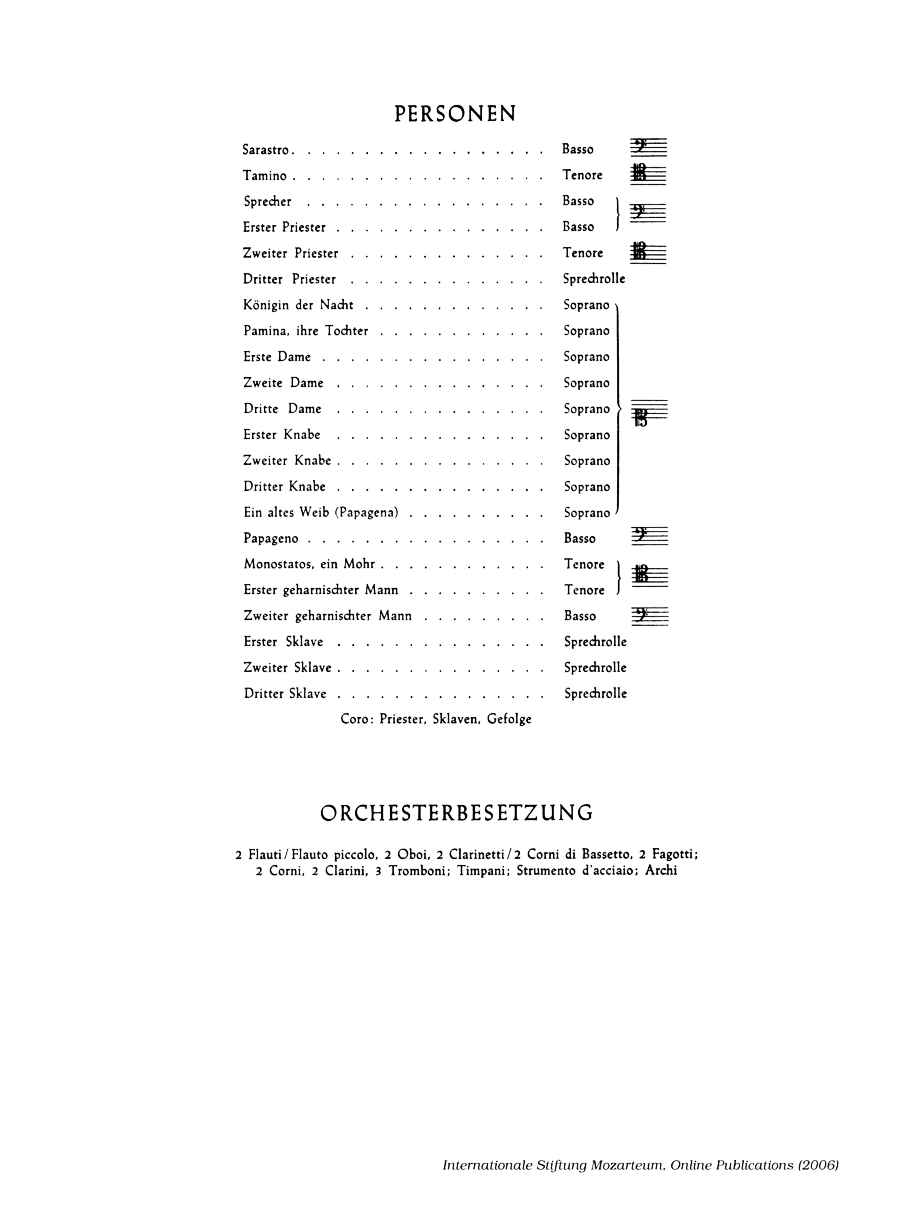
| Role | Voice type[5] | Contemporary classification[6] |
Premiere cast, 30 September 1791 Conductor: Wolfgang Amadeus Mozart |
|---|---|---|---|
| Tamino | tenor | Benedikt Schack | |
| Papageno | bass | baritone | Emanuel Schikaneder |
| Pamina | soprano | Anna Gottlieb | |
| The Queen of the NightTemplate:Efn | soprano | coloratura soprano | Josepha Hofer |
| Sarastro | bass | Franz Xaver Gerl | |
| Three ladies | 3 sopranos | sopranos, mezzo-soprano | Mlle Klöpfer, Mlle Hofmann, ElisabethTemplate:Sfn Schack |
| Monostatos | tenor | baritone | Johann Joseph Nouseul |
| Three boys | sopranoTemplate:Efn | treble, alto, mezzo-soprano | Anna Schikaneder; Anselm Handelgruber; Franz Anton Maurer |
| Speaker of the temple | bass | bass-baritone | Herr Winter |
| First Priest | tenor | Johann Michael Kistler | |
| First armoured man | |||
| Second Priest | bass | Urban Schikaneder | |
| Third Priest | speaking role | bass | Herr Moll |
| Second armoured man | bass | ||
| Papagena | soprano | Barbara Gerl | |
| Three slaves | speaking roles | bass, 2 tenors | Karl Ludwig Giesecke, Herr Frasel, Herr Starke |
| Priests, women, people, slaves, chorus | |||
The names of the performers at the premiere are taken from a preserved playbill for this performance (at right), which does not give full names; "Hr." = Herr, Mr.; "Mme." = Madame, Mrs.; "Mlle." = Mademoiselle, Miss.[7]Template:Sfn

While the female roles in the opera are assigned to different voice types, the playbill for the premiere performance referred to all of the female singers as "sopranos". The casting of the roles relies on the actual vocal range of the part.Template:Sfn
Orchestration
The work is scored for two flutes (one doubling on piccolo), two oboes, two clarinets (doubling basset horns), two bassoons, two horns, two trumpets, three trombones (alto, tenor, and bass), timpani and strings. It also requires a four-part chorus for several numbers (notably the finales of each act). Mozart also called for a Script error: No such module "Lang". (instrument of steel) to perform Papageno's magic bells. This instrument has since been lost to history, though modern day scholars believe it to be a keyed glockenspiel, which is usually replaced with a celesta in modern-day performances.[8]
Charles Rosen has remarked on the character of Mozart's orchestration:
Die Zauberflöte has the greatest variety of orchestral color that the eighteenth century was to know; the very lavishness, however, is paradoxically also an economy as each effect is a concentrated one, each one—Papageno's whistle, the Queen of the Night's coloratura, the bells, Sarastro's trombones, even the farewell in scene 1 for clarinets and pizzicato strings—a single dramatic stroke."Template:Sfn
Synopsis
Overture
The overture, composed after the other parts of the opera were complete, begins with a solemn three-chord sequence from the brass, associated with the Priests of the Temple of Wisdom. (The number three is highly significant in Freemasonry and recurs as the number of ladies, boys and temples.)[9] It transitions in an adagio to a lively fugue[10] in E-flat major. Halfway through, there is a false ending. After another three-chord brass sequence, the fugue resumes in E-flat minor, returning to E-flat major.
Act 1
Scene 1: A rough, rocky landscape
_-_Archivio_Storico_Ricordi_ICON012437.jpg)
Tamino, a handsome prince lost in a distant land, is pursued by a serpent and asks the gods to save him (aria: "Script error: No such module "Lang"." / Help! Help!, segued into trio "Script error: No such module "Lang"." / Die, monster, by our might!). He faints, and three ladies, attendants of the Queen of the Night, appear and kill the serpent. They find the unconscious prince extremely attractive, and each of them tries to persuade the other two to leave her alone with him. After arguing, they reluctantly decide to leave together.
Tamino wakes up and is surprised to find himself still alive and the serpent dead. Papageno enters dressed as a bird. He describes his life as a bird-catcher, complaining he has no wife or girlfriend (aria: "Script error: No such module "Lang"." / The birdcatcher am I indeed). Tamino introduces himself to Papageno, thinking Papageno killed the serpent. Papageno happily takes the credit – claiming he strangled it with his bare hands. The three ladies suddenly reappear and instead of giving Papageno wine, cake and figs, they give him water and a stone, and padlock his mouth closed as a warning not to lie. They give Tamino a portrait of the Queen of the Night's daughter Pamina, with whom Tamino falls instantly in love (aria: Script error: No such module "Lang". / This portrait is enchantingly beautiful).
The ladies return and tell Tamino that Pamina has been captured by Sarastro, whom they describe as a powerful, evil demon. Tamino vows to rescue Pamina. The Queen of the Night appears and promises Tamino that Pamina will be his if he rescues her from Sarastro (Recitative: Script error: No such module "Lang". / Oh, tremble not, my dear son! – and aria: Script error: No such module "Lang". / You will go to free her). The Queen and the ladies leave and Papageno can only hum to bemoan the padlock on his mouth. (Quintet: "Hm! Hm! Hm! Hm!"). The ladies return and remove the padlock with a warning not to lie any more. They give Tamino a magic flute which has the power to change sorrow into joy, and Papageno magic bells for protection, telling him to go with Tamino. The ladies tell of three boys who will guide Tamino and Papageno to Sarastro's temple. Together Tamino and Papageno set forth.
Scene 2: A room in Sarastro's palace

Pamina is dragged in by Sarastro's slaves, having tried to escape. Monostatos, a blackamoor and chief of the slaves, orders them to chain her and leave her alone with him. Papageno, sent ahead by Tamino to help find Pamina, enters (Trio: "Script error: No such module "Lang"." / Just come in, you fine little dove!). Monostatos and Papageno are each terrified by the other's strange appearance and both flee, each thinking the other is the devil. Papageno returns and announces to Pamina that her mother has sent Tamino to save her. Pamina rejoices to hear that Tamino is in love with her. She offers sympathy and hope to Papageno, who longs for a wife. Together they reflect on the joys and sacred value of marital love (duet: "Script error: No such module "Lang"." / In men, who feel love).
Finale. Scene 3: A grove in front of a temple

The three boys lead Tamino to Sarastro's temple, promising that if he remains patient, wise and steadfast, he will succeed in rescuing Pamina (Quartet: "Script error: No such module "Lang"." / This path leads you to your goal). Tamino approaches the right-hand entrance (the Temple of Reason) and is denied access by voices from within. The same happens when he goes to the entrance on the left (the Temple of Nature). But from the entrance in the middle (the Temple of Wisdom), a senior priest appears. (The priest is referred to as "The Speaker" in the libretto, but his role is sung.) He tells Tamino that Sarastro is benevolent, not evil, and that he should not trust the Queen of the Night. With a hidden male chorus, he promises that Tamino's confusion will be lifted when he approaches the temple in a spirit of friendship, and that Pamina is alive. Tamino plays his magic flute. Animals appear and dance, enraptured, to his music. Tamino hears Papageno's pipes sounding offstage, and hurries off to find him (aria: "Script error: No such module "Lang"." / How strong is thy magic tone).

Papageno and Pamina enter, searching for Tamino (trio: "Script error: No such module "Lang"." / Swift steps, ready courage). They are recaptured by Monostatos and his slaves. Papageno plays his magic bells, causing Monostatos and his slaves to dance off the stage, mesmerised by the beauty of the music (chorus: "Script error: No such module "Lang"." / That sounds so splendid). Papageno and Pamina hear the sound of Sarastro's retinue approaching. Papageno is frightened and asks Pamina what they should say. She answers that they must tell the truth. Sarastro enters, with a crowd of followers. (chorus: "Script error: No such module "Lang"." / Long live Sarastro!) Pamina falls at Sarastro's feet and confesses that she tried to escape because Monostatos had forced his attentions on her. Sarastro receives her kindly and assures her that he wishes only for her happiness, but he refuses to return her to her mother, whom he describes as a proud, headstrong woman, and a bad influence on those around her. Pamina, he says, must be guided by a man.
Monostatos brings in Tamino. The two lovers see one another for the first time and embrace, causing indignation among Sarastro's followers. Monostatos tells Sarastro that he caught Papageno and Pamina trying to escape, and demands a reward. Sarastro ironically "rewards" Monostatos with a beating and sends him away. He announces that Tamino and Pamina must both undergo trials to be purified. The priests declare that virtue and righteousness will sanctify life and make mortals like gods ("Script error: No such module "Lang"." / If virtue and justice).
Act 2
Scene 1: A grove of palms
The council of priests of Isis and Osiris, headed by Sarastro, enters to the sound of a solemn march. Sarastro tells the priests that Tamino is ready to undergo the ordeals that will lead to enlightenment. He invokes the gods Isis and Osiris, asking them to protect Tamino and Pamina (Aria and chorus: "Script error: No such module "Lang". / O Isis and Osiris").
Scene 2: The courtyard of the Temple of Ordeal
Tamino and Papageno are led in by two priests for the first trial. The two priests advise Tamino and Papageno of the dangers ahead of them, warn them of women's wiles and swear them to silence (Duet: "Script error: No such module "Lang"." / Keep yourselves from women's tricks). The three ladies appear and remind Tamino and Papageno of what the Queen has said about Sarastro, trying to tempt them into speaking. (Quintet: "Script error: No such module "Lang"." / How, how, how) Papageno cannot resist answering the ladies, but Tamino remains aloof, angrily instructing Papageno not to listen to the ladies' threats and to keep quiet. Seeing that Tamino will not speak to them, the ladies withdraw in confusion. The Speaker and a priest return and lead Tamino and Papageno away.
Scene 3: A garden
Pamina is asleep. Monostatos creeps in and ogles her. (Aria: "Script error: No such module "Lang"." / All feel the joys of love) He is about to kiss her, when the Queen of the Night appears. Monostatos hides. Waking, Pamina tells her that Tamino is joining Sarastro's brotherhood and that she is thinking of accompanying him. The Queen is not pleased. She explains that her husband, the previous owner of the temple, on his deathbed gave the ownership to Sarastro instead of to her, rendering the Queen powerless (this is in the original libretto, but is usually omitted from modern productions). She gives Pamina a dagger, ordering her to kill Sarastro with it and threatening to disown her if she does not. (Aria: "Script error: No such module "Lang"." / Hell's vengeance boils in my heart). She leaves. Monostatos returns and tries to force Pamina's love by threatening to reveal the Queen's plot, but Sarastro enters and drives him off. Pamina begs Sarastro to forgive her mother and he reassures her that revenge and cruelty have no place in his domain (Aria: "Script error: No such module "Lang"." / Within these sacred halls).
Scene 4: A hall in the Temple of Ordeal

Tamino and Papageno are led in by priests, who remind them that they must remain silent. Papageno complains of thirst. An old woman enters and offers Papageno a cup of water. He drinks and teasingly asks whether she has a boyfriend. She replies that she does and that his name is Papageno. She disappears as Papageno asks for her name, and the three boys bring in food, the magic flute, and the bells, sent from Sarastro (Trio: "Script error: No such module "Lang"." / We welcome you a second time). Tamino begins to play the flute, which summons Pamina. She tries to speak with him, but Tamino, bound by his vow of silence, cannot answer her, and Pamina begins to believe that he no longer loves her. (Aria: "Script error: No such module "Lang"." / Oh, I feel it, it is gone) She leaves in despair.
Scene 5: The pyramids
The priests celebrate Tamino's successes so far, and pray that he will succeed and become worthy of their order (Chorus: "Script error: No such module "Lang"." / O Isis and Osiris). Pamina is brought in and Sarastro instructs Pamina and Tamino to bid each other farewell before the greater trials ahead, alarming them by describing it as their "final farewell". (Trio: Sarastro, Pamina, Tamino – "Script error: No such module "Lang"." / Shall I see you no more, dear one? — Note: In order to preserve the continuity of Pamina's suicidal feelings, this trio is sometimes performed earlier in act 2, preceding or immediately following the chorus "Script error: No such module "Lang".".Template:Efn[11]) They exit and Papageno enters. The priests grant his request for a glass of wine and he expresses his desire for a wife. (Aria: "Script error: No such module "Lang"." / A girl or a woman). The elderly woman reappears and warns him that unless he immediately promises to marry her, he will be imprisoned forever. When Papageno promises to love her faithfully (muttering that he will only do this until something better comes along), she is transformed into the young and pretty Papagena. Papageno rushes to embrace her, but the priests drive him back, telling him that he is not yet worthy of her.
Finale. Scene 6: A garden
The three boys hail the dawn. They observe Pamina, who is contemplating suicide because she believes Tamino has abandoned her. The boys restrain her and reassure her of Tamino's love. (Quartet: "Script error: No such module "Lang"." / To herald the morning, soon will shine). The scene changes without a break, leading into scene 7.
Scene 7: At the Mountains of Ordeal

(One mountain has a waterfall, the other emits fire.) Two men in armor lead Tamino in. They promise enlightenment to those who successfully overcome the fear of death ("Script error: No such module "Lang"." / He who walks this path weighed down with cares – sung to a Baroque chorale prelude, inspired by Martin Luther's hymn "Ach Gott, vom Himmel sieh darein" / Oh God, look down from heavenTemplate:Efn[12]). Tamino declares that he is ready to be tested. Pamina calls to him from offstage. The men in armour assure him that the trial by silence is over and he is free to speak with her. Pamina enters and declares her intention to undergo the remaining trials with him. She hands him the magic flute to help them through the trials ("Script error: No such module "Lang". / Oh, what luck, my Tamino!"). Protected by the music of the magic flute, they pass unscathed through fire and water. Offstage, the priests hail their triumph and invite the couple to enter the temple. The scene changes without a break, leading into scene 8.
Scene 8: A garden with a tree
.jpg)
Papageno despairs at having lost Papagena and decides to hang himself (Aria/Quartet: "Script error: No such module "Lang"." / Papagena! Papagena! Papagena! Dear woman, dear dove, my beauty) He hesitates, counting to three, but more and more slowly. The three boys appear and stop him. They remind him he can play his magic bells to summon Papagena. She appears and, united, the happy couple stutter in astonishment and make bird-like courting sounds at each other. They plan their future and dream of the many children they will have together (Duet: "Pa-Pa-Pa-Papageno").Template:Efn The scenes change without a break, leading into scene 9.
Scene 9: A rocky landscape outside the temple; night
Monostatos appears with the Queen of the Night and her three ladies. They plot to destroy the temple ("Script error: No such module "Lang"." / Just quiet, quiet) and the Queen confirms her promise to give Pamina to Monostatos, but suddenly, with thunder and lightning, they are cast out into eternal night. The scene changes without a break, leading into scene 10.
Scene 10: The Temple of the Sun
Sarastro announces the sun's triumph over the night and the fraudulent power of hypocrites. The chorus hails the newly consecrated Tamino and Pamina, and gives thanks to Isis and Osiris.
Premiere and reception
The opera premiered in Vienna on 30 September 1791 at the suburban Freihaus-Theater auf der Wieden.Template:Sfn Mozart conducted the orchestraTemplate:Efn and Schikaneder himself played Papageno, while the role of the Queen of the Night was sung by Mozart's sister-in-law Josepha Hofer.
On the reception of the opera, Mozart scholar Maynard Solomon writes: Template:Quote
As Mozart's letters show, he was very pleased to have achieved such a success. Solomon continues: Template:Quote
The opera celebrated its 100th performance in November 1792, though Mozart did not have the pleasure of witnessing this milestone, as he had died on 5 December 1791. The opera was first performed outside Vienna (21 September 1792) in Lemberg,[13] then in Prague. It then made "triumphal progress through Germany's opera houses great and small",Template:Sfn and with the early 19th century spread to essentially all the countries of Europe—and eventually, everywhere in the world—where opera is cultivated.[14]
As Peter Branscombe documents, the earlier performances were often of highly altered, sometimes even mutilated, versions of the opera (see Ludwig Wenzel Lachnith). Productions of the past century have tended to be more faithful to Mozart's music, though faithful rendering of Mozart and Schikaneder's original (quite explicit) stage directions and dramatic vision continues to be rare; with isolated exceptions, modern productions strongly reflect the creative preferences of the stage director.[15]
The Magic Flute is among the most frequently performed of all operas.[16][17]
Critic of the 1970s, Pauline Kael once described the opera as making a "special claim on one's affections, because its libretto is high camp. It's a peerlessly silly masterpiece: sublimely lucid music arising out of a parodistic fairy tale that celebrates in all seriousness the exalted brotherhood of the Freemasons."[18]
First publication
On 28 December 1791, three and a half weeks after Mozart's death, his widow Constanze offered to send a manuscript score of The Magic Flute to the electoral court in Bonn. Nikolaus Simrock published this text in the first full-score edition (Bonn, 1814), claiming that it was "in accordance with Mozart's own wishes" (Allgemeine musikalische Zeitung, 13 September 1815).[19][20]
Themes
Script error: No such module "Labelled list hatnote". Script error: No such module "Labelled list hatnote".
The Magic Flute is noted for its prominent Masonic elements,[21] although some scholars hold that the Masonic influence is exaggerated.[22][23][24] Schikaneder and Mozart were Freemasons, as was Ignaz Alberti, engraver and printer of the first libretto.[25] The opera is also influenced by Enlightenment philosophy and can be regarded as advocating enlightened absolutism. The Queen of the Night is seen by some to represent a dangerous form of obscurantism, by others to represent Roman Catholic Empress Maria Theresa,[26] who banned Freemasonry from Austria.[27] Still others see the Roman Catholic Church itself, which was and still is strongly anti-Masonic.[28] Likewise, the literature repeatedly addresses the fact that the central theme of the work is not only "love", but also becoming a better person by overcoming trials (similar to Wagner's Parsifal later on).[29]
Musical numbers
| Overture. The overture is frequently played on its own. | Script error: No such module "Listen". |
| Act 1 1. Introduction: "Zu Hilfe! Zu Hilfe! Sonst bin ich verloren" – Tamino, Three Ladies |
Script error: No such module "Listen". |
| 2. Aria: "Der Vogelfänger bin ich ja" – Papageno | Script error: No such module "Listen". |
| 3. Aria: "Dies Bildnis ist bezaubernd schön" – Tamino | Script error: No such module "Listen". |
| 4. Recitative and aria: "O zittre nicht, mein lieber Sohn" – The Queen of the Night | Script error: No such module "Listen". |
| 5 Quintet: "Hm Hm Hm" – Tamino, Papageno, Three Ladies | Script error: No such module "Listen". |
| 6. Terzet: "Du feines Täubchen, nur herein!" – Monostatos, Pamina, Papageno | Script error: No such module "Listen". |
| 7. Duet: "Bei Männern, welche Liebe fühlen" – Pamina and Papageno | Script error: No such module "Listen". |
| 8. Finale 1: "Zum Ziele führt dich diese Bahn" "Wie stark ist nicht dein Zauberton" "Schnelle Füße, rascher Mut ... Das klinget so herrlich" "Es lebe Sarastro" |
Script error: No such module "Listen". |
| Act 2 9. March of the Priests |
Script error: No such module "Listen". |
| 10. Aria with chorus: "O Isis und Osiris" – Sarastro | Script error: No such module "Listen". |
| 11. Duet: "Bewahret euch vor Weibertücken" – Second Priest, Speaker | Script error: No such module "Listen". |
| 12. Quintet: "Wie? Ihr an diesem Schreckensort?" – Three Ladies, Tamino, Papageno | Script error: No such module "Listen". |
| 13. Aria: "Alles fühlt der Liebe Freuden" – Monostatos | Script error: No such module "Listen". |
| 14. Aria: "Der Hölle Rache kocht in meinem Herzen" – The Queen of the Night | Script error: No such module "Listen". |
| 15. Aria: "In diesen heil'gen Hallen" – Sarastro | Script error: No such module "Listen". |
| 16. Terzet: "Seid uns zum zweitenmal willkommen" – Three Boys | Script error: No such module "Listen". |
| 17. Aria: "Ach, ich fühl's, es ist verschwunden" – Pamina | Script error: No such module "Listen". |
| 18. Chorus: "Template:Ill" – Priests | Script error: No such module "Listen". |
| 19. Terzet: "Soll ich dich, Teurer, nicht mehr seh'n?" – Pamina, Tamino, Sarastro | Script error: No such module "Listen". |
| 20. Aria: "Ein Mädchen oder Weibchen" (A girl or a woman) – Papageno | Script error: No such module "Listen". |
| 21. Finale 2: "Bald prangt, den Morgen zu verkünden" "Der, welcher wandert diese Straße voll Beschwerden" "Tamino mein! ... Triumph, Triumph! du edles Paar! Besieget hast du die Gefahr!" "Papagena! Weibchen, Täubchen, meine Schöne ... Pa-Pa-Pa-Pa-Pa" "Nur stille" "Die Strahlen der Sonne vertreiben die Nacht ... Es siegte die Stärke" |
Script error: No such module "Listen". |
Recordings
Script error: No such module "Labelled list hatnote".
The first known recording of The Magic FluteTemplate:'s overture was issued around 1903, by the Victor Talking Machine Company and played by the Victor Grand Concert Band.[30]
The first complete recording of The Magic Flute was of a live performance at the 1937 Salzburg Festival, with Arturo Toscanini conducting the Vienna Philharmonic and Vienna State Opera, though the recording was not officially issued until many years later. The first studio recording of the work, with Sir Thomas Beecham conducting the Berlin Philharmonic, was completed in 1938. Both of these historic recordings have been reissued on LP and compact disc. Since then there have been many recordings, in both audio and video formats.[31][32]
See also
Notes and references
Notes Template:Notelist
References
Sources
- Script error: No such module "citation/CS1". with supplementary footnotes by Cliff Eisen.
- Script error: No such module "citation/CS1".
- Script error: No such module "citation/CS1".
- Script error: No such module "citation/CS1".
- Script error: No such module "citation/CS1".
- Script error: No such module "citation/CS1".
- Script error: No such module "citation/CS1".
- Script error: No such module "citation/CS1".
Further reading
- Script error: No such module "Citation/CS1".
- Script error: No such module "citation/CS1".
- Script error: No such module "Citation/CS1".
- Script error: No such module "citation/CS1".
- Script error: No such module "citation/CS1".
- Script error: No such module "citation/CS1". see also Das Labyrinth
External links
Template:Sister project Template:NMA
- Libretto, critical editions, diplomatic editions, source evaluation (German only), links to online DME recordings; Digital Mozart Edition
- Die Zauberflöte. Facsimile of Mozart's autograph
- Die Zauberflöte: Scores at the International Music Score Library Project
- Opera Guide, synopsis, libretto, highlights
- Opera in a nutshell, soundfiles (MIDI)
- Libretto and English translation, Aria-Database.com
- Frontispiece of the first edition libretto
- Brief programme notes from 2006 Opera Gold production, Goldsmiths, University of London
- San Diego OperaTalk! with Nick Reveles: Mozart's The Magic Flute, UC-TV and San Diego Opera
- Template:Trim Template:Replace on YouTubeScript error: No such module "Check for unknown parameters"., Arnold Östman conducting the Drottningholm Court Theatre Orchestra, 1992; see The Magic Flute discography.
Template:The Magic Flute Template:Wolfgang Amadeus Mozart Template:Mozart operas (horizontal) Template:Portal bar Template:Authority control
- ↑ Script error: No such module "citation/CS1".
- ↑ Script error: No such module "Citation/CS1".
- ↑ Script error: No such module "Citation/CS1".
- ↑ Template:Cite thesis
- ↑ Score (roles), Neue Mozart-Ausgabe
- ↑ Script error: No such module "citation/CS1".
- ↑ Script error: No such module "citation/CS1".
- ↑ "The otherworldly feeling of Mozart's magic" by Louise Schwartzkoff, The Sydney Morning Herald, 28 July 2009
- ↑ Script error: No such module "citation/CS1".
- ↑ "The Magic Flute Overture", Kennedy Center for the Performing Arts. Retrieved 2 February 2016. Template:Webarchive
- ↑ Script error: No such module "citation/CS1".
- ↑ Script error: No such module "Citation/CS1".
- ↑ Lemberg, today the Ukrainian city of Lviv, was at the time a provincial center of the Austrian Empire. The Lviv performance was brought to the attention of musical scholarship only recently by Dexter Edge and David Black
- ↑ For extensive discussion of the spread of The Magic Flute and its performance traditions, see Script error: No such module "Footnotes"..
- ↑ For discussion and examples, see Script error: No such module "Footnotes"..
- ↑ Script error: No such module "citation/CS1". Number 3.
- ↑ "The 20 greatest operas ever written", Classic FM (UK), 19 July 2022. Number 7
- ↑ Script error: No such module "citation/CS1".
- ↑ Script error: No such module "citation/CS1".
- ↑ Script error: No such module "citation/CS1".
- ↑ See, for instance, Julian Rushton, "Die Zauberflöte" in The New Grove Dictionary of Opera, ed. Stanley Sadie, 4 vols. (London and New York, 1992), Volume 4, pp. 1215–1218, and in "Mozart" in volume III of the same dictionary, pp. 489–503.
- ↑ Script error: No such module "Citation/CS1".
- ↑ Script error: No such module "Citation/CS1".
- ↑ Script error: No such module "citation/CS1". (PDF download available)
- ↑ Script error: No such module "citation/CS1".
- ↑ Script error: No such module "citation/CS1".
- ↑ Template:Cite videoTemplate:Cbignore
- ↑ Script error: No such module "citation/CS1".
- ↑ Script error: No such module "citation/CS1".
- ↑ Script error: No such module "citation/CS1".
- ↑ Script error: No such module "citation/CS1".
- ↑ Script error: No such module "citation/CS1".
- Pages with script errors
- Pages with broken file links
- Works with IMSLP links
- Articles with International Music Score Library Project links
- The Magic Flute
- 1791 in the Habsburg monarchy
- 1791 in the Holy Roman Empire
- 18th century in Vienna
- 1791 operas
- German-language operas
- Operas
- Operas adapted into films
- Operas by Wolfgang Amadeus Mozart
- Operas set in mythological places
- Operas set in ancient Egypt
- Singspiele
- Blackface theatre