Smiley: Difference between revisions
imported>Sumanuil Reverted 1 edit by 208.40.86.22 (talk) to last revision by Materialscientist |
imported>Bayoustarwatch resotong == See also == it has been here for some time Undid revision 1323034620 by ~2025-34820-35 (talk) |
||
| (One intermediate revision by the same user not shown) | |||
| Line 1: | Line 1: | ||
{{Short description|Stylized image of a smiling face}} | {{Short description|Stylized image of a smiling face}} | ||
{{redirect-several|Smiley Face|Happy face|Smiley}} | |||
{{redirect-several|Smiley Face|Happy face}} | |||
{{Use dmy dates|date=March 2021}} | {{Use dmy dates|date=March 2021}} | ||
[[File:Smiley.svg|thumb|Example of a smiley face]] | [[File:Smiley.svg|thumb|Example of a smiley face]] | ||
[[File:SmileyFaceEmoticonExample.png|thumb|An example of an [[emoticon]] smiley face (represented using a [[Colon (punctuation)|colon]] followed by a [[parenthesis]]) used in direct communication, as seen in this screenshot of an [[email]] | [[File:SmileyFaceEmoticonExample.png|thumb|An example of an [[emoticon]] smiley face (represented using a [[Colon (punctuation)|colon]] followed by a [[parenthesis]]) used in direct communication, as seen in this screenshot of an [[email]]]] | ||
[[File:smile.png|thumb|Another example of a smiley]] | |||
[[File:Sabritas smiley face.svg|thumb|The smiley face of [[Sabritas]] named Oscar, having an open mouth.]] | |||
A '''smiley''', | A '''smiley''', also known as a '''smiley face''', is a basic [[ideogram]] representing a [[Smile|smiling face]].<ref name=SmileyFaceMW>{{Cite web |url=https://www.merriam-webster.com/dictionary/smiley%20face |title="Smiley face." Merriam-Webster.com Dictionary, Merriam-Webster |access-date=17 February 2024 |archive-date=7 June 2024 |archive-url=https://web.archive.org/web/20240607183317/https://www.merriam-webster.com/dictionary/smiley%20face |url-status=live }}</ref><ref name=OxfordNewWords>[https://archive.org/details/oxforddictionary00tull/page/268/mode/2up?q=smiley Smiley-The Oxford dictionary of new words : a popular guide to words in the news(1991)]</ref> Since the 1950s, it has become part of [[popular culture]] worldwide, used either as a standalone ideogram or as a form of communication, such as [[emoticon]]s. The smiley began as two dots and a line representing eyes and a mouth. More elaborate designs emerged in the 1950s, featuring noses, eyebrows, and outlines. New York radio station [[WMCA (AM)|WMCA]] used a yellow and black design for its ''"[[WMCA (AM)#Good Guys era|Good Guys!]]"'' campaign in the early 1960s.<ref name=WMCA1>{{cite magazine |title=New York "Good Guys" show |url=https://books.google.com/books?id=WwsEAAAAMBAJ&dq=WMCA+sweatshirt&pg=PA31 |magazine=[[Billboard (magazine)|Billboard]] |date=July 20, 1963 |access-date=17 November 2021 |archive-date=7 June 2024 |archive-url=https://web.archive.org/web/20240607183331/https://books.google.com/books?id=WwsEAAAAMBAJ&dq=WMCA+sweatshirt&pg=PA31#v=onepage&q=WMCA%20sweatshirt&f=false |url-status=live }}</ref><ref name=Americanfads>[https://archive.org/details/americanfads00john/page/120/mode/2up?q=Smile+Buttons American fads by Richard A Johnson, 1985, p 121-124]</ref><ref name="Adams">{{cite web |first=Cecil |last=Adams |work=The Straight Dope |title=Who invented the smiley face? |date=23 April 1993 |access-date=18 April 2011 |url=http://www.straightdope.com/columns/read/961/who-invented-the-smiley-face |archive-date=18 May 2013 |archive-url=https://web.archive.org/web/20130518141340/http://www.straightdope.com/columns/read/961/who-invented-the-smiley-face |url-status=live }}</ref> More yellow-and-black designs appeared in the 1960s and 1970s, including works by [[Harvey Ross Ball]] in 1963,<ref name=smileySeptember91971>{{Cite web |url=https://newspaperarchive.com/other-articles-clipping-sep-09-1971-3502894/ |title=Ethridge, Mark. "Several Firms Claim to Be Originators of Smile Button". ''Nashua Telegraph''. September 9, 1971. |access-date=10 October 2022 |archive-date=10 October 2022 |archive-url=https://web.archive.org/web/20221010165952/https://newspaperarchive.com/other-articles-clipping-sep-09-1971-3502894/ |url-status=live }}</ref><ref name="Adams" /><ref name=Stamp2013>{{cite book|last1=Stamp|first1=Jimmy|title=Who really invented the Smiley face|date=13 March 2013|publisher=Smithsonian|location=Washington DC|url=http://www.smithsonianmag.com/arts-culture/who-really-invented-the-smiley-face-2058483/?no-ist|access-date=29 May 2015|archive-date=15 April 2014|archive-url=https://archive.today/20140415233744/http://www.smithsonianmag.com/arts-culture/who-really-invented-the-smiley-face-2058483/?no-ist|url-status=live}}</ref> and [[The Smiley Company|Franklin Loufrani]] in 1971.<ref name=cnn20060705>{{cite news| url=https://money.cnn.com/2006/07/05/news/companies/walmart.smileyworld/| work=CNN Money| title=Wal-Mart fights to keep the smiley face:Retail giant says symbol personifies its price-reducing policy, but London-based firm says it secured rights years ago.| date=5 July 2006| access-date=26 September 2022| archive-date=30 September 2022| archive-url=https://web.archive.org/web/20220930183245/https://money.cnn.com/2006/07/05/news/companies/walmart.smileyworld/| url-status=live}}</ref><ref name=Frenchtrademarks1990>[https://archive.org/details/lesmarquesfranca0000amio/page/236/mode/2up?q=Loufrani Les marques françaises : 150 ans de graphisme, 1824-1974 = French trademarks by Amiot, Edith(1990) p 236]</ref><ref name=FranklinLoufraniTM>[https://data.inpi.fr/marques/FR1199660 INPI Brand: FR1199660] {{Webarchive|url=https://web.archive.org/web/20240607183305/https://data.inpi.fr/marques/FR1199660 |date=7 June 2024 }} ***Renewal*** of the Deposit Made on October 1, 1971 at the [[National Institute of Industrial Property (France)|INPI]] No. 120.846 and Registered No. 832.277</ref> [[The Smiley Company]], founded by Franklin Loufrani, claims to hold the rights to a version of the smiley face in over 100 countries. It has become one of the top 100 licensing companies globally. | ||
There was a smile fad in 1971 in the [[United States]].<ref name=fad>[https://www.newspapers.com/article/the-charlotte-news-fad-is-sweeping-char/132117179/ Fad Is Sweeping Charlotte | There was a "smile face" fad in 1971 in the [[United States]].<ref name=Spainbrothers1>[https://www.newspapers.com/article/the-daily-times-news-two-brothers-put-th/132119272/ "Two Brothers Put The Smile On Buttons For Latest Fad" By Nancy B. Clarke, Women's News Service, The Daily Times-News Burlington, North Carolina, Sun, Aug 22, 1971, Page 20.] {{Webarchive|url=https://web.archive.org/web/20240131223133/https://www.newspapers.com/article/the-daily-times-news-two-brothers-put-th/132119272/ |date=31 January 2024 }} Retrieved 31 Jan 2024</ref><ref name=fad>[https://www.newspapers.com/article/the-charlotte-news-fad-is-sweeping-char/132117179/ Fad Is Sweeping Charlotte – A Little Smile That's Going Places, The Charlotte News, Charlotte, North Carolina, Fri, Jul 9, 1971, Page 5.] {{Webarchive|url=https://web.archive.org/web/20240607183315/https://www.newspapers.com/article/the-charlotte-news-fad-is-sweeping-char/132117179/ |date=7 June 2024 }} Retrieved 31 Jan 2024</ref><ref name=LATESTNATIONALFAD>[https://www.newspapers.com/article/lubbock-avalanche-journal-latest-nationa/111391536/ LATEST NATIONAL FAD Smiling Faces Now Appear On Everything From Ear Screws To Blue Jeans, Lubbock Avalanche-Journal, Lubbock, Texas, Fri, Sep 3, 1971, Page 80 (part 1)] {{Webarchive|url=https://web.archive.org/web/20240607183320/https://www.newspapers.com/article/lubbock-avalanche-journal-latest-nationa/111391536/ |date=7 June 2024 }} and [https://www.newspapers.com/article/lubbock-avalanche-journal-latest-nationa/131923693/ (part 2)] {{Webarchive|url=https://web.archive.org/web/20240131190556/https://www.newspapers.com/article/lubbock-avalanche-journal-latest-nationa/131923693/ |date=31 January 2024 }} Retrieved 31 Jan 2024</ref><ref name=Americanfads /><ref name=time30Aug1971>[https://archive.org/details/time-1971-11-15/Time%201971-08-30/page/36/mode/1up Put On A Happy Face, Time, August 30, 1971, Page 36]</ref> The [[Associated Press]] (AP) ran a [[wirephoto]] showing Joy P. Young and Harvey Ball holding the design of the smiley and reported on September 11, 1971, that "two affiliated insurance companies" claimed credit for the symbol and Harvey Ball designed it; Bernard and Murray Spain claimed credit for introducing it to the market.<ref>[https://www.newspapers.com/article/press-telegram-nation-in-quest-of-symbol/135012106/ Nation in quest of symbol takes 'smile' pin to heart, Press-Telegram Long Beach, California, Sat, Sep 11, 1971, Page 10] {{Webarchive|url=https://web.archive.org/web/20240131190557/https://www.newspapers.com/article/press-telegram-nation-in-quest-of-symbol/135012106/ |date=31 January 2024 }} Retrieved 31 Jan 2024</ref> This referred to the Worcester Mutual Fire Insurance Company of America and the Guarantee Mutual Assurance Company of America, whose 1963 "Smile Power" campaign first distributed smiley buttons to employees.<ref name="MoreheadNews1972">{{cite news|title=Where Did "Smiley" Come From?|work=Morehead News|location=Morehead, Kentucky|date=1972-09-07|page=11|url=https://www.newspapers.com/article/morehead-news-where-did-smiley-come/155482637/|url-status=live|archive-url=https://web.archive.org/web/20250424171352/https://www.newspapers.com/article/morehead-news-where-did-smiley-come/155482637/|access-date=2025-08-25|quote=…Worcester/Guarantee president John Adam, Jr., admitted: "I guess we proved that a smile really goes a long way." He added, when asked why the companies hadn't trademarked the button design: "We never intended to keep the smile to ourselves—we want everyone to smile and to keep smiling and to remind them that that is our first goal in serving our customers—keep 'em smiling!"|archive-date=24 April 2025}}</ref> In October 1971,<ref name=cnn20060705/> Loufrani trademarked his design in [[France]] while working as a journalist for the [[French language|French]] [[newspaper]] France-Soir.<ref name="cnn20060705" /><ref name="HistoryTSC">[https://web.archive.org/web/20120330002129/http://www.smileycompany.com:80/smile/history History(of smiley by The Smiley company by way of The Wayback Machine)]</ref><ref name="FiftyYears">{{Cite news |url=https://www.theguardian.com/business/2022/sep/25/fifty-years-and-500m-dollars-the-happy-business-of-the-smiley-symbol |title=Fifty years and $500m: the happy business of the smiley symbol |website=[[TheGuardian.com]] |date=25 September 2022 |access-date=17 February 2024 |archive-date=7 June 2024 |archive-url=https://web.archive.org/web/20240607183315/https://www.theguardian.com/business/2022/sep/25/fifty-years-and-500m-dollars-the-happy-business-of-the-smiley-symbol |url-status=live |last1=Coldwell |first1=Will }}</ref> | ||
Today, the smiley face has evolved from an [[ideogram]] into a template for communication and use in written language. The internet smiley originated with [[Scott Fahlman]] in the 1980s, when he first theorized that [[ASCII|ASCII characters]] could be used to create faces and convey emotions in text. Since then, Fahlman's designs have become digital [[pictogram]]s known as [[emoticon]]s.<ref name=SmileyLore >{{cite web|url=https://www.cs.cmu.edu/~sef/sefSmiley.htm|title=Smiley Lore :-)|work=cmu.edu|access-date=7 August 2014|archive-date=19 July 2014|archive-url=https://web.archive.org/web/20140719172612/http://www.cs.cmu.edu/~sef/sefSmiley.htm|url-status=live}}</ref> They are loosely based on the ideograms designed in the 1960s and 1970s, continuing with the yellow and black design. | |||
==Origin== | |||
===As a surname and adjective=== | |||
{{Too much detail|date=October 2025}} | |||
The word smiley can be traced back to [[Lanarkshire]], [[Scotland]], as a surname, and is home to other variations such as Smylie, Smyly, or Smaillie.<ref>{{cite web |title=Smiley Family History |url=https://www.ancestry.com/last-name-meaning/smiley |publisher=[[Ancestry.com]]}}</ref> During this period in history, surnames emerged from medieval nicknames. In this scenario, it would describe a person with a cheerful nature.<ref>{{cite web |title=Last name: Smiley |url=https://surnamedb.com/Surname/smiley |website=The Internet Surname Database |publisher=Name Origin Research |access-date=29 April 2025}}</ref> The first recorded person is believed to be Thomas Smiley, who was recorded in [[Derry]], Northern Ireland, in 1660 as a major military figure.<ref name="origin">The Scots in Ulster Surname Map by Dr. William Roulston, Ulster Historical Foundation, 2008</ref> As a [[Williamite]] and following the migration of Scots to Ireland in the [[Plantation of Ulster]], [[Thomas Smiley]] would likely have been a descendant of migrants from Lanarkshire in the previous century. | |||
As an adjective, the word "smiley" was used in literature occasionally, but it came after the word was used as a surname. As with the surname, smiley came about from the creative or colloquial shortening of smiling to mimic spoken dialect.<ref>{{cite journal |last1=Honkapohja |first1=Alpo |last2=Marcus |first2=Imogen |title=The long history of shortening: a diachronic analysis of abbreviation practices from the fifteenth to the twenty-first century |journal=English Language and Linguistics |url=https://www.cambridge.org/core/journals/english-language-and-linguistics/article/long-history-of-shortening-a-diachronic-analysis-of-abbreviation-practices-from-the-fifteenth-to-the-twentyfirst-century/3296F47F350D4C519DC737A9ED18447D |publisher=[[Cambridge University]] |date=2024 |volume=28 |pages=43–71 |doi=10.1017/S1360674323000436 |access-date=28 July 2025 |archive-date=9 August 2024 |archive-url=https://web.archive.org/web/20240809110605/https://www.cambridge.org/core/journals/english-language-and-linguistics/article/long-history-of-shortening-a-diachronic-analysis-of-abbreviation-practices-from-the-fifteenth-to-the-twentyfirst-century/3296F47F350D4C519DC737A9ED18447D |url-status=live |hdl=10852/106434 |hdl-access=free }}</ref> [[James Russell Lowell]] used the word "smily" to replace “smiling” in his mid-19th-century poem, ''The Courtin’''.<ref name="CPOED">Clarendon Press. (1989). smiley. ''The Oxford English Dictionary'' (Vol. XV, p. 790).</ref><ref name=RRLCourtin>[https://www.bartleby.com/371/624.html '' The Courtin’'' By James Russell Lowell (1819–1891) Biglow Papers] {{Webarchive|url=https://web.archive.org/web/20220318200036/https://www.bartleby.com/371/624.html |date=18 March 2022 }} Retrieved 2022-03-18</ref> Over a century later, in 1957, author Jane McHenry in ''[[USA Weekend|Family Weekly]]'' magazine wrote, "Draw a big ''smiley face'' on the plate!"<ref name="DoItYourself">[https://www.newspapers.com/article/vicksburg-evening-post-do-it-yourself/137952725/ Do-It-Yourself Carnival by Jane McHenry] {{Webarchive|url=https://web.archive.org/web/20240219024300/https://www.newspapers.com/article/vicksburg-evening-post-do-it-yourself/137952725/ |date=19 February 2024}} Vicksburg Evening Post Vicksburg, Mississippi • Sun, Sep 8, 1957, Page 38--Part of the syndicated ''Junior TREASURE Chest'' Edited by [[Marjorie Barrows]] Editor of ''The Children' Hour''</ref> A year later, there was an illustration of a noseless smiling face containing two dots, eyebrows, and a single curved line for a mouth in a write-up in ''Family Weekly'', Galloping Ghosts! by Bill Ross, with the text:<blockquote>Collect six empty pop bottles and six cone-shaped paper cups. With crayons draw smiley faces on three of the cups and scary ones on the others. Put a cup on top of each bottle and line them up as 'ghosts.'. .Keep score by counting five points for each scary-faced ghost knocked over and, since it is a night for spooks, only one point for each ''smiley''!<ref name="GallopingGhosts">[https://www.newspapers.com/article/the-tyler-courier-times-galloping-ghosts/139919424/ Galloping Ghosts! By Bill Ross] {{Webarchive|url=https://web.archive.org/web/20240304190949/https://www.newspapers.com/article/the-tyler-courier-times-galloping-ghosts/139919424/ |date=4 March 2024 }} The Tyler Courier-Times Tyler, Texas • Sun, Oct 26, 1958 Page 64--Part of the syndicated ''Junior TREASURE Chest'' Edited by [[Marjorie Barrows]] Editor of ''The Children' Hour''</ref></blockquote> | |||
===Name of designs=== | |||
<ref name= | Early designs were often referred to as "smiling face" or "happy face". In 1961, the [[WMCA (AM)|WMCA]]'s Good Guys! incorporated a black smiley onto a yellow sweatshirt,<ref name=EverybodysPutting>[https://www.newspapers.com/article/asbury-park-press-everybodys-putting-on/111248106/ Everybody's Putting on a Happy Face, Asbury Park Press Asbury Park, New Jersey, Sun, Jul 25, 1971, Page 36] {{Webarchive|url=https://web.archive.org/web/20240221192922/https://www.newspapers.com/article/asbury-park-press-everybodys-putting-on/111248106/ |date=21 February 2024 }} Retrieved 02-21-2024</ref> and it was nicknamed the "happy face". The Spain Brothers and [[Harvey Ross Ball]] both had designs in the 1970s that concentrated more on slogans than the actual name of the smiley. When Ball's design was completed, it was not given an official name. It was, however, labeled as "The Smile Insurance Company", which appeared on the back of the badges he created. The label was due to the fact that the badges were designed for commercial use by an insurance company. The Spain Brothers used the slogan "[[Have a nice day]]",<ref name="Adams" /><ref name=Spainbrothers1/> which is now more frequently associated with the smiley face rather than the slogan itself. In September 1972, a retrospective news article traced the popularization of smiley buttons to the 1963 "smile power" campaign launched by the Worcester Mutual Fire Insurance Company of America and the Guarantee Mutual Assurance Company of America. The companies distributed the original "smiley buttons" to employees to promote a "smile attitude" toward customers and among their own staff. Worcester/Guarantee president John Adam, Jr., admitted: "I guess we proved that a smile really goes a long way." He added, in response to queries why the companies had not trademarked the button design: "We never intended to keep the smile to ourselves—we want everyone to smile and to keep smiling and to remind them that that is our first goal in serving our customers—keep 'em smiling!"<ref name=MoreheadNews1972/> | ||
The word "smiley" was used by [[The Smiley Company|Franklin Loufrani]] in France when he registered his smiley design for trademark protection while working as a journalist for France-Soir in 1971. The smiley accompanied positive news in the newspaper and eventually became the foundation for The Smiley Company, a licensing operation.<ref name=vice2>{{cite web |last1=Golby |first1=Joel |title=The Man Who Owns the Smiley Face |url=https://www.vice.com/en/article/the-man-who-owns-the-smiley-face/ |publisher=[[Vice (magazine)|Vice]] |date=24 January 2018 |access-date=3 December 2019 |archive-date=3 December 2019 |archive-url=https://web.archive.org/web/20191203204045/https://www.vice.com/en_uk/article/j5pyyb/the-man-who-owns-the-smiley-face |url-status=live }}</ref> | |||
Other competing terms were used, such as ''smiling face'' and ''happy face'', before consensus was reached on the term ''smiley''. The name smiley became commonly used in the 1970s and 1980s as the yellow and black [[ideogram]] began to appear more in [[popular culture]]. The ideogram has since been used as a foundation to create [[Emoji|emoticon emojis]]. These are digital interpretations of the smiley ideogram and have since become the most commonly used set of emojis, as they were adopted by [[Unicode]] in 2006 onwards. Smiley has since become a broader term that often includes both the ideogram design and [[emoji]]s that use the same yellow and black design. | |||
==Ideogram history== | ==Ideogram history== | ||
===Early history of smiling faces=== | ===Early history of smiling faces=== | ||
[[ | {{Original research|date=October 2025}} | ||
The oldest known smiling face was found by a team of [[Archaeology|archaeologists]] led by Nicolò Marchetti of the [[University of Bologna]]. Marchetti and his team pieced together fragments of a [[Hittites|Hittite]] pot, dating back to approximately 1700 BC, found in [[Karkamış]], [[Turkey]]. Once the pot had been pieced together, the team noticed that the item had a large smiling face engraved on it, becoming the first item with such a design to be found.<ref>{{cite news |last=Uzundere Kocalar |first=Zuhal |date=17 July 2017 |title=Ancient pot discovery in Turkey contests smiley origin |url=https://www.aa.com.tr/en/culture-and-art/ancient-pot-discovery-in-turkey-contests-smiley-origin/863503 |url-status=live |archive-url=https://web.archive.org/web/20170721164610/http://aa.com.tr/en/culture-and-art/ancient-pot-discovery-in-turkey-contests-smiley-origin/863503 |archive-date=21 July 2017 |access-date=28 July 2017 |work=Anadolu Ajansı}}</ref> | |||
[[File:Erwin Schulhoff - In Futurum - rests (original).jpg|thumb|upright|Page from the score of [[Erwin Schulhoff]]'s "{{lang|de|In Futurum}}" (one of his "{{lang|de|Fünf Pittoresken}}") includes smiley faces]] | |||
The score of [[Erwin Schulhoff]]'s "{{lang|de|In Futurum}}" (the middle movement of his "{{lang|de|Fünf Pittoresken}}", published in 1919) includes smiling and sad faces.<ref>"{{lang|de|In Futurum}}" sheet music</ref><ref>{{cite magazine |last1=Carey |first1=Leo |title=Sh-h-h |url=https://www.newyorker.com/magazine/2004/05/24/sh-h-h-5 |access-date=29 August 2025 |magazine=The New Yorker |date=16 May 2004 |quote=There are fermatas, exclamation points, question marks, and, in the middle and at the end, enigmatic signs that look like a hybrid of a half note and a smiley face}}</ref> | |||
</ | |||
In the | In the 1930s, an eccentric Depression-era tramp was popularly dubbed "Santa Claus Smith". He identified himself as John S. Smith of Riga, Latvia, Europe. He wandered across the United States, giving hand-scrawled checks for extravagant sums to people who showed him small kindnesses, such as meals, coffee, or lifts. His checks were written in indelible pencil on scraps of brown wrapping paper. They typically featured a crude smiling-face doodle—two dots for eyes, a dot for a nose, and a curved line for a mouth. His idiosyncratic handwriting often included the misspelling of "thousand" Contemporary documentation of his checks and the doodled smile can be found in bank correspondence reviewed for Joseph Mitchell’s 1940 profile. Later historical accounts have highlighted the episode as an early cultural appearance of a smile motif in the United States.<ref name="Mitchell1940">{{cite magazine |last=Mitchell |first=Joseph |date=March 30, 1940 |title=Santa Claus Smith of Riga, Latvia, Europe |url=https://www.newyorker.com/magazine/1940/03/30/santa-claus-smith-of-riga-latvia-europe |magazine=The New Yorker |access-date=24 August 2025}}</ref><ref name="Dash2011">{{cite web |last=Dash |first=Mike |date=December 5, 2011 |title=Making the Rounds With Santa Claus Smith: For six years, an elderly tramp toured the U.S., paying those who helped him with checks for sums of up to $900,000 |url=https://www.smithsonianmag.com/history/making-the-rounds-with-santa-claus-smith-1735875/ |website=Smithsonian Magazine |access-date=24 August 2025 |archive-date=22 August 2025 |archive-url=https://web.archive.org/web/20250822021903/https://www.smithsonianmag.com/history/making-the-rounds-with-santa-claus-smith-1735875/ |url-status=live }}</ref> | ||
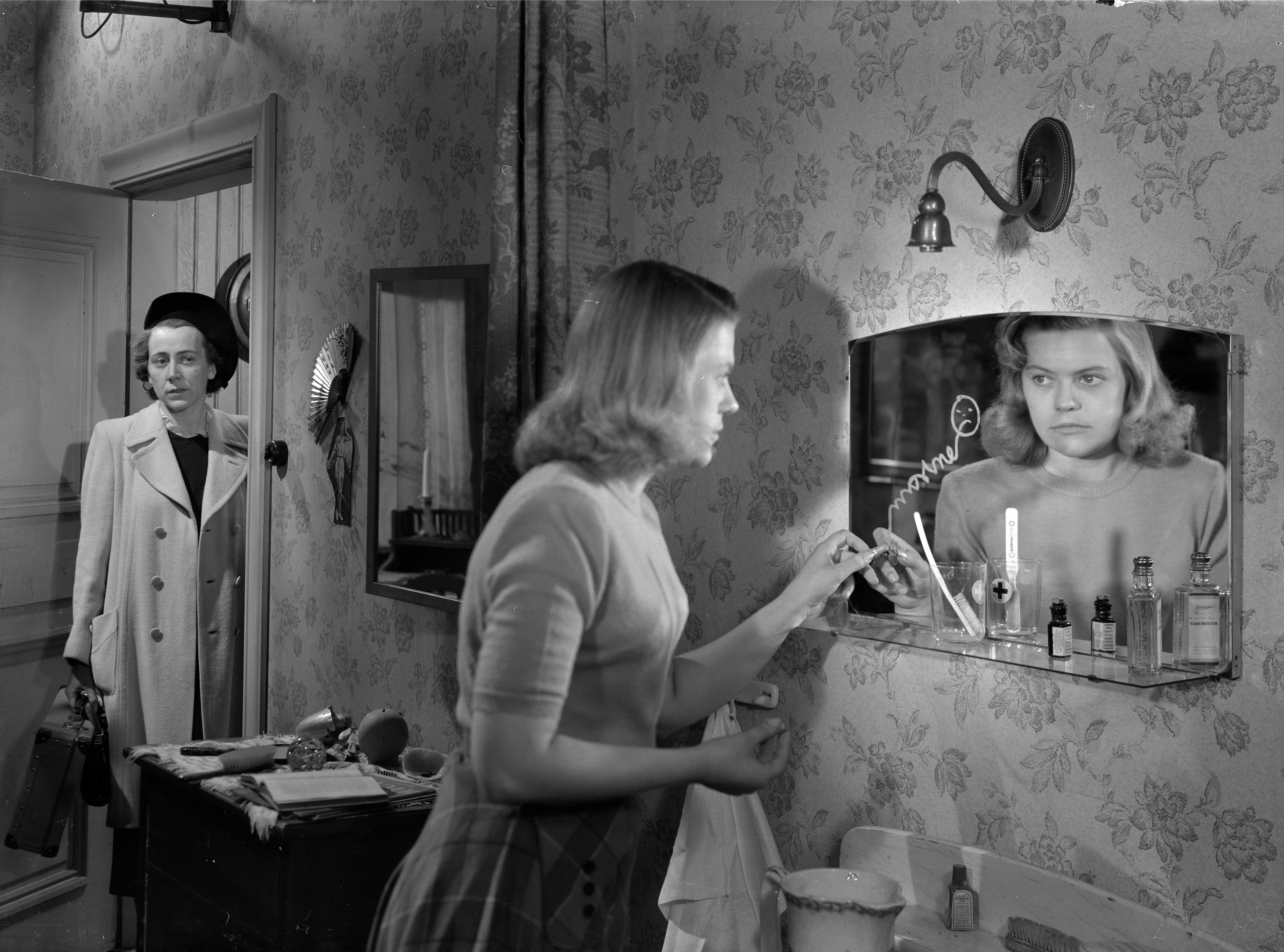
[[Ingmar Bergman]]'s 1948 film [[Port of Call (1948 film)|''Port of Call'']] features a scene where the unhappy Berit (played by [[Nine-Christine Jönsson]]<ref name=PortofCallIMDb>{{Cite web |url=https://www.imdb.com/title/tt0040418/ |title=Port of Call (IMDb) |website=[[IMDb]] |access-date=17 February 2024 |archive-date=4 June 2024 |archive-url=https://web.archive.org/web/20240604202114/https://www.imdb.com/title/tt0040418/ |url-status=live }}</ref>) draws a ''sad'' face – closely resembling the modern "frowny" face but with a dot for the nose – in lipstick on her mirror before being interrupted.<ref>''Ingmarbergman.se''. [http://ingmarbergman.se/sites/default/files/hamnstad_1948-26_005_huvudbild_webb.jpg A still from the scene] {{Webarchive|url=https://web.archive.org/web/20151117135152/http://ingmarbergman.se/sites/default/files/hamnstad_1948-26_005_huvudbild_webb.jpg |date=17 November 2015 }}.</ref><ref name=HistoryTSC /> In September 1963, there was the premiere<ref name=PremiereofTheFunnyCompany>[https://www.newspapers.com/article/highland-park-news-herald-and-journal-pr/130928006/ Premiere to Be Held at Highland Theatre] {{Webarchive|url=https://web.archive.org/web/20240607183756/https://www.newspapers.com/article/highland-park-news-herald-and-journal-pr/130928006/ |date=7 June 2024 }} Highland Park News-Herald and Journal Los Angeles, California, Thu, Sep 5, 1963, Page 28</ref> of [[The Funny Company]], an American children's TV program, which had a noseless Smiling face used as a kids' club logo; the closing credits ended with the message, "Keep Smiling!"<ref>{{cite news|last=Savage|first=Jon|date=20 Feb 2009|title=A design for life|url=https://www.theguardian.com/artanddesign/2009/feb/21/smiley-face-design-history|work=the Guardian|access-date=January 5, 2022|archive-date=16 November 2010|archive-url=https://web.archive.org/web/20101116162325/http://www.guardian.co.uk/artanddesign/2009/feb/21/smiley-face-design-history|url-status=live}}</ref><ref>{{cite web|url=https://www.youtube.com/watch?v=o90dNrWhqxc|title="The Funny Company (1963)"|website=www.youtube.com|date=24 April 2018 |access-date=February 27, 2024|archive-date=27 February 2024|archive-url=https://web.archive.org/web/20240227184049/https://www.youtube.com/watch?v=o90dNrWhqxc|url-status=live}}</ref><ref name=FunnyCompanyTM>[https://tsdr.uspto.gov/documentviewer?caseId=sn60764727&docId=ORC20060315104331#docIndex=0&page=1 The Funny Company, Inc. US Trademark Registration Certificate No. 764,727, Feb 11, 1964, Ser. No. 164,341, file Mar. 11, 1963 First Use Jan 10, 1963, First Use in Commerce Feb. 13, 1963] {{Webarchive|url=https://web.archive.org/web/20220106042735/https://tsdr.uspto.gov/documentviewer?caseId=sn60764727&docId=ORC20060315104331#docIndex=0&page=1 |date=6 January 2022 }} access date March 27, 2022</ref><ref name=Woolery>{{cite book |last1=Woolery |first1=George W. |title=Children's Television: The First Thirty-Five Years, 1946-1981 |date=1983 |publisher=Scarecrow Press |isbn=0-8108-1557-5 |url=https://archive.org/details/childrenstelevis0000wool/page/114/mode/2up?q=keep+smiling|accessdate=19 March 2024 |pages=113–115}}</ref> | |||
{{multiple image | |||
| align = right | |||
| footer = Dating from 1741 to 1953, a collection of smiling face designs from illustrations from literature, advertising, and promotional material. They include the film poster for the 1953 film, [[Lili (1953 film)|Lili]]. | |||
| image1 = Smiley 1741 Hennet.jpg | |||
| width1 = 150 | |||
| image2 = Smiley Regensburg 3.jpg | |||
| width2 = 150 | |||
| image3 = A_smiley_face_balloon_from_a_Gregory_FUNNY-B'LOONS_ad_on_page_20_of_The_Billboard_March_18_1922.jpg | |||
| width3 = 150 | |||
| image4 = NYHT Smiley 10th March 1953.jpg | |||
| width4 = 150 | |||
}} | |||
In the latter half of the 20th century, the face now known as a smiley has evolved into a well-known symbol recognizable for its yellow and black features. The first known combination of yellow and black was used for a smiling face in late 1962, when New York City radio station WMCA released a yellow sweatshirt as part of a marketing campaign.<ref name=billboard>{{cite magazine |title=Focus on Deejay Scene |url=https://books.google.com/books?id=KRgEAAAAMBAJ&q=WMCA+sweatshirt+1962&pg=PA34 |magazine=[[Billboard (magazine)|Billboard]] |page=34 |date=15 December 1962 |access-date=21 November 2020 |archive-date=7 June 2024 |archive-url=https://web.archive.org/web/20240607183801/https://books.google.com/books?id=KRgEAAAAMBAJ&q=WMCA+sweatshirt+1962&pg=PA34#v=snippet&q=WMCA%20sweatshirt%201962&f=false |url-status=live }}</ref><ref name=IHeartDesign>[https://archive.org/details/iheartdesignsign0000unse/page/24/mode/2up?q=smiley I heart design : significant graphic design selected by designers, illustrators, and critics]</ref> By 1963, over 11,000 sweatshirts had been given away. They had featured in [[Billboard (magazine)|Billboard magazine]], and numerous celebrities had also been pictured wearing them, including actress [[Patsy King]] and [[Mick Jagger]].<ref name=WMCA1 /><ref name=HistoryTSC /> The radio station used the happy face as part of a competition for listeners. When the station called listeners, any listener who answered their phone with "WMCA Good Guys!" was rewarded with a "WMCA Good Guys!" sweatshirt that incorporated the yellow and black happy face into its design.<ref>{{citation |url= https://www.telegraph.co.uk/culture/tvandradio/9059885/Smileys-People-Radio-4-The-million-dollar-smile.html |archive-url=https://ghostarchive.org/archive/20220112/https://www.telegraph.co.uk/culture/tvandradio/9059885/Smileys-People-Radio-4-The-million-dollar-smile.html |archive-date=12 January 2022 |url-access=subscription |url-status=live |title= Smiley's People (Radio 4): The million dollar smile |first= Alastair |last= Sooke |date= 3 February 2012 |work= The Telegraph |quote= [Loufrani] points out that a smiley face was a key feature of a well-known promotional campaign for a radio network on America's East Coast in the late Fifties.}}{{cbignore}}</ref><ref name=nyt2001 /><ref name=lennox /> The features of the WMCA smiley were a yellow face, with black dots as eyes, and a slightly crooked smile. The outline of the face was also not smooth, giving it a more hand-drawn look.<ref name=lennox>{{citation |title= Now You Know More: The Book of Answers |volume= 2 |author= Doug Lennox, illustrated by Catriona Wight |edition= illustrated |publisher= Dundurn |year= 2004 |isbn= 9781550025309 |page= 50 |url= https://books.google.com/books?id=P4gCzZsOY0UC&q=smiley+wmca&pg=PA50 |access-date= 21 November 2020 |archive-date= 7 June 2024 |archive-url= https://web.archive.org/web/20240607183758/https://books.google.com/books?id=P4gCzZsOY0UC&q=smiley+wmca&pg=PA50#v=snippet&q=smiley%20wmca&f=false |url-status= live }}</ref> Originally, the yellow and black sweatshirt (sometimes referred to as gold), had WMCA Good Guys! written on the front with no smiley face.<ref name=FiftyYears /><ref name=billboard /> | |||
[[File:Authentic Worcester-made smiley face, Harvey Ball.jpg|thumb|right|"Authentic [[Worcester, Massachusetts|Worcester]]-made smiley face", by Harvey Ball]] | |||
A number of [[United States]]–based designs of yellow and black happy faces emerged over the next decade.<ref name=SmallBusinessWorld1966 >[https://archive.org/details/sim_business-world_1966-09_3_9/mode/2up ''Button Helps Firms Gain 'Smile' Image'', "Small Business World 1966-09:Vol 3 Iss 9 page 1.]</ref><ref name=Stamp2013 /><ref name=FiftyYears /> State Mutual Life Assurance Company in [[Worcester, Massachusetts]], wanted to raise the morale of its staff following a merger with another [[insurance company]].<ref name=Lasted43>[https://www.newspapers.com/article/hartford-courant-a-grin-thats-lasted-43/132117431/ A Grin That's Lasted 43 Years - Smiley Face Got Its Start In Worcester (part 1)] {{Webarchive|url=https://web.archive.org/web/20240220195740/https://www.newspapers.com/article/hartford-courant-a-grin-thats-lasted-43/132117431/ |date=20 February 2024 }} and [https://www.newspapers.com/article/hartford-courant-smiley-grew-with-americ/132117354/ Smiley Grew With America’s Search For Positives(part 2)] {{Webarchive|url=https://web.archive.org/web/20240220195741/https://www.newspapers.com/article/hartford-courant-smiley-grew-with-americ/132117354/ |date=20 February 2024 }} Hartford Courant, Hartford, Connecticut, Fri, Sep 29, 2006, Pages D01, D05</ref> Company Vice President John Adam, Jr., suggested a "friendship campaign". He assigned Joy Young, Assistant Director of Sales and Marketing, to lead the project. According to [[Worcester Historical Museum]]'s documents, Young requested that freelance artist [[Harvey Ball]] design ''"a little smile to be used on buttons, desk cards and posters"''.<ref name=worcesterhistory1>{{cite web |title=The Smiley Face |url=https://www.worcesterhistory.org/worcesters-history/worcesters-own/smiley-face/ |publisher=[[Worcester Historical Museum]] |access-date=27 August 2025 |archive-date=1 December 2024 |archive-url=https://web.archive.org/web/20241201114121/https://www.worcesterhistory.org/worcesters-history/worcesters-own/smiley-face/ |url-status=dead }} ''archive''</ref> Ball completed the happy face in ten minutes and was paid $45 ({{Inflation|US|45|1963|fmt=eq}}).<ref name=nyt2001>{{cite news |first=William H. |last=Honan |author-link=William H. Honan |title=H. R. Ball, 79, Ad Executive Credited With happy Face |url=https://www.nytimes.com/2001/04/14/us/h-r-ball-79-ad-executive-credited-with-smiley-face.html |newspaper=[[The New York Times]] |date=14 April 2001 |access-date=29 August 2009 |archive-date=29 June 2019 |archive-url=https://web.archive.org/web/20190629121520/https://www.nytimes.com/2001/04/14/us/h-r-ball-79-ad-executive-credited-with-smiley-face.html |url-status=live }}</ref><ref name="Adams" /> His rendition, with a bright yellow background, dark oval eyes, a full smile, and creases at the sides of the mouth,<ref name=lennox/> was imprinted on more than fifty million [[Pin-back button|buttons]] and became familiar worldwide. The design is so simple that it is certain that similar versions were produced before 1963, including those cited above. However, Ball's rendition, as described here, has become the most iconic version.<ref name=nyt2001/><ref name="Adams" /> | |||
In 1967, Seattle graphic artist George Tanagi<ref>{{Cite web |title=George Tanagi's Work Is All Around {{!}} The Seattle Times |url=https://archive.seattletimes.com/archive/19991220/A19991221083424/george-tanagis-work-is-all-around |access-date=2024-12-22 |website=archive.seattletimes.com |archive-date=22 December 2024 |archive-url=https://web.archive.org/web/20241222233713/https://archive.seattletimes.com/archive/19991220/A19991221083424/george-tanagis-work-is-all-around |url-status=live }}</ref> drew his own version at the request of advertising agent David Stern. Tanagi's design was used in a Seattle-based University Federal Savings & Loan advertising campaign.<ref name="MOHAI">{{Cite web |url=https://digitalcollections.lib.washington.edu/digital/collection/imlsmohai/id/17555 |title=Smiley face pin from University Federal Savings, 1967 (Museum of History and Industry) |access-date=21 February 2024 |archive-date=21 February 2024 |archive-url=https://web.archive.org/web/20240221161030/https://digitalcollections.lib.washington.edu/digital/collection/imlsmohai/id/17555 |url-status=live }}</ref> Lee Adams's lyrics inspired the "Put on a Happy Face" ad campaign from the musical ''[[Bye Bye Birdie]]''. Stern, the man behind this campaign, also incorporated the Happy Face in his run for Seattle mayor in 1993.<ref name="Adams" /> Throughout the 1960s, the term "happy face" was used much more commonly in the [[United States]] than "smiley" to describe earlier versions of commercial smiling face designs.<ref>{{cite web |title=Don't put on a happy face! Are you using the smiley emoji all wrong? |url=https://www.theguardian.com/technology/2021/aug/11/dont-put-on-a-happy-face-are-you-using-the-smiley-emoji-all-wrong |work=[[The Guardian]] |date=August 11, 2021}}</ref> | |||
The Philadelphia-based brothers Bernard and Murray Spain also used the design on novelty items for their business, Traffic Stoppers. They focused on the slogan "Have a happy day". The Spain brothers expanded their business rapidly, selling millions of buttons in several sizes by 1971. They reported that they did not receive royalties from other companies producing smile designs and only claimed limited copyright protection when the image was paired with text such as "Have a Happy Day" or "Have a Nice Day". They also carried other manufacturers’ smile products alongside their own, reasoning that these "just enhance our own products".<ref name=Spainbrothers1 /><ref>[https://archive.org/details/catalogofco1971325711libr/page/162/mode/2up?q=%22+Have+a+happy+day%22+%22Traffic+Stoppers%22 Catalog of Copyright Entries 3D Ser Vol 25 Pts 7-11A by Library of Congress. Copyright Office. 1971]</ref> which mutated into "[[Have a nice day]]". As with Harvey Ball, they also produced happy face badges, producing over 50 million with New York button manufacturer NG Slater.<ref name="Peter Shapiro 2001, pp44-49">Peter Shapiro, "Smiling Faces Sometimes", in ''The Wire'', issue 203, January 2001, pp. 44–49.</ref><ref name=NYTOct161971>{{Cite web |url=https://www.nytimes.com/1971/10/16/archives/when-you-the-whole-world-with-you.html |title=When You ☺ the Whole World ☺ With You, The New York Times(Oct. 16, 1971) |website=[[The New York Times]] |date=16 October 1971 |access-date=18 February 2024 |archive-date=18 February 2024 |archive-url=https://web.archive.org/web/20240218154901/https://www.nytimes.com/1971/10/16/archives/when-you-the-whole-world-with-you.html |url-status=live }}</ref><ref name=Treen19720320>[https://www.newspapers.com/article/newsday-suffolk-edition-the-smile-butt/133614840/ The smile button: It's Enough to Man Cry(part 1) By Joseph M Treen Newsday (Suffolk Edition), Melville, New York, Mon, Mar 20, 1972 page 3 A] {{Webarchive|url=https://web.archive.org/web/20240228192438/https://www.newspapers.com/article/newsday-suffolk-edition-the-smile-butt/133614840/ |date=28 February 2024 }} and [https://www.newspapers.com/article/newsday-suffolk-edition-the-smile-butt/133992267/ (part 2 page 12 A) ]</ref> | |||
In [[ | In 1972, Frenchman Franklin Loufrani [[trademarked]] a version of a smiley face. He used it to highlight the good news parts of the newspaper ''[[France Soir]]''. He simply called the design "Smiley" and launched The Smiley Company. In 1996, Nicolas Loufrani, the son of Franklin Loufrani, took over the family business and built it into a [[multinational corporation]]. Nicolas Loufrani was outwardly skeptical of [[Harvey Ball]]'s claim to have created the first smiley face. While noting that the design his father came up with and Ball's design were nearly identical, Loufrani argued that the design is so simple that no one person can claim to have created it. As evidence for this, Loufrani's website cites early cave paintings found in France (dating back to 2500 BC) that he claims are the first depictions of a smiley face. Loufrani also points to a 1960 radio ad campaign that reportedly employed a similar design.<ref name=Stamp2013 /><ref name=HistoryTSC /> | ||
== | The Smiley Company claims to own trademark rights to some version of the Smiley face in about one hundred countries.<ref>{{cite news | url=https://www.nytimes.com/2006/07/05/business/worldbusiness/05smiley.html?pagewanted=all | work=The New York Times | first=Thomas | last=Crampton | title=Smiley Face Is Serious to Company | date=5 July 2006 | access-date=20 February 2017 | archive-date=1 July 2017 | archive-url=https://web.archive.org/web/20170701081618/http://www.nytimes.com/2006/07/05/business/worldbusiness/05smiley.html?pagewanted=all | url-status=live }}</ref> Its subsidiary, SmileyWorld Ltd, in London, headed by Nicolas Loufrani, creates or approves all of the licensed Smiley products sold in countries where it holds the trademark.<ref name="vice2"/> The Smiley brand and logo have significant exposure through licensees in various sectors, including clothing, home decoration, perfumery, plush, stationery, and publishing, as well as through promotional campaigns.<ref>{{cite web|url=http://www.licensing.biz/company-profiles/24/Smiley-Licensing |title=Smiley Licensing | Company Profile by |website=Licensing.biz |access-date=14 March 2013 |url-status=dead |archive-url=https://web.archive.org/web/20120229123013/http://www.licensing.biz/company-profiles/24/Smiley-Licensing |archive-date=29 February 2012 }}</ref> The Smiley Company is one of the 100 top licensing companies in the world, with a 2012 turnover of US$167 million.<ref>{{cite web|url=http://www.rankingthebrands.com/PDF/Top%20125%20Global%20Licensors%202011,%20License%20Global.pdf|title=Global License : Ranking the brands|website=Rankingthebrands.com|access-date=21 September 2018|archive-date=20 November 2018|archive-url=https://web.archive.org/web/20181120011154/https://www.rankingthebrands.com/PDF/Top%20125%20Global%20Licensors%202011,%20License%20Global.pdf|url-status=live}}</ref> The first Smiley shop opened in London in the [[Boxpark]] shopping center in December 2011.<ref>{{cite web |first=Giedrius |last=Ivanauskas |url=http://madeinshoreditch.co.uk/2012/01/16/boxpark-shoreditch-interview-with-nicolas-loufrani-ceo-of-smiley/ |title=Boxpark Shoreditch: Interview with Nicolas Loufrani CEO of Smiley | Made in Shoreditch - A Magazine About Style, Innovation, Dining, Nightlife and People in Shoreditch |publisher=Made in Shoreditch |date=16 January 2012 |access-date=14 March 2013 |url-status=dead |archive-url=https://web.archive.org/web/20130307075637/http://madeinshoreditch.co.uk/2012/01/16/boxpark-shoreditch-interview-with-nicolas-loufrani-ceo-of-smiley/ |archive-date=7 March 2013 }}</ref> In 2022, there were many birthday celebrations for the smiley. Many of these came in the form of collaborations between The Smiley Company and large retailers, such as [[Nordstrom]].<ref>{{cite web |last1=Verdon |first1=Joan |title=Nordstrom And Luxury Brands Help The Smiley Face Celebrate Its 50th Birthday |url=https://www.forbes.com/sites/joanverdon/2022/03/04/nordstrom-and-luxury-brands-help-the-smiley-face-celebrate-its-50th-birthday/ |work=[[Forbes]] |date=March 4, 2022 |access-date=30 May 2022 |archive-date=30 May 2022 |archive-url=https://web.archive.org/web/20220530154940/https://www.forbes.com/sites/joanverdon/2022/03/04/nordstrom-and-luxury-brands-help-the-smiley-face-celebrate-its-50th-birthday/ |url-status=live }}</ref> | ||
{{ | |||
The | |||
The | The digital evolution of the smiley into online communication began in the late 1990s with its incorporation into early emoticons and instant messaging systems. By the early 2000s, instant messaging platforms such as [[MSN Messenger]] were introducing official toolbars that allowed users to send pictographic icons. Microsoft’s 2004 beta of MSN Messenger 7, for instance, included "special emoticons, the smiley faces and other icons that indicate emotions".<ref>{{cite web |last=Evers |first=Joris |title=Microsoft set to release MSN Messenger 7.0 beta |url=https://www.networkworld.com/article/872294/security-microsoft-set-to-release-msn-messenger-7-0-beta.html |publisher=Network World |date=September 30, 2004 |access-date=26 August 2025}}</ref> Prior to such official integrations, third-party "smiley toolbars" and plug-ins were already widely used. One example is the "SmileyWorld" toolbar developed by Nicolas Loufrani, which the Smiley Company claims drew inspiration from its earlier "Smiley Dictionary" of icons, although these claims primarily derive from the company's own promotional materials.<ref>{{cite web |title=Who Invented the Emojis? |url=https://smiley.com/pages/who-invented-the-emojis |website=The Smiley Company |access-date=26 August 2025 |archive-url=https://web.archive.org/web/20240615121122/https://smiley.com/pages/who-invented-the-emojis |archive-date=15 June 2024 |url-status=live}}</ref> Independent reporting distinguishes between "emoticons", which are text-based symbols popularized in the 1980s, and "emoji", which originated with NTT DoCoMo in Japan in the late 1990s.<ref>{{cite news |last=Hern |first=Alex |title=Don't know the difference between emoji and emoticons? Let me explain |url=https://www.theguardian.com/technology/2015/feb/06/difference-between-emoji-and-emoticons-explained |work=The Guardian |date=6 February 2015 |access-date=26 August 2025 |archive-date=8 June 2023 |archive-url=https://web.archive.org/web/20230608113509/https://www.theguardian.com/technology/2015/feb/06/difference-between-emoji-and-emoticons-explained |url-status=live }}</ref> | ||
[[File:London2012OlympicsSmileyBall.png|thumb|Smiley ball at [[London 2012 Olympics]]]] | |||
In recent times, the smiley has been used as a symbol for happiness or to spread joy in public places or at various events. One recorded example of this was at the [[2012 Summer Olympics opening ceremony|London 2012 opening ceremony]]. Balls were released into the crowd as the show began. The balls were large but light enough that members of the crowd could use them like a [[beach ball]], with each ball containing a large black smiley face on one side.<ref>{{cite web |last1=Gunn |first1=Frank |title=Spectators play with giant smiley face beach balls during the pre-show for the Olympic Games Opening ceremonies in London on Friday July 27, 2012 |url=http://www.vancouversun.com/sports/2012-summer-games/story.html?id=7006231 |publisher=[[Vancouver Sun]] |date=28 July 2012 |access-date=9 April 2020 |archive-date=3 October 2020 |archive-url=https://web.archive.org/web/20201003030255/http://www.vancouversun.com/sports/2012-summer-games/story.html?id=7006231 |url-status=dead }}</ref> | |||
In [[China]], there has been a steady growth in the use of smileys in its culture, both as a physical brand and also digitally.<ref>{{cite web |last1=Borak |first1=Masha |title=In China, the smiley face does not mean what you think it means |url=https://www.techinasia.com/smiley-face-emoji-meaning-china |publisher=TechinAsia}}</ref> This rise in popularity has led to the opening of numerous smiley merchandise stores in the country. By the end of 2024, 15 stores had opened in the country in cities such as [[Guangzhou]], [[Suzhou, Jiangsu|Suzhou]], and [[Xiamen]]. It was expected that the number could top 50 stores by the end of 2027.<ref>{{cite web |title=The Smiley Company Expands to China |url=https://www.licenseglobal.com/retail-news-trends/the-smiley-company-expands-to-china |publisher=License Global}}</ref> Other countries in Asia were also experiencing a similar boom, including [[Thailand]], where three stores opened in 2024.<ref>{{cite web |last1=Langsworthy |first1=Billy |title=Smiley opens pop-up stores in Thailand |url=https://www.brandsuntapped.com/smiley-opens-pop-up-stores-in-thailand/ |publisher=Brands Untapped |date=November 21, 2024}}</ref> | |||
{{ | == Language and communication == | ||
< | {{main|Emoticon}}The earliest known smiling face to be included in a written document was drawn by a [[Slovaks|Slovak]] notary to indicate his satisfaction with the state of his town's municipal financial records in 1635.<ref>{{cite web |url=http://www.pitt.edu/~votruba/qsonhist/smileyoldestslovakia.html |title=17th-century Emoji |last=Votruba |first=Martin |work=Slovak Studies Program |publisher=University of Pittsburgh |access-date=4 March 2017 |archive-date=10 August 2018 |archive-url=https://web.archive.org/web/20180810182423/http://www.pitt.edu/~votruba/qsonhist/smileyoldestslovakia.html |url-status=dead }}</ref> The gold smiling face was drawn on the bottom of the legal document, appearing next to lawyer Jan Ladislaides' signature.<ref>{{cite web |last1=Ghosh |first1=Shreesha |title=World's Oldest Emoji Discovered? Scientists In Slovakia Say They Found 'Smiley Face Emoji' |url=https://www.ibtimes.com/worlds-oldest-emoji-discovered-scientists-slovakia-say-they-found-smiley-face-emoji-2486982 |work=International Business Times |date=6 February 2017 |access-date=21 April 2020 |archive-date=3 October 2020 |archive-url=https://web.archive.org/web/20201003060707/https://www.ibtimes.com/worlds-oldest-emoji-discovered-scientists-slovakia-say-they-found-smiley-face-emoji-2486982 |url-status=live }}</ref> The Danish poet and author [[Johannes V. Jensen]] was famous for experimenting with the form of his writing, amongst other things. In a letter sent to publisher Ernst Bojesen in December 1900, he includes both a happy and a sad face. It was in the 1900s that the design evolved from a basic eye and mouth design into a more recognizable design.<ref name=JensenSMiley>[https://web.archive.org/web/20210917154853/https://politiken.dk/underholdning/bagsiden/art5576386/Johannes-V.-Jensen-var-f%C3%B8rst-ude-med-smileyen Johannes V. Jensen var først ude med smileyen]</ref> | ||
A disputed early use of a smiling ASCII emoticon in a printed text may have been in [[Robert Herrick (poet)|Robert Herrick]]'s poem ''To Fortune'' (1648),<ref>{{cite news|last=Madrigal|first=Alexis C.|title=The First Emoticon May Have Appeared in ... 1648|url=https://www.theatlantic.com/technology/archive/2014/04/the-first-emoticon-may-have-appeared-in-1648/360622/|access-date=15 April 2014|newspaper=[[The Atlantic]]|date=14 April 2014|archive-date=15 April 2014|archive-url=https://web.archive.org/web/20140415112942/http://www.theatlantic.com/technology/archive/2014/04/the-first-emoticon-may-have-appeared-in-1648/360622/|url-status=live}}</ref> which contains the line "Upon my ruins (smiling yet :)". Journalist Levi Stahl has suggested that this may have been an intentional "orthographic joke". However, this occurrence is likely merely the colon placed inside parentheses rather than outside of them, as is standard typographic practice today: "(smiling yet):". There are citations of similar punctuation in a non-humorous context, even within Herrick's own work.<ref>{{cite web|url=http://www.slate.com/blogs/lexicon_valley/2014/04/15/emoticon_robert_herrick_s_17th_century_poem_to_fortune_does_not_contain.html|title=Emoticon: Robert Herrick's 17th-century poem "To Fortune" does not contain a smiley face.|work=Slate Magazine|date=15 April 2014|access-date=7 August 2014|archive-date=20 July 2014|archive-url=https://web.archive.org/web/20140720083955/http://www.slate.com/blogs/lexicon_valley/2014/04/15/emoticon_robert_herrick_s_17th_century_poem_to_fortune_does_not_contain.html|url-status=live}}</ref> It is likely that the parenthesis was added later by modern editors.<ref>{{cite web|url=http://text-patterns.thenewatlantis.com/2014/04/smileys-emoticons-typewriter-art.html|title=smileys, emoticons, typewriter art|work=Text Patterns - The New Atlantis|access-date=9 August 2014|archive-date=28 February 2017|archive-url=https://web.archive.org/web/20170228115123/http://text-patterns.thenewatlantis.com/2014/04/smileys-emoticons-typewriter-art.html|url-status=dead}}</ref> | |||
On the [[Internet]], emojis have become a visual means of conveyance that uses images. The first known mention on the Internet was on 19 September 1982, when [[Scott Fahlman]] from [[Carnegie Mellon University]] wrote:<ref>[http://www-2.cs.cmu.edu/~sef/Orig-Smiley.htm Fahlman's original message] {{Webarchive|url=https://web.archive.org/web/20080513084941/http://www-2.cs.cmu.edu/~sef/Orig-Smiley.htm |date=13 May 2008 }} Retrieved October 27, 2013.</ref><ref name=SmileyLore /> | |||
{{blockquote | |||
|{{pre | |||
|I propose that the following character sequence for joke markers: | |||
:-) | |||
Read it sideways. Actually, it is probably more economical to mark | |||
things that are NOT jokes, given current trends. For this, use | |||
:-( | |||
}}}} | |||
Yellow graphical smileys have been used for many different purposes, including use in early 1980s [[video game]]s. [[Yahoo! Messenger]] (from 1998) used smiley symbols in the user list next to each user, and also as an icon for the application. | Yellow graphical smileys have been used for many different purposes, including use in early 1980s [[video game]]s. [[Yahoo! Messenger]] (from 1998) used smiley symbols in the user list next to each user, and also as an icon for the application. In November 2001, and later, smiley emojis inside the actual chat text was adopted by several chat systems, including Yahoo Messenger. | ||
[[File:Codepage-437 (cropped).png|thumb|Smiley faces from DOS code page 437]] | [[File:Codepage-437 (cropped).png|thumb|Smiley faces from DOS code page 437]] | ||
The smiley is the printable version of characters 1 and 2 of (black-and-white versions of) [[codepage 437]] (1981) of the first [[IBM PC]] and all subsequent PC compatible computers. For modern computers, all versions of [[Microsoft Windows]] after [[Windows 95]]<ref>{{cite web |url= http://wgl.typ.pl/help/enintro.htm#fonts.multi.wgl4 |title= WGL Assistant v1.1: The Multilingual Font Manager |archive-url= https://web.archive.org/web/20080324205903/http://wgl.typ.pl/help/enintro.htm |archive-date= 24 March 2008 }}</ref> can use the smiley as part of [[Windows Glyph List 4]], although some [[computer font]]s miss some characters.<ref>[http://www.microsoft.com/typography/links/News.aspx?NID=901 Announcing WGL Assistant. Announcement: WGL Assistant V1.1 Beta available] {{Webarchive|url=https://web.archive.org/web/20111013101749/http://www.microsoft.com/typography/links/News.aspx?NID=901 |date=13 October 2011 }}, comp.fonts, 27 July 1999, Microsoft Typography – News archive.</ref> | The smiley is the printable version of characters 1 and 2 of (black-and-white versions of) [[codepage 437]] (1981) of the first [[IBM PC]] and all subsequent PC compatible computers. For modern computers, all versions of [[Microsoft Windows]] after [[Windows 95]]<ref>{{cite web |url= http://wgl.typ.pl/help/enintro.htm#fonts.multi.wgl4 |title= WGL Assistant v1.1: The Multilingual Font Manager |archive-url= https://web.archive.org/web/20080324205903/http://wgl.typ.pl/help/enintro.htm |archive-date= 24 March 2008 }}</ref> can use the smiley as part of [[Windows Glyph List 4]], although some [[computer font]]s miss some characters.<ref>[http://www.microsoft.com/typography/links/News.aspx?NID=901 Announcing WGL Assistant. Announcement: WGL Assistant V1.1 Beta available] {{Webarchive|url=https://web.archive.org/web/20111013101749/http://www.microsoft.com/typography/links/News.aspx?NID=901 |date=13 October 2011 }}, comp.fonts, 27 July 1999, Microsoft Typography – News archive.</ref> | ||
| Line 93: | Line 110: | ||
|} | |} | ||
Later additions to Unicode included a large number of variants expressing a range of human emotions, in particular with the addition of the "[[Emoticons (Unicode block)|Emoticons]]" and "[[Supplemental Symbols and Pictographs]] blocks in Unicode versions 6.0 (2010) and 8.0 (2015), respectively. | Later additions to Unicode included a large number of variants expressing a range of human emotions, in particular with the addition of the "[[Emoticons (Unicode block)|Emoticons]]" and "[[Supplemental Symbols and Pictographs]] blocks in Unicode versions 6.0 (2010) and 8.0 (2015), respectively. These were introduced for compatibility with the ad-hoc implementation of [[emoticon]]s by Japanese telephone carriers in unused ranges of the [[Shift JIS]] standard. This resulted in a de facto standard in the range with lead bytes 0xF5 to 0xF9.<ref>{{cite web | url=https://www.fileformat.info/info/emoji/docomo.htm | title=Original Emoji from DoCoMo | publisher=FileFormat.info | access-date=2 September 2019 | archive-date=19 July 2023 | archive-url=https://web.archive.org/web/20230719142247/https://www.fileformat.info/info/emoji/docomo.htm | url-status=live }}</ref>[[KDDI]] has gone much further than this, introducing hundreds more in the space with lead bytes 0xF3 and 0xF4.<ref>{{cite web | url=https://www.fileformat.info/info/emoji/kddi.htm | title=Original Emoji from KDDI | publisher=FileFormat.info | access-date=2 September 2019 | archive-date=19 July 2023 | archive-url=https://web.archive.org/web/20230719220744/https://www.fileformat.info/info/emoji/kddi.htm | url-status=live }}</ref> | ||
These were introduced for compatibility with the ad-hoc implementation of [[emoticon]]s by Japanese telephone carriers in unused ranges of the [[Shift JIS]] standard. | |||
This resulted in a de facto standard in the range with lead bytes 0xF5 to 0xF9.<ref>{{cite web | url=https://www.fileformat.info/info/emoji/docomo.htm | title=Original Emoji from DoCoMo | publisher=FileFormat.info | access-date=2 September 2019 | archive-date=19 July 2023 | archive-url=https://web.archive.org/web/20230719142247/https://www.fileformat.info/info/emoji/docomo.htm | url-status=live }}</ref> | |||
[[KDDI]] has gone much further than this, | |||
Recent studies have investigated how various [[Demographics|demographic factors]] influence individuals' [[Interpretation (philosophy)|interpretations]] and [[Mental representation|representations]] of [[smiley face | Recent studies have investigated how various [[Demographics|demographic factors]] influence individuals' [[Interpretation (philosophy)|interpretations]] and [[Mental representation|representations]] of [[smiley face]]s. A notable study by Clarke et al. (2018) involved an [[observational study]] with 723 participants who were "asked to [[Drawing|draw]] a smiley face for themselves" to examine the impact of [[gender]] and [[Ageing|age]] on the way individuals depict smiley faces upon prompting. The findings revealed significant disparities: [[women]] and younger participants (aged 30 or younger) were more inclined to illustrate traditional smiley faces, characterized by simple designs that primarily include [[eye]]s and a [[mouth]], often excluding additional features such as [[nose]]s or outlines. These results highlight the presence of demographic biases in the interpretation and depiction of smiley faces, underscoring the need for careful consideration of these factors in [[Scientific method|research]] and [[Survey methodology|surveys]] that utilize smileys or similar facial symbols, particularly those that rely on [[Self-report inventory|self-reported outcomes]] or [[Likert scale|scales]] incorporating facial images to denote [[emotion]]al or [[Affect (psychology)|evaluative states]].<ref>Clarke, M., McAneney, H., Chan, F., & Maguire, L. (2018). Inconsistencies in the drawing and interpretation of smiley faces: an observational study. ''BMC Research Notes'', 11, Article 77. https://doi.org/10.1186/s13104-018-3185-0</ref> | ||
<gallery class="center"> | |||
|- | |||
Face-smile.svg|smiling face <br/ > :) | |||
Face-wink.svg|winking face <br/ > ;) | |||
Face-surprise.svg|surprised face <br/ > :O | |||
Face-confused.svg|confused face <br/ > :/ | |||
</gallery> | |||
<gallery class="center"> | |||
Face-sad.svg|sad face <br/ > :( | |||
Face-crying.svg|crying face <br/ > :'( | |||
Face-grin.svg|grinning face <br/ > :D | |||
Face-kiss.svg|kissing face <br/ > :* | |||
</gallery> | |||
== Symbolism in popular culture and applications == | == Symbolism in popular culture and applications == | ||
The smiley has now become synonymous with culture | The smiley has now become synonymous with culture worldwide. It is used for [[communication]], imagery, branding, and topical purposes to display a range of [[emotion]]s. In print, numerous brands have used a yellow happy face to symbolize happiness, dating back to the 1960s. | ||
===United States advertising campaigns=== | ===United States advertising campaigns=== | ||
Different designs were used in advertising campaigns in the early to mid-20th century. Much of this activity was centered on the [[Northeastern United States]].{{citation needed|date=April 2024}} One of the first known commercial uses of a smiling face was in 1919, when the Buffalo Steam Roller Company in [[Buffalo, New York]], applied stickers on receipts with the word ''"thanks"'' and a smiling face above it. The face contained a lot of detail, with eyebrows, a nose, teeth, a chin, and facial creases reminiscent of "man-in-the-Moon" style characteristics.<ref>{{cite web |last1=van Den Berg |first1=Erik |title=De smiley is niet stuk te krijgen |url=https://www.volkskrant.nl/nieuws-achtergrond/de-smiley-is-niet-stuk-te-krijgen~b3837d85/ |publisher=[[de Volkskrant]] |access-date=5 April 2024 |archive-date=5 April 2024 |archive-url=https://web.archive.org/web/20240405144351/https://www.volkskrant.nl/nieuws-achtergrond/de-smiley-is-niet-stuk-te-krijgen~b3837d85/ |url-status=live }}</ref> Another early commercial use of a smiling face was in 1922 when the Gregory Rubber Company of [[Akron, Ohio]], ran an ad for "smiley face" balloons in ''The Billboard''. This happy face had hair, a nose, teeth, pie eyes, and triangles over the eyes.<ref name="ad1">{{cite web|url=https://commons.wikimedia.org/w/index.php?title=File:The_Billboard_1922-03-18-_Vol_34_Iss_11_(IA_sim_billboard_1922-03-18_34_11).pdf&page=28|title="The Gregory Rubber Co Toys ad on page 20 of The Billboard March 18, 1922"|website=commons.wikimedia.org|access-date=2021-06-16|archive-date=11 August 2021|archive-url=https://web.archive.org/web/20210811235416/https://commons.wikimedia.org/w/index.php?title=File:The_Billboard_1922-03-18-_Vol_34_Iss_11_(IA_sim_billboard_1922-03-18_34_11).pdf&page=28|url-status=live}}</ref> In 1953 and 1958, similar happy faces were used in promotional campaigns for the films [[Lili (1953 film)|Lili]] (1953) and [[Gigi (1958 film)|Gigi]] (1958).<ref>[https://www.newspapers.com/article/daily-news-an-early-smiley-in-an-ad-for/137152573/ An early smiley in an ad for the movie LILI (1953).] {{Webarchive|url=https://web.archive.org/web/20240223150955/https://www.newspapers.com/article/daily-news-an-early-smiley-in-an-ad-for/137152573/ |date=23 February 2024 }} (newspapers.com) Daily News, New York, New York, Tue, Mar 10, 1953, Page 312</ref> | |||
Happy faces in northeastern United States, and later in the entire country, became a "common theme" within advertising circles from the 1960s onwards. This rose to prominence during the 1960s and was remixed and interpreted in different ways up until the 1980s. There were sporadic designs of smiling faces or happy | Happy faces in the northeastern United States, and later in the entire country, became a "common theme" within advertising circles from the 1960s onwards. This rose to prominence during the 1960s and was remixed and interpreted in different ways up until the 1980s. There were sporadic designs of smiling faces or happy faces before this, but it wasn't until the WMCA in the early 1960s used yellow and black that the theme became more commonplace. | ||
===In print=== | ===In print=== | ||
In the [[United States]], there were many instances of smiling faces in the 1900s. However, the first industry to widely adopt the smiley was the [[comics]] and cartoons sector. | |||
Franklin Loufrani used the word smiley when he designed a smiling face for the newspaper he was working for at the time. The Loufrani design emerged in 1971, when Loufrani created a smiley face for the newspaper ''[[France-Soir]]''. The newspaper used Loufrani's smiley to highlight stories that they defined as "''feel-good news''"<ref name="vice2" /> This particular smiley went on to form The Smiley Company. [[Mad (magazine)|Mad]] magazine notably used the smiley face a year later, in 1972, across its entire front page for the April edition of the magazine. This was one of the first instances in which the smiling face had been adapted, with one of the twenty visible smileys pulling a face.<ref>{{cite news |title=Front cover of Mad |issue=150 |publisher=[[Mad (magazine)|Mad]] |date=April 1972 |pages=1}}</ref> | |||
In the [[DC Comics]], shady businessman "[[Boss Smiley]]" (a political boss with a smiley face for a head) makes several appearances.<ref name="TrueStory">{{Cite web |title=The True Story of The Smiley Face T-shirt by Imri Merritt, August 15, 2022 |url=https://www.rushordertees.com/blog/smiley-face-history/ |url-status=live |archive-url=https://web.archive.org/web/20240220192952/https://www.rushordertees.com/blog/smiley-face-history/ |archive-date=20 February 2024 |access-date=20 February 2024}}</ref> | |||
The logo for and cover of the omnibus edition of the ''[[Watchmen]]'' comic book series features a smiley badge worn by the character, the Comedian, with blood splattered on it from the murder that initiates the events of the story. | |||
===Music and film=== | ===Music and film=== | ||
As music genres began to | As music genres began to develop their own cultures from the 1970s onwards, many cultures started incorporating a smiling face into their culture. In the late 1970s, the [[United States|American]] band [[Dead Kennedys]] launched their first recording, "[[California über alles]]". The single cover was a collage intended to resemble a [[Nazi]] rally prior to [[World War II]]. It featured three of the vertical banners commonly used at such rallies, but with the usual [[swastika]]s replaced by large smileys.<ref>Johnson, Heather. "[http://mixonline.com/mag/audio_dead_kennedys/index.html Dead Kennedys' 'California Uber Alles'] {{webarchive|url=https://web.archive.org/web/20141110093019/http://mixonline.com/mag/audio_dead_kennedys/index.html |date=2014-11-10 }}". ''[[Mix Online]]''. 1 October 2005.</ref> In the UK, the happy face has been associated with [[psychedelic culture]] since the [[Ubi Dwyer]] and the [[Windsor Free Festival]] in the 1970s, as well as with [[electronic dance music]] culture, particularly with [[acid house]], which emerged during the [[Second Summer of Love]] in the late 1980s. The association was cemented when the band [[Bomb the Bass]] used an extracted smiley from the comic book series ''[[Watchmen]]'' on the center of its "[[Beat Dis]]" hit single. | ||
[[File:Watchmen-smiley.svg|thumb|The ''[[Watchmen]]'' comic series logo]] | [[File:Watchmen-smiley.svg|thumb|The ''[[Watchmen]]'' comic series logo]] | ||
In addition to the movie adaptation of ''[[Watchmen]]'', the film ''[[Suicide Squad (2016 film)|Suicide Squad]]'' has the character [[Deadshot]] staring into the window of a clothing store. Behind a line of mannequins is a yellow smiley face pin, which had been closely associated | In addition to the movie adaptation of ''[[Watchmen]]'', the film ''[[Suicide Squad (2016 film)|Suicide Squad]]'' has the character [[Deadshot]] staring into the window of a clothing store. Behind a line of mannequins is a yellow smiley face pin, which had been closely associated with another DC comic character, the [[Comedian (character)|Comedian]].<ref>{{cite web |last1=Steinberg |first1=Nick |title=20 Hidden Details In 'Suicide Squad' You May Have Missed |date=10 August 2016 |url=https://www.goliath.com/movies/20-hidden-details-in-suicide-squad-you-may-have-missed/ |publisher=Goliath |access-date=9 April 2020 |archive-date=24 September 2020 |archive-url=https://web.archive.org/web/20200924103051/https://www.goliath.com/movies/20-hidden-details-in-suicide-squad-you-may-have-missed/ |url-status=dead }}</ref> The 2001 film ''[[Evolution (2001 film)|Evolution]]'' features a three-eyed smiley face as its logo. It was later carried over to the movie's spin-off cartoon, ''[[Alienators: Evolution Continues]]''. | ||
In the | In the late 1980s, the smiley again became a prominent image within the [[music industry]]. It was adopted during the growth of [[acid house]] across [[Europe]] and the UK in the late 1980s. According to many, this began when DJ [[Danny Rampling]] used the smiley to celebrate [[Paul Oakenfold]]'s birthday.<ref>{{cite web |date=18 April 2018 |title=The strange, tangled history of the acid house smiley |url=https://www.redbull.com/gb-en/history-of-the-acid-house-smiley |url-status=live |archive-url=https://web.archive.org/web/20191203192535/https://www.redbull.com/gb-en/history-of-the-acid-house-smiley |archive-date=3 December 2019 |access-date=3 December 2019 |publisher=[[Red Bull]]}}</ref> This sparked a movement in which the smiley face moved into various dance genres, becoming a symbol of 1980s dance music.<ref>{{cite web |date=5 January 2017 |title=Acid History: How The Smiley Became The Iconic Face Of Rave |url=https://www.electronicbeats.net/the-feed/untold-history-rave-smiley/ |url-status=live |archive-url=https://web.archive.org/web/20191203192540/https://www.electronicbeats.net/the-feed/untold-history-rave-smiley/ |archive-date=3 December 2019 |access-date=3 December 2019 |work=ElectronicBeats magazine}}</ref> | ||
In the | In the 1994 film ''[[Forrest Gump]]'' it is implied that the titular character inspired the smiley face design after wiping his face on a T-shirt while running across the country. | ||
In 2022, [[David Guetta]] collaborated with [[Felix Da Housecat]] and [[Miss Kittin|Kittin]] to release the song, ''Silver Screen'', a reimagined version of the 2001 [[ | In 2022, [[David Guetta]] collaborated with [[Felix Da Housecat]] and [[Miss Kittin|Kittin]] to release the song, ''Silver Screen'', a reimagined version of the 2001 [[Dance (music genre)|dance]] track. Guetta's version celebrated positivity and happiness.<ref>{{cite web |last1=Crews |first1=Isaac |title=David Guetta Joins Smiley's Campaign Of Positivity With An Exclusive Video Release For Upbeat Anthem 'Silver Screen' |url=https://sounderground.net/david-guetta-joins-smileys-campaign-of-positivity-with-an-exclusive-video-release-for-upbeat-anthem-silver-screen |publisher=Sounderground |date=March 12, 2022 |access-date=30 May 2022 |archive-date=7 June 2024 |archive-url=https://web.archive.org/web/20240607183800/http://ww1.sounderground.net/ |url-status=live }}</ref> The music video features a cameo from street artist [[André Saraiva]] and portrays different groups portraying the message "Take The Time To Smile". The video partners that message with numerous smileys, on the sides of buildings, on placards, and on posters. | ||
===Physical products=== | ===Physical products=== | ||
[[Vittel (water)|Vittel]] announced in 2017 that | [[Vittel (water)|Vittel]] announced in 2017 that it would be using the smiley on a special edition design of its [[water bottle]]s. [[AdAge]] referred to its use as a "feel-good effect", and water bottles featuring the smiley icon had an 11.8% increase in sales compared to standard bottles, with 128 million bottles sold across Europe that bore the smiley design.<ref name=adage>{{cite web |title=How Smiley's "Defiant Optimism" Helps Brands emerge from Darker Times |date=June 2021 |url=https://adage.com/article/smiley/how-smileys-defiant-optimism-helps-brands-emerge-dark-times/2339736 |publisher=[[AdAge]] |access-date=20 October 2021 |archive-date=27 January 2022 |archive-url=https://web.archive.org/web/20220127143122/https://adage.com/article/smiley/how-smileys-defiant-optimism-helps-brands-emerge-dark-times/2339736 |url-status=live }}</ref> | ||
In the UK, "Jammie Dodgers", a legendary biscuit line, | In the UK, "Jammie Dodgers", a legendary biscuit line, features a smiley face engraved into circular cookies. | ||
===Art and fashion=== | ===Art and fashion=== | ||
As part of his early works, graffiti artist [[Banksy]] frequently | [[File:Smilies graffiti Tel Aviv.jpg|thumb|257x257px|Smilies in Tel Aviv street art]] | ||
As part of his early works, anti-consumerist graffiti artist [[Banksy]] frequently incorporated the smiley face into his art. The first of his major works that included a smiley was his Flying Copper portrait, which was completed in 2004. It was during a period when Banksy experimented with creating portraits on canvas and paper. He also used the smiley in 2005 to replace the Grim Reaper's face. The image became known as "''grin reaper''"<ref>{{cite web |title=The Staying Power of the Smiley Face |url=https://www.artsy.net/article/artsy-editorial-staying-power-smiley-face |publisher=Artsy |date=15 August 2019 |access-date=9 April 2020 |archive-date=9 April 2020 |archive-url=https://web.archive.org/web/20200409105133/https://www.artsy.net/article/artsy-editorial-staying-power-smiley-face |url-status=live }}</ref><ref>{{cite news |last1=O'Brien |first1=Jennifer |title=Banksy to sell works at Art Source fair in Dublin |url=https://www.thetimes.com/world/ireland-world/article/banksy-to-sell-works-at-art-source-fair-in-dublin-knchl60nw |work=[[The Times]] |access-date=9 April 2020 |archive-date=3 October 2020 |archive-url=https://web.archive.org/web/20201003061830/https://www.thetimes.co.uk/article/banksy-to-sell-works-at-art-source-fair-in-dublin-knchl60nw |url-status=live }}</ref> In 2007, ''In 2007, [[The Smiley Company]] partnered with [[Moschino]] for the campaign, "Smiley for Moschino.''<ref name=businessoffashion>{{cite web |title=The Smiley Company's Evolution From Licensor to a €350m Lifestyle Brand |url=https://www.businessoffashion.com/articles/news-analysis/the-smiley-companys-evolution-from-licensor-to-a-350m-lifestyle-brand/ |publisher=Business of Fashion |date=March 15, 2022 |access-date=30 May 2022 |archive-date=7 June 2024 |archive-url=https://web.archive.org/web/20240607183800/https://www.businessoffashion.com/articles/news-analysis/the-smiley-companys-evolution-from-licensor-to-a-350m-lifestyle-brand/ |url-status=live }}</ref> | |||
During the [[COVID-19 pandemic]], fashion label [[Pull & Bear]] announced they would be releasing t-shirts with a smiley design incorporated on the front.<ref name=adage /> Other fashion labels that have used the smiley on their garments include [[H&M]] and [[Zara (retailer)|Zara]]. The smiley has also featured on high-end fashion lines, including [[Fendi]] and [[Moncler]].<ref>{{cite web |last1=Gallagher |first1=Jacob |title=The Shockingly Large Business Behind the Iconic Smiley Face |url=https://www.wsj.com/articles/the-shockingly-large-business-behind-the-iconic-smiley-face-11559058457 |newspaper=[[The Wall Street Journal]] |date=May 28, 2019 |access-date=20 October 2021 |archive-date=1 December 2021 |archive-url=https://web.archive.org/web/20211201100151/https://www.wsj.com/articles/the-shockingly-large-business-behind-the-iconic-smiley-face-11559058457 |url-status=live }}</ref> High end French jeweller Valerie Messika produced white gold and yellow pendants, which contained a smiley face.<ref>{{cite web |last1=Baërd |first1=Elodie |title=Joaillerie: Messika célèbre les 50 ans de Smiley avec le sourire |url=https://www.lefigaro.fr/industrie-mode/bijouterie-souriez-vous-etes-chez-messika-20220221 |publisher=[[Le Figaro]] |language=French |date=February 21, 2022 |access-date=30 May 2022 |archive-date=30 May 2022 |archive-url=https://web.archive.org/web/20220530154939/https://www.lefigaro.fr/industrie-mode/bijouterie-souriez-vous-etes-chez-messika-20220221 |url-status=live }}</ref> | During the [[COVID-19 pandemic]], fashion label [[Pull & Bear]] announced they would be releasing t-shirts with a smiley design incorporated on the front.<ref name=adage /> Other fashion labels that have used the smiley on their garments include [[H&M]] and [[Zara (retailer)|Zara]]. The smiley has also featured on high-end fashion lines, including [[Fendi]] and [[Moncler]].<ref>{{cite web |last1=Gallagher |first1=Jacob |title=The Shockingly Large Business Behind the Iconic Smiley Face |url=https://www.wsj.com/articles/the-shockingly-large-business-behind-the-iconic-smiley-face-11559058457 |newspaper=[[The Wall Street Journal]] |date=May 28, 2019 |access-date=20 October 2021 |archive-date=1 December 2021 |archive-url=https://web.archive.org/web/20211201100151/https://www.wsj.com/articles/the-shockingly-large-business-behind-the-iconic-smiley-face-11559058457 |url-status=live }}</ref> High-end French jeweller Valerie Messika produced white gold and yellow pendants, which contained a smiley face.<ref>{{cite web |last1=Baërd |first1=Elodie |title=Joaillerie: Messika célèbre les 50 ans de Smiley avec le sourire |url=https://www.lefigaro.fr/industrie-mode/bijouterie-souriez-vous-etes-chez-messika-20220221 |publisher=[[Le Figaro]] |language=French |date=February 21, 2022 |access-date=30 May 2022 |archive-date=30 May 2022 |archive-url=https://web.archive.org/web/20220530154939/https://www.lefigaro.fr/industrie-mode/bijouterie-souriez-vous-etes-chez-messika-20220221 |url-status=live }}</ref> | ||
For the 50th birthday of the Smiley, [[Galeries Lafayette]] in [[Paris]], [[Beijing]] and [[Shanghai]] | For the 50th birthday of the Smiley, [[Galeries Lafayette]] in [[Paris]], [[Beijing]], and [[Shanghai]], as well as 10 [[Nordstrom]] department stores, sold limited-edition smiley products to commemorate the anniversary.<ref>{{cite web |last1=Verdon |first1=Joan |title=Nordstrom And Luxury Brands Help The Smiley Face Celebrate Its 50th Birthday |url=https://www.forbes.com/sites/joanverdon/2022/03/04/nordstrom-and-luxury-brands-help-the-smiley-face-celebrate-its-50th-birthday/?sh=69c443e025ba |work=[[Forbes]] |date=March 4, 2022 |access-date=30 May 2022 |archive-date=30 May 2022 |archive-url=https://web.archive.org/web/20220530154939/https://www.forbes.com/sites/joanverdon/2022/03/04/nordstrom-and-luxury-brands-help-the-smiley-face-celebrate-its-50th-birthday/?sh=69c443e025ba |url-status=live }}</ref> During the same year, [[Lee (jeans)|Lee Jeans]] announced the launch of a new clothing collection, Lee x Smiley.<ref>{{cite web |last1=Russell Jones |first1=John |title=Lee Celebrates Smiley 50th Anniversary with new Collection |url=https://mr-mag.com/lee-celebrates-smiley-50th-anniversary-with-new-global-collaboration/ |publisher=MR (magazine) |date=March 9, 2022 |access-date=30 May 2022 |archive-date=12 August 2022 |archive-url=https://web.archive.org/web/20220812100419/https://mr-mag.com/lee-celebrates-smiley-50th-anniversary-with-new-global-collaboration/ |url-status=live }}</ref> | ||
===Gaming=== | ===Gaming=== | ||
In 1980, [[Namco]] released the now famous ''[[Pac-Man]]'', a yellow faced cartoon character. In 2008, the video game ''[[Battlefield: Bad Company]]'' | In 1980, [[Namco]] released the now-famous ''[[Pac-Man]]'', a yellow-faced cartoon character. In 2008, the video game ''[[Battlefield: Bad Company]]'' featured a yellow smiley as part of its branding. The smiley appeared throughout the game and also on the cover. The smiley normally appeared on the side of a grenade, which became synonymous with the ''Battlefield'' series.<ref>{{cite magazine |title=Hands-on: Battlefield - Bad Company |url=https://www.wired.com/2008/02/hands-on-battle/ |magazine=[[Wired (magazine)|Wired]] |date=28 February 2008 |access-date=9 April 2020 |archive-date=9 August 2020 |archive-url=https://web.archive.org/web/20200809183752/https://www.wired.com/2008/02/hands-on-battle/ |url-status=live }}</ref> | ||
The 1987 [[Atari ST]] game ''[[MIDI Maze]]'', released on other platforms as ''Faceball 2000'', features round, yellow Smileys as enemies. When a player is eliminated, these enemies taunt the player with the phrase "[[Have a nice day]]. | The 1987 [[Atari ST]] game ''[[MIDI Maze]]'', released on other platforms as ''Faceball 2000'', features round, yellow Smileys as enemies. When a player is eliminated, these enemies taunt the player with the phrase "[[Have a nice day]]". | ||
The Pokémon [[Ditto (Pokémon)|Ditto]] is based on the smiley face. [[Game Freak]]'s staff described Ditto as "the weirdest Pokémon" in the franchise.<ref name="ditto">{{cite magazine |first=Andy |last=Eddy |authorlink=Andy Eddy |magazine=@Gamer |quote=Andy toured the Game Freak offices, including the themed conference rooms—one of which is like a jungle. In fact, Andy later interviewed Matsuda and Sugimori here. [...] they deemed Ditto the weirdest Pokémon—a simple blob that began as a tribute to the classic yellow smiley face.|issue=6 |publisher=[[Best Buy]] |date=February 2011|title=Feature}}</ref> | The Pokémon [[Ditto (Pokémon)|Ditto]] is based on the smiley face. [[Game Freak]]'s staff described Ditto as "the weirdest Pokémon" in the franchise.<ref name="ditto">{{cite magazine |first=Andy |last=Eddy |authorlink=Andy Eddy |magazine=@Gamer |quote=Andy toured the Game Freak offices, including the themed conference rooms—one of which is like a jungle. In fact, Andy later interviewed Matsuda and Sugimori here. [...] they deemed Ditto the weirdest Pokémon—a simple blob that began as a tribute to the classic yellow smiley face.|issue=6 |publisher=[[Best Buy]] |date=February 2011|title=Feature}}</ref> | ||
===Events, business, and social sciences=== | ===Events, business, and social sciences=== | ||
[[User experience]] researchers have shown that the use of smileys to represent measurement [[Scale (social sciences)|scales]] may ease the challenges related to [[translation]] and implementation for brief cross-cultural surveys.<ref>{{Cite book |last1=Sedley |first1=Aaron |url=https://www.rti.org/rti-press-publication/language-survey-research |title=Scaling the Smileys: A Multicountry Investigation (Chapter 12) in The Essential Role of Language in Survey Research |last2=Yang |first2=Yongwei |date=2020-04-30 |publisher=RTI Press |isbn=978-1-934831-24-3 |editor-last=Sha |editor-first=Mandy |doi=10.3768/rtipress.bk.0023.2004 |access-date=11 December 2023 |archive-url=https://web.archive.org/web/20231211122733/https://www.rti.org/rti-press-publication/language-survey-research |archive-date=11 December 2023 |url-status=live |doi-access=free}}</ref> [[Walmart]] uses a smiley face as its mascot.<ref>{{Cite web |date=2016-06-01 |title=Why the (Smiley) Face? A Chat with Walmart's CMO |url=https://corporate.walmart.com/newsroom/business/20160601/why-the-smiley-face-a-chat-with-walmarts-cmo |url-status=dead |archive-url=https://web.archive.org/web/20200228123412/https://corporate.walmart.com/newsroom/business/20160601/why-the-smiley-face-a-chat-with-walmarts-cmo |archive-date=28 February 2020 |access-date=2024-02-21 |website=Corporate - US (The Wayback Machine) |language=en}}</ref> During the [[2012 Summer Olympics opening ceremony|London 2012 opening ceremony]], early on in the show, a number of giant yellow beach balls were released into the audience. Each had a large smiley face.<ref>{{cite web |last1=Gunn |first1=Frank |title=Spectators play with giant smiley face beach balls during the pre-show for the Olympic Games Opening ceremonies in London on Friday July 27, 2012 |url=http://www.vancouversun.com/sports/2012-summer-games/story.html?id=7006231 |publisher=[[Vancouver Sun]] |date=28 July 2012 |access-date=9 April 2020 |archive-date=3 October 2020 |archive-url=https://web.archive.org/web/20201003030255/http://www.vancouversun.com/sports/2012-summer-games/story.html?id=7006231 |url-status=dead }}</ref> | |||
The [[Brooklyn Bridge]] had a smiley projected onto the base one evening in 2020. The smiley was part of a wider campaign by [[The Smiley Company]] | The [[Brooklyn Bridge]] had a smiley projected onto the base one evening in 2020. The smiley was part of a wider campaign by [[The Smiley Company]] aimed at increasing happiness among [[New York City|New Yorkers]]. The 82-foot-wide projected smiley featured light pink lipstick on the mouth of the smiley.<ref>{{cite web |title=Giant smiley face projected onto Brooklyn Bridge to cheer up New Yorkers |url=https://nypost.com/2020/07/28/why-is-there-a-giant-emoji-on-the-brooklyn-bridge/ |publisher=[[NY Post]] |date=July 28, 2020 |access-date=5 April 2024 |archive-date=5 April 2024 |archive-url=https://web.archive.org/web/20240405144352/https://nypost.com/2020/07/28/why-is-there-a-giant-emoji-on-the-brooklyn-bridge/ |url-status=live }}</ref> | ||
In 2022, [[Assouline]] published "50 Years of Good News, | In 2022, [[Assouline]] published "50 Years of Good News", a comprehensive examination of the cultural development of the smiley face and its widespread use.<ref>{{cite web |last1=Seamons |first1=Helen |title=We love: Fashion fixes for the week ahead – in pictures |url=https://www.theguardian.com/fashion/gallery/2022/feb/05/we-love-fashion-fixes-for-the-week-ahead-in-pictures |newspaper=[[The Guardian]] |date=February 5, 2022 |access-date=30 May 2022 |archive-date=7 June 2024 |archive-url=https://web.archive.org/web/20240607183803/https://www.theguardian.com/fashion/gallery/2022/feb/05/we-love-fashion-fixes-for-the-week-ahead-in-pictures |url-status=live }}</ref> | ||
In 2022, the [[International Day of Happiness]] was celebrated by projecting a smiley onto a number of landmarks around the globe. In [[Seoul]], [[South Korea]], a smiley celebrating happiness was projected onto [[N Seoul Tower| | In 2022, the [[International Day of Happiness]] was celebrated by projecting a smiley onto a number of landmarks around the globe. In [[Seoul]], [[South Korea]], a smiley celebrating happiness was projected onto the [[N Seoul Tower|Seoul Tower]].<ref>{{cite web | author1=신소연 |title='스마일리' 보며 행복해져볼까[언박싱] | work=헤럴드경제 |url=http://nbiz.heraldcorp.com/view.php?ud=20220321000240 |publisher=[[The Korea Herald]] |language=Korean |date=March 21, 2021 |access-date=30 May 2022 |archive-date=25 April 2023 |archive-url=https://web.archive.org/web/20230425054319/http://nbiz.heraldcorp.com/view.php?ud=20220321000240 |url-status=live }}</ref> | ||
== | == Claim of ownership and trademark disputes == | ||
In 1997, Franklin Loufrani attempted to trademark | In 1997, Franklin Loufrani attempted to trademark the ideogram he created in the [[United States]]. [[Walmart]] contested his application, as it began using a similar graphic for its "Rolling Back Prices" campaign a year prior. The fallout led to a 2002 court case that lasted more than a decade before a settlement was reached.<ref name=" phase">{{cite journal| first =Mark| last = Kabel| date =22 October 2006| title =Wal-Mart phasing out smiley face vests| journal= Associated Press}}</ref><ref>{{cite journal| first = Richard| last = Williamson| date = 30 October 2006| title = The last days of Walmart's smiley face| journal = Adweek| url = http://adweek.blogs.com/adfreak/2006/10/the_last_days_o.html| access-date = 8 April 2024| archive-date = 2 January 2008| archive-url = https://web.archive.org/web/20080102074313/http://adweek.blogs.com/adfreak/2006/10/the_last_days_o.html| url-status = bot: unknown}}</ref> Despite that, Walmart sued an online parodist for alleged "trademark infringement" after he used the symbol. The District Court found in favor of the parodist when, in March 2008, the judge concluded that Walmart's smiley face logo was not shown to be "[[Trademark distinctiveness|inherently distinctive]]" and that it "has failed to establish that the smiley face has acquired secondary meaning or that it is otherwise a protectable trademark" under [[United States trademark law|U.S. law]].<ref>{{cite web| url=http://www.citizen.org/litigation/forms/cases/getlinkforcase.cfm?cID=206| date=28 March 2008| title=Smith v. Wal-Mart Stores, Inc.| publisher=Citizen Vox| access-date=2 February 2011| archive-date=17 January 2013| archive-url=https://web.archive.org/web/20130117010411/http://www.citizen.org/litigation/forms/cases/getlinkforcase.cfm?cID=206| url-status=live}} The relevant text is in the Order granting summary judgment: Timothy C. Batten Sr., "Order" (21 March 2008)", section "B. Threshold Issue: Trademark Ownership", case "1:06-cv-00526-TCB", document 103, pages 15–19</ref><ref>Smith v. Wal-Mart Stores, Inc. - 537 FSupp2d 1302 - March 20, 2008 - https://h2o.law.harvard.edu/collages/14555 {{Webarchive|url=https://web.archive.org/web/20220914183931/https://h2o.law.harvard.edu/collages/14555 |date=14 September 2022 }}</ref><ref>Smith v. Wal-Mart Stores, Inc. – 537 FSupp2d 1302 – March 20, 2008 - https://www.dmlp.org/sites/citmedialaw.org/files/2008-03-20-Order%20Granting%20Summary%20Judgment.pdf {{Webarchive|url=https://web.archive.org/web/20221005213728/http://www.dmlp.org/sites/citmedialaw.org/files/2008-03-20-Order%20Granting%20Summary%20Judgment.pdf |date=5 October 2022 }}</ref> In June 2010, Walmart and [[The Smiley Company]] founded by Loufrani settled their 10-year-old dispute in front of the Chicago federal court. The terms remain confidential.<ref>[https://www.bloomberg.com/news/2011-07-01/sony-astellas-intel-apple-wal-mart-intellectual-property.html Sony, Astellas, Intel, Apple, Wal-Mart, Warner: Intellectual Property] {{Webarchive|url=https://web.archive.org/web/20240607183801/https://www.bloomberg.com/news/articles/2011-07-01/sony-astellas-intel-apple-wal-mart-intellectual-property |date=7 June 2024 }} Victoria Slind-Flor, 1 July 2011, Bloomberg. The case is Loufrani v. Wal-Mart Stores Inc., 1:09-cv- 03062, U.S. District Court, Northern District of Illinois (Chicago).</ref><ref name=109cv03062>{{Cite web |url=https://www.courtlistener.com/docket/5501354/loufrani-v-wal-mart-stores-inc/ |title=(Docket Entried and select Court filing) Loufrani v. Wal-Mart Stores Inc., 1:09-cv-03062, (N.D. Ill.)--CourtListener |access-date=7 October 2023 |archive-date=24 October 2023 |archive-url=https://web.archive.org/web/20231024025021/https://www.courtlistener.com/docket/5501354/loufrani-v-wal-mart-stores-inc/ |url-status=live }}</ref> In 2016, Walmart reintroduced the smiley face on its website, social media profiles, and in select stores.<ref>{{Cite web|url=https://money.cnn.com/2016/06/02/news/companies/walmart-smiley/index.html|title=Walmart's Smiley is back after 10 years and a lawsuit|last=Smith|first=Aaron|date=2 June 2016|website=CNNMoney|access-date=18 January 2017|archive-date=18 January 2017|archive-url=https://web.archive.org/web/20170118230053/http://money.cnn.com/2016/06/02/news/companies/walmart-smiley/index.html|url-status=live}}</ref> | ||
The band [[Nirvana (band)|Nirvana]] created its own smiley design in 1991.<ref name=smileynirvana>{{cite magazine |last1=Rosenbaum |first1=Claudia |title=California Graphic Artist Claims He, Not Kurt Cobain, Created Nirvana's Smiley Face Logo |url=https://www.billboard.com/articles/business/9454294/california-graphic-artist-claims-he-not-kurt-cobain-created-nirvana-smiley-face-logo |magazine=[[Billboard (magazine)|Billboard]] |date=23 September 2020 |access-date=21 June 2021 |archive-date=22 June 2021 |archive-url=https://web.archive.org/web/20210622090526/https://www.billboard.com/articles/business/9454294/california-graphic-artist-claims-he-not-kurt-cobain-created-nirvana-smiley-face-logo |url-status=live }}</ref> It was claimed that [[Kurt Cobain]] | The band [[Nirvana (band)|Nirvana]] created its own smiley design in 1991.<ref name=smileynirvana>{{cite magazine |last1=Rosenbaum |first1=Claudia |title=California Graphic Artist Claims He, Not Kurt Cobain, Created Nirvana's Smiley Face Logo |url=https://www.billboard.com/articles/business/9454294/california-graphic-artist-claims-he-not-kurt-cobain-created-nirvana-smiley-face-logo |magazine=[[Billboard (magazine)|Billboard]] |date=23 September 2020 |access-date=21 June 2021 |archive-date=22 June 2021 |archive-url=https://web.archive.org/web/20210622090526/https://www.billboard.com/articles/business/9454294/california-graphic-artist-claims-he-not-kurt-cobain-created-nirvana-smiley-face-logo |url-status=live }}</ref> It was claimed that [[Kurt Cobain]] designed the Nirvana smiley. In 2020, media reports suggested that a [[Los Angeles]]–based freelance designer was, in fact, behind the designs.<ref name=smileynirvana /> | ||
Fashion house [[Marc Jacobs]] designed a smiley in 2018, which had a yellow outline, with the letters M and J replacing the eyes. The mouth design was similar to the | Fashion house [[Marc Jacobs]] designed a smiley in 2018, which had a yellow outline, with the letters M and J replacing the eyes. The mouth design was similar to the Nirvana design. In January 2019, legal representatives of Nirvana announced they were suing Marc Jacobs for a [[Copyright|breach of copyright]].<ref>{{cite web |last1=Snapes |first1=Laura |title=Nirvana sue designer Marc Jacobs over alleged copyright breach |url=https://www.theguardian.com/music/2019/jan/03/nirvana-sue-designer-marc-jacobs-over-alleged-copyright-breach |newspaper=[[The Guardian]] |date=January 3, 2019}}</ref> Following the announcement by a judge in Los Angeles that the suit could move forward, Marc Jacobs announced a [[countersuit]] against Nirvana.<ref>{{cite web |title=Marc Jacobs countersues Nirvana in T-shirt copyright dispute |url=https://www.theguardian.com/music/2019/nov/28/marc-jacobs-countersues-nirvana-in-t-shirt-copyright-dispute |newspaper=[[The Guardian]]|date=28 November 2019 }}</ref> In 2020, a [[Los Angeles|Los Angeles–based]] designer claimed to be the creator of the Nirvana smiley and thus became an intervenor in the case between Nirvana and Marc Jacobs.<ref>{{cite web |title=Artist files lawsuit after claiming he came up with Nirvana's 'smily face' logo |url=https://www.nme.com/news/music/artist-files-lawsuit-after-claiming-he-came-up-with-nirvanas-smily-face-logo-2761676 |publisher=[[NME]] |date=September 25, 2020 |access-date=30 May 2022 |archive-date=30 May 2022 |archive-url=https://web.archive.org/web/20220530154939/https://www.nme.com/news/music/artist-files-lawsuit-after-claiming-he-came-up-with-nirvanas-smily-face-logo-2761676 |url-status=live }}</ref> | ||
== See also == | == See also == | ||
| Line 170: | Line 198: | ||
* [[Acid2]] | * [[Acid2]] | ||
* [[Body language]] | * [[Body language]] | ||
* [[Facial Action Coding System]] | * [[Facial Action Coding System]] | ||
* [[Galle (Martian crater)]] | * [[Galle (Martian crater)]] | ||
Latest revision as of 12:39, 19 November 2025
Template:Short description Template:Redirect-several Template:Use dmy dates


A smiley, also known as a smiley face, is a basic ideogram representing a smiling face.[1][2] Since the 1950s, it has become part of popular culture worldwide, used either as a standalone ideogram or as a form of communication, such as emoticons. The smiley began as two dots and a line representing eyes and a mouth. More elaborate designs emerged in the 1950s, featuring noses, eyebrows, and outlines. New York radio station WMCA used a yellow and black design for its "Good Guys!" campaign in the early 1960s.[3][4][5] More yellow-and-black designs appeared in the 1960s and 1970s, including works by Harvey Ross Ball in 1963,[6][5][7] and Franklin Loufrani in 1971.[8][9][10] The Smiley Company, founded by Franklin Loufrani, claims to hold the rights to a version of the smiley face in over 100 countries. It has become one of the top 100 licensing companies globally.
There was a "smile face" fad in 1971 in the United States.[11][12][13][4][14] The Associated Press (AP) ran a wirephoto showing Joy P. Young and Harvey Ball holding the design of the smiley and reported on September 11, 1971, that "two affiliated insurance companies" claimed credit for the symbol and Harvey Ball designed it; Bernard and Murray Spain claimed credit for introducing it to the market.[15] This referred to the Worcester Mutual Fire Insurance Company of America and the Guarantee Mutual Assurance Company of America, whose 1963 "Smile Power" campaign first distributed smiley buttons to employees.[16] In October 1971,[8] Loufrani trademarked his design in France while working as a journalist for the French newspaper France-Soir.[8][17][18] Today, the smiley face has evolved from an ideogram into a template for communication and use in written language. The internet smiley originated with Scott Fahlman in the 1980s, when he first theorized that ASCII characters could be used to create faces and convey emotions in text. Since then, Fahlman's designs have become digital pictograms known as emoticons.[19] They are loosely based on the ideograms designed in the 1960s and 1970s, continuing with the yellow and black design.
Origin
As a surname and adjective
Template:Too much detail The word smiley can be traced back to Lanarkshire, Scotland, as a surname, and is home to other variations such as Smylie, Smyly, or Smaillie.[20] During this period in history, surnames emerged from medieval nicknames. In this scenario, it would describe a person with a cheerful nature.[21] The first recorded person is believed to be Thomas Smiley, who was recorded in Derry, Northern Ireland, in 1660 as a major military figure.[22] As a Williamite and following the migration of Scots to Ireland in the Plantation of Ulster, Thomas Smiley would likely have been a descendant of migrants from Lanarkshire in the previous century.
As an adjective, the word "smiley" was used in literature occasionally, but it came after the word was used as a surname. As with the surname, smiley came about from the creative or colloquial shortening of smiling to mimic spoken dialect.[23] James Russell Lowell used the word "smily" to replace “smiling” in his mid-19th-century poem, The Courtin’.[24][25] Over a century later, in 1957, author Jane McHenry in Family Weekly magazine wrote, "Draw a big smiley face on the plate!"[26] A year later, there was an illustration of a noseless smiling face containing two dots, eyebrows, and a single curved line for a mouth in a write-up in Family Weekly, Galloping Ghosts! by Bill Ross, with the text:
Collect six empty pop bottles and six cone-shaped paper cups. With crayons draw smiley faces on three of the cups and scary ones on the others. Put a cup on top of each bottle and line them up as 'ghosts.'. .Keep score by counting five points for each scary-faced ghost knocked over and, since it is a night for spooks, only one point for each smiley![27]
Name of designs
Early designs were often referred to as "smiling face" or "happy face". In 1961, the WMCA's Good Guys! incorporated a black smiley onto a yellow sweatshirt,[28] and it was nicknamed the "happy face". The Spain Brothers and Harvey Ross Ball both had designs in the 1970s that concentrated more on slogans than the actual name of the smiley. When Ball's design was completed, it was not given an official name. It was, however, labeled as "The Smile Insurance Company", which appeared on the back of the badges he created. The label was due to the fact that the badges were designed for commercial use by an insurance company. The Spain Brothers used the slogan "Have a nice day",[5][11] which is now more frequently associated with the smiley face rather than the slogan itself. In September 1972, a retrospective news article traced the popularization of smiley buttons to the 1963 "smile power" campaign launched by the Worcester Mutual Fire Insurance Company of America and the Guarantee Mutual Assurance Company of America. The companies distributed the original "smiley buttons" to employees to promote a "smile attitude" toward customers and among their own staff. Worcester/Guarantee president John Adam, Jr., admitted: "I guess we proved that a smile really goes a long way." He added, in response to queries why the companies had not trademarked the button design: "We never intended to keep the smile to ourselves—we want everyone to smile and to keep smiling and to remind them that that is our first goal in serving our customers—keep 'em smiling!"[16]
The word "smiley" was used by Franklin Loufrani in France when he registered his smiley design for trademark protection while working as a journalist for France-Soir in 1971. The smiley accompanied positive news in the newspaper and eventually became the foundation for The Smiley Company, a licensing operation.[29]
Other competing terms were used, such as smiling face and happy face, before consensus was reached on the term smiley. The name smiley became commonly used in the 1970s and 1980s as the yellow and black ideogram began to appear more in popular culture. The ideogram has since been used as a foundation to create emoticon emojis. These are digital interpretations of the smiley ideogram and have since become the most commonly used set of emojis, as they were adopted by Unicode in 2006 onwards. Smiley has since become a broader term that often includes both the ideogram design and emojis that use the same yellow and black design.
Ideogram history
Early history of smiling faces
Script error: No such module "Unsubst". The oldest known smiling face was found by a team of archaeologists led by Nicolò Marchetti of the University of Bologna. Marchetti and his team pieced together fragments of a Hittite pot, dating back to approximately 1700 BC, found in Karkamış, Turkey. Once the pot had been pieced together, the team noticed that the item had a large smiling face engraved on it, becoming the first item with such a design to be found.[30]
.jpg)
The score of Erwin Schulhoff's "Script error: No such module "Lang"." (the middle movement of his "Script error: No such module "Lang".", published in 1919) includes smiling and sad faces.[31][32]
In the 1930s, an eccentric Depression-era tramp was popularly dubbed "Santa Claus Smith". He identified himself as John S. Smith of Riga, Latvia, Europe. He wandered across the United States, giving hand-scrawled checks for extravagant sums to people who showed him small kindnesses, such as meals, coffee, or lifts. His checks were written in indelible pencil on scraps of brown wrapping paper. They typically featured a crude smiling-face doodle—two dots for eyes, a dot for a nose, and a curved line for a mouth. His idiosyncratic handwriting often included the misspelling of "thousand" Contemporary documentation of his checks and the doodled smile can be found in bank correspondence reviewed for Joseph Mitchell’s 1940 profile. Later historical accounts have highlighted the episode as an early cultural appearance of a smile motif in the United States.[33][34]
Ingmar Bergman's 1948 film Port of Call features a scene where the unhappy Berit (played by Nine-Christine Jönsson[35]) draws a sad face – closely resembling the modern "frowny" face but with a dot for the nose – in lipstick on her mirror before being interrupted.[36][17] In September 1963, there was the premiere[37] of The Funny Company, an American children's TV program, which had a noseless Smiling face used as a kids' club logo; the closing credits ended with the message, "Keep Smiling!"[38][39][40][41]
In the latter half of the 20th century, the face now known as a smiley has evolved into a well-known symbol recognizable for its yellow and black features. The first known combination of yellow and black was used for a smiling face in late 1962, when New York City radio station WMCA released a yellow sweatshirt as part of a marketing campaign.[42][43] By 1963, over 11,000 sweatshirts had been given away. They had featured in Billboard magazine, and numerous celebrities had also been pictured wearing them, including actress Patsy King and Mick Jagger.[3][17] The radio station used the happy face as part of a competition for listeners. When the station called listeners, any listener who answered their phone with "WMCA Good Guys!" was rewarded with a "WMCA Good Guys!" sweatshirt that incorporated the yellow and black happy face into its design.[44][45][46] The features of the WMCA smiley were a yellow face, with black dots as eyes, and a slightly crooked smile. The outline of the face was also not smooth, giving it a more hand-drawn look.[46] Originally, the yellow and black sweatshirt (sometimes referred to as gold), had WMCA Good Guys! written on the front with no smiley face.[18][42]

A number of United States–based designs of yellow and black happy faces emerged over the next decade.[47][7][18] State Mutual Life Assurance Company in Worcester, Massachusetts, wanted to raise the morale of its staff following a merger with another insurance company.[48] Company Vice President John Adam, Jr., suggested a "friendship campaign". He assigned Joy Young, Assistant Director of Sales and Marketing, to lead the project. According to Worcester Historical Museum's documents, Young requested that freelance artist Harvey Ball design "a little smile to be used on buttons, desk cards and posters".[49] Ball completed the happy face in ten minutes and was paid $45 (Template:Inflation).[45][5] His rendition, with a bright yellow background, dark oval eyes, a full smile, and creases at the sides of the mouth,[46] was imprinted on more than fifty million buttons and became familiar worldwide. The design is so simple that it is certain that similar versions were produced before 1963, including those cited above. However, Ball's rendition, as described here, has become the most iconic version.[45][5]
In 1967, Seattle graphic artist George Tanagi[50] drew his own version at the request of advertising agent David Stern. Tanagi's design was used in a Seattle-based University Federal Savings & Loan advertising campaign.[51] Lee Adams's lyrics inspired the "Put on a Happy Face" ad campaign from the musical Bye Bye Birdie. Stern, the man behind this campaign, also incorporated the Happy Face in his run for Seattle mayor in 1993.[5] Throughout the 1960s, the term "happy face" was used much more commonly in the United States than "smiley" to describe earlier versions of commercial smiling face designs.[52]
The Philadelphia-based brothers Bernard and Murray Spain also used the design on novelty items for their business, Traffic Stoppers. They focused on the slogan "Have a happy day". The Spain brothers expanded their business rapidly, selling millions of buttons in several sizes by 1971. They reported that they did not receive royalties from other companies producing smile designs and only claimed limited copyright protection when the image was paired with text such as "Have a Happy Day" or "Have a Nice Day". They also carried other manufacturers’ smile products alongside their own, reasoning that these "just enhance our own products".[11][53] which mutated into "Have a nice day". As with Harvey Ball, they also produced happy face badges, producing over 50 million with New York button manufacturer NG Slater.[54][55][56]
In 1972, Frenchman Franklin Loufrani trademarked a version of a smiley face. He used it to highlight the good news parts of the newspaper France Soir. He simply called the design "Smiley" and launched The Smiley Company. In 1996, Nicolas Loufrani, the son of Franklin Loufrani, took over the family business and built it into a multinational corporation. Nicolas Loufrani was outwardly skeptical of Harvey Ball's claim to have created the first smiley face. While noting that the design his father came up with and Ball's design were nearly identical, Loufrani argued that the design is so simple that no one person can claim to have created it. As evidence for this, Loufrani's website cites early cave paintings found in France (dating back to 2500 BC) that he claims are the first depictions of a smiley face. Loufrani also points to a 1960 radio ad campaign that reportedly employed a similar design.[7][17]
The Smiley Company claims to own trademark rights to some version of the Smiley face in about one hundred countries.[57] Its subsidiary, SmileyWorld Ltd, in London, headed by Nicolas Loufrani, creates or approves all of the licensed Smiley products sold in countries where it holds the trademark.[29] The Smiley brand and logo have significant exposure through licensees in various sectors, including clothing, home decoration, perfumery, plush, stationery, and publishing, as well as through promotional campaigns.[58] The Smiley Company is one of the 100 top licensing companies in the world, with a 2012 turnover of US$167 million.[59] The first Smiley shop opened in London in the Boxpark shopping center in December 2011.[60] In 2022, there were many birthday celebrations for the smiley. Many of these came in the form of collaborations between The Smiley Company and large retailers, such as Nordstrom.[61]
The digital evolution of the smiley into online communication began in the late 1990s with its incorporation into early emoticons and instant messaging systems. By the early 2000s, instant messaging platforms such as MSN Messenger were introducing official toolbars that allowed users to send pictographic icons. Microsoft’s 2004 beta of MSN Messenger 7, for instance, included "special emoticons, the smiley faces and other icons that indicate emotions".[62] Prior to such official integrations, third-party "smiley toolbars" and plug-ins were already widely used. One example is the "SmileyWorld" toolbar developed by Nicolas Loufrani, which the Smiley Company claims drew inspiration from its earlier "Smiley Dictionary" of icons, although these claims primarily derive from the company's own promotional materials.[63] Independent reporting distinguishes between "emoticons", which are text-based symbols popularized in the 1980s, and "emoji", which originated with NTT DoCoMo in Japan in the late 1990s.[64]

In recent times, the smiley has been used as a symbol for happiness or to spread joy in public places or at various events. One recorded example of this was at the London 2012 opening ceremony. Balls were released into the crowd as the show began. The balls were large but light enough that members of the crowd could use them like a beach ball, with each ball containing a large black smiley face on one side.[65]
In China, there has been a steady growth in the use of smileys in its culture, both as a physical brand and also digitally.[66] This rise in popularity has led to the opening of numerous smiley merchandise stores in the country. By the end of 2024, 15 stores had opened in the country in cities such as Guangzhou, Suzhou, and Xiamen. It was expected that the number could top 50 stores by the end of 2027.[67] Other countries in Asia were also experiencing a similar boom, including Thailand, where three stores opened in 2024.[68]
Language and communication
Script error: No such module "Labelled list hatnote".The earliest known smiling face to be included in a written document was drawn by a Slovak notary to indicate his satisfaction with the state of his town's municipal financial records in 1635.[69] The gold smiling face was drawn on the bottom of the legal document, appearing next to lawyer Jan Ladislaides' signature.[70] The Danish poet and author Johannes V. Jensen was famous for experimenting with the form of his writing, amongst other things. In a letter sent to publisher Ernst Bojesen in December 1900, he includes both a happy and a sad face. It was in the 1900s that the design evolved from a basic eye and mouth design into a more recognizable design.[71]
A disputed early use of a smiling ASCII emoticon in a printed text may have been in Robert Herrick's poem To Fortune (1648),[72] which contains the line "Upon my ruins (smiling yet :)". Journalist Levi Stahl has suggested that this may have been an intentional "orthographic joke". However, this occurrence is likely merely the colon placed inside parentheses rather than outside of them, as is standard typographic practice today: "(smiling yet):". There are citations of similar punctuation in a non-humorous context, even within Herrick's own work.[73] It is likely that the parenthesis was added later by modern editors.[74]
On the Internet, emojis have become a visual means of conveyance that uses images. The first known mention on the Internet was on 19 September 1982, when Scott Fahlman from Carnegie Mellon University wrote:[75][19]
<templatestyles src="Template:Blockquote/styles.css" />
<templatestyles src="Pre/styles.css"/>
I propose that the following character sequence for joke markers:

:-)

Read it sideways.  Actually, it is probably more economical to mark
things that are NOT jokes, given current trends.  For this, use

:-(
Script error: No such module "Check for unknown parameters".
Yellow graphical smileys have been used for many different purposes, including use in early 1980s video games. Yahoo! Messenger (from 1998) used smiley symbols in the user list next to each user, and also as an icon for the application. In November 2001, and later, smiley emojis inside the actual chat text was adopted by several chat systems, including Yahoo Messenger.
.png)
The smiley is the printable version of characters 1 and 2 of (black-and-white versions of) codepage 437 (1981) of the first IBM PC and all subsequent PC compatible computers. For modern computers, all versions of Microsoft Windows after Windows 95[76] can use the smiley as part of Windows Glyph List 4, although some computer fonts miss some characters.[77]
The smiley face was included in Unicode's Miscellaneous Symbols from version 1.1 (1993).[78]
| Unicode smiley characters: | |||
| ☺ | U+263A | Template:Key press+Template:Key press | White Smiling Face (This may appear as an emoji on some devices) |
| ☻ | U+263B | Template:Key press+Template:Key press | Black Smiling Face |
| Miscellaneous Symbols also contains the frowning face: | |||
| ☹ | U+2639 | White Frowning Face | |
Later additions to Unicode included a large number of variants expressing a range of human emotions, in particular with the addition of the "Emoticons" and "Supplemental Symbols and Pictographs blocks in Unicode versions 6.0 (2010) and 8.0 (2015), respectively. These were introduced for compatibility with the ad-hoc implementation of emoticons by Japanese telephone carriers in unused ranges of the Shift JIS standard. This resulted in a de facto standard in the range with lead bytes 0xF5 to 0xF9.[79]KDDI has gone much further than this, introducing hundreds more in the space with lead bytes 0xF3 and 0xF4.[80]
Recent studies have investigated how various demographic factors influence individuals' interpretations and representations of smiley faces. A notable study by Clarke et al. (2018) involved an observational study with 723 participants who were "asked to draw a smiley face for themselves" to examine the impact of gender and age on the way individuals depict smiley faces upon prompting. The findings revealed significant disparities: women and younger participants (aged 30 or younger) were more inclined to illustrate traditional smiley faces, characterized by simple designs that primarily include eyes and a mouth, often excluding additional features such as noses or outlines. These results highlight the presence of demographic biases in the interpretation and depiction of smiley faces, underscoring the need for careful consideration of these factors in research and surveys that utilize smileys or similar facial symbols, particularly those that rely on self-reported outcomes or scales incorporating facial images to denote emotional or evaluative states.[81]
-
smiling face
:) -
winking face
;) -
surprised face
:O -
confused face
:/


-
sad face
:( -
crying face
:'( -
grinning face
:D -
kissing face
:*


Symbolism in popular culture and applications
The smiley has now become synonymous with culture worldwide. It is used for communication, imagery, branding, and topical purposes to display a range of emotions. In print, numerous brands have used a yellow happy face to symbolize happiness, dating back to the 1960s.
United States advertising campaigns
Different designs were used in advertising campaigns in the early to mid-20th century. Much of this activity was centered on the Northeastern United States.Script error: No such module "Unsubst". One of the first known commercial uses of a smiling face was in 1919, when the Buffalo Steam Roller Company in Buffalo, New York, applied stickers on receipts with the word "thanks" and a smiling face above it. The face contained a lot of detail, with eyebrows, a nose, teeth, a chin, and facial creases reminiscent of "man-in-the-Moon" style characteristics.[82] Another early commercial use of a smiling face was in 1922 when the Gregory Rubber Company of Akron, Ohio, ran an ad for "smiley face" balloons in The Billboard. This happy face had hair, a nose, teeth, pie eyes, and triangles over the eyes.[83] In 1953 and 1958, similar happy faces were used in promotional campaigns for the films Lili (1953) and Gigi (1958).[84]
Happy faces in the northeastern United States, and later in the entire country, became a "common theme" within advertising circles from the 1960s onwards. This rose to prominence during the 1960s and was remixed and interpreted in different ways up until the 1980s. There were sporadic designs of smiling faces or happy faces before this, but it wasn't until the WMCA in the early 1960s used yellow and black that the theme became more commonplace.
In print
In the United States, there were many instances of smiling faces in the 1900s. However, the first industry to widely adopt the smiley was the comics and cartoons sector.
Franklin Loufrani used the word smiley when he designed a smiling face for the newspaper he was working for at the time. The Loufrani design emerged in 1971, when Loufrani created a smiley face for the newspaper France-Soir. The newspaper used Loufrani's smiley to highlight stories that they defined as "feel-good news"[29] This particular smiley went on to form The Smiley Company. Mad magazine notably used the smiley face a year later, in 1972, across its entire front page for the April edition of the magazine. This was one of the first instances in which the smiling face had been adapted, with one of the twenty visible smileys pulling a face.[85]
In the DC Comics, shady businessman "Boss Smiley" (a political boss with a smiley face for a head) makes several appearances.[86]
The logo for and cover of the omnibus edition of the Watchmen comic book series features a smiley badge worn by the character, the Comedian, with blood splattered on it from the murder that initiates the events of the story.
Music and film
As music genres began to develop their own cultures from the 1970s onwards, many cultures started incorporating a smiling face into their culture. In the late 1970s, the American band Dead Kennedys launched their first recording, "California über alles". The single cover was a collage intended to resemble a Nazi rally prior to World War II. It featured three of the vertical banners commonly used at such rallies, but with the usual swastikas replaced by large smileys.[87] In the UK, the happy face has been associated with psychedelic culture since the Ubi Dwyer and the Windsor Free Festival in the 1970s, as well as with electronic dance music culture, particularly with acid house, which emerged during the Second Summer of Love in the late 1980s. The association was cemented when the band Bomb the Bass used an extracted smiley from the comic book series Watchmen on the center of its "Beat Dis" hit single.

In addition to the movie adaptation of Watchmen, the film Suicide Squad has the character Deadshot staring into the window of a clothing store. Behind a line of mannequins is a yellow smiley face pin, which had been closely associated with another DC comic character, the Comedian.[88] The 2001 film Evolution features a three-eyed smiley face as its logo. It was later carried over to the movie's spin-off cartoon, Alienators: Evolution Continues.
In the late 1980s, the smiley again became a prominent image within the music industry. It was adopted during the growth of acid house across Europe and the UK in the late 1980s. According to many, this began when DJ Danny Rampling used the smiley to celebrate Paul Oakenfold's birthday.[89] This sparked a movement in which the smiley face moved into various dance genres, becoming a symbol of 1980s dance music.[90]
In the 1994 film Forrest Gump it is implied that the titular character inspired the smiley face design after wiping his face on a T-shirt while running across the country.
In 2022, David Guetta collaborated with Felix Da Housecat and Kittin to release the song, Silver Screen, a reimagined version of the 2001 dance track. Guetta's version celebrated positivity and happiness.[91] The music video features a cameo from street artist André Saraiva and portrays different groups portraying the message "Take The Time To Smile". The video partners that message with numerous smileys, on the sides of buildings, on placards, and on posters.
Physical products
Vittel announced in 2017 that it would be using the smiley on a special edition design of its water bottles. AdAge referred to its use as a "feel-good effect", and water bottles featuring the smiley icon had an 11.8% increase in sales compared to standard bottles, with 128 million bottles sold across Europe that bore the smiley design.[92] In the UK, "Jammie Dodgers", a legendary biscuit line, features a smiley face engraved into circular cookies.
Art and fashion

As part of his early works, anti-consumerist graffiti artist Banksy frequently incorporated the smiley face into his art. The first of his major works that included a smiley was his Flying Copper portrait, which was completed in 2004. It was during a period when Banksy experimented with creating portraits on canvas and paper. He also used the smiley in 2005 to replace the Grim Reaper's face. The image became known as "grin reaper"[93][94] In 2007, In 2007, The Smiley Company partnered with Moschino for the campaign, "Smiley for Moschino.[95]
During the COVID-19 pandemic, fashion label Pull & Bear announced they would be releasing t-shirts with a smiley design incorporated on the front.[92] Other fashion labels that have used the smiley on their garments include H&M and Zara. The smiley has also featured on high-end fashion lines, including Fendi and Moncler.[96] High-end French jeweller Valerie Messika produced white gold and yellow pendants, which contained a smiley face.[97]
For the 50th birthday of the Smiley, Galeries Lafayette in Paris, Beijing, and Shanghai, as well as 10 Nordstrom department stores, sold limited-edition smiley products to commemorate the anniversary.[98] During the same year, Lee Jeans announced the launch of a new clothing collection, Lee x Smiley.[99]
Gaming
In 1980, Namco released the now-famous Pac-Man, a yellow-faced cartoon character. In 2008, the video game Battlefield: Bad Company featured a yellow smiley as part of its branding. The smiley appeared throughout the game and also on the cover. The smiley normally appeared on the side of a grenade, which became synonymous with the Battlefield series.[100]
The 1987 Atari ST game MIDI Maze, released on other platforms as Faceball 2000, features round, yellow Smileys as enemies. When a player is eliminated, these enemies taunt the player with the phrase "Have a nice day".
The Pokémon Ditto is based on the smiley face. Game Freak's staff described Ditto as "the weirdest Pokémon" in the franchise.[101]
Events, business, and social sciences
User experience researchers have shown that the use of smileys to represent measurement scales may ease the challenges related to translation and implementation for brief cross-cultural surveys.[102] Walmart uses a smiley face as its mascot.[103] During the London 2012 opening ceremony, early on in the show, a number of giant yellow beach balls were released into the audience. Each had a large smiley face.[104]
The Brooklyn Bridge had a smiley projected onto the base one evening in 2020. The smiley was part of a wider campaign by The Smiley Company aimed at increasing happiness among New Yorkers. The 82-foot-wide projected smiley featured light pink lipstick on the mouth of the smiley.[105]
In 2022, Assouline published "50 Years of Good News", a comprehensive examination of the cultural development of the smiley face and its widespread use.[106]
In 2022, the International Day of Happiness was celebrated by projecting a smiley onto a number of landmarks around the globe. In Seoul, South Korea, a smiley celebrating happiness was projected onto the Seoul Tower.[107]
Claim of ownership and trademark disputes
In 1997, Franklin Loufrani attempted to trademark the ideogram he created in the United States. Walmart contested his application, as it began using a similar graphic for its "Rolling Back Prices" campaign a year prior. The fallout led to a 2002 court case that lasted more than a decade before a settlement was reached.[108][109] Despite that, Walmart sued an online parodist for alleged "trademark infringement" after he used the symbol. The District Court found in favor of the parodist when, in March 2008, the judge concluded that Walmart's smiley face logo was not shown to be "inherently distinctive" and that it "has failed to establish that the smiley face has acquired secondary meaning or that it is otherwise a protectable trademark" under U.S. law.[110][111][112] In June 2010, Walmart and The Smiley Company founded by Loufrani settled their 10-year-old dispute in front of the Chicago federal court. The terms remain confidential.[113][114] In 2016, Walmart reintroduced the smiley face on its website, social media profiles, and in select stores.[115]
The band Nirvana created its own smiley design in 1991.[116] It was claimed that Kurt Cobain designed the Nirvana smiley. In 2020, media reports suggested that a Los Angeles–based freelance designer was, in fact, behind the designs.[116]
Fashion house Marc Jacobs designed a smiley in 2018, which had a yellow outline, with the letters M and J replacing the eyes. The mouth design was similar to the Nirvana design. In January 2019, legal representatives of Nirvana announced they were suing Marc Jacobs for a breach of copyright.[117] Following the announcement by a judge in Los Angeles that the suit could move forward, Marc Jacobs announced a countersuit against Nirvana.[118] In 2020, a Los Angeles–based designer claimed to be the creator of the Nirvana smiley and thus became an intervenor in the case between Nirvana and Marc Jacobs.[119]
See also
Template:Sister project Template:Sister project
- Acid2
- Body language
- Facial Action Coding System
- Galle (Martian crater)
- Henohenomoheji
- Kolobok
- Mr. Yuk
- Pac-Man (character)
- Pareidolia
- Red John
- SDSS J1038+4849
- Social intelligence
References
Template:Nonverbal communication
- ↑ Script error: No such module "citation/CS1".
- ↑ Smiley-The Oxford dictionary of new words : a popular guide to words in the news(1991)
- ↑ a b Template:Cite magazine
- ↑ a b American fads by Richard A Johnson, 1985, p 121-124
- ↑ a b c d e f Script error: No such module "citation/CS1".
- ↑ Script error: No such module "citation/CS1".
- ↑ a b c Script error: No such module "citation/CS1".
- ↑ a b c Script error: No such module "citation/CS1".
- ↑ Les marques françaises : 150 ans de graphisme, 1824-1974 = French trademarks by Amiot, Edith(1990) p 236
- ↑ INPI Brand: FR1199660 Template:Webarchive ***Renewal*** of the Deposit Made on October 1, 1971 at the INPI No. 120.846 and Registered No. 832.277
- ↑ a b c "Two Brothers Put The Smile On Buttons For Latest Fad" By Nancy B. Clarke, Women's News Service, The Daily Times-News Burlington, North Carolina, Sun, Aug 22, 1971, Page 20. Template:Webarchive Retrieved 31 Jan 2024
- ↑ Fad Is Sweeping Charlotte – A Little Smile That's Going Places, The Charlotte News, Charlotte, North Carolina, Fri, Jul 9, 1971, Page 5. Template:Webarchive Retrieved 31 Jan 2024
- ↑ LATEST NATIONAL FAD Smiling Faces Now Appear On Everything From Ear Screws To Blue Jeans, Lubbock Avalanche-Journal, Lubbock, Texas, Fri, Sep 3, 1971, Page 80 (part 1) Template:Webarchive and (part 2) Template:Webarchive Retrieved 31 Jan 2024
- ↑ Put On A Happy Face, Time, August 30, 1971, Page 36
- ↑ Nation in quest of symbol takes 'smile' pin to heart, Press-Telegram Long Beach, California, Sat, Sep 11, 1971, Page 10 Template:Webarchive Retrieved 31 Jan 2024
- ↑ a b Script error: No such module "citation/CS1".
- ↑ a b c d History(of smiley by The Smiley company by way of The Wayback Machine)
- ↑ a b c Script error: No such module "citation/CS1".
- ↑ a b Script error: No such module "citation/CS1".
- ↑ Script error: No such module "citation/CS1".
- ↑ Script error: No such module "citation/CS1".
- ↑ The Scots in Ulster Surname Map by Dr. William Roulston, Ulster Historical Foundation, 2008
- ↑ Script error: No such module "Citation/CS1".
- ↑ Clarendon Press. (1989). smiley. The Oxford English Dictionary (Vol. XV, p. 790).
- ↑ The Courtin’ By James Russell Lowell (1819–1891) Biglow Papers Template:Webarchive Retrieved 2022-03-18
- ↑ Do-It-Yourself Carnival by Jane McHenry Template:Webarchive Vicksburg Evening Post Vicksburg, Mississippi • Sun, Sep 8, 1957, Page 38--Part of the syndicated Junior TREASURE Chest Edited by Marjorie Barrows Editor of The Children' Hour
- ↑ Galloping Ghosts! By Bill Ross Template:Webarchive The Tyler Courier-Times Tyler, Texas • Sun, Oct 26, 1958 Page 64--Part of the syndicated Junior TREASURE Chest Edited by Marjorie Barrows Editor of The Children' Hour
- ↑ Everybody's Putting on a Happy Face, Asbury Park Press Asbury Park, New Jersey, Sun, Jul 25, 1971, Page 36 Template:Webarchive Retrieved 02-21-2024
- ↑ a b c Script error: No such module "citation/CS1".
- ↑ Script error: No such module "citation/CS1".
- ↑ "Script error: No such module "Lang"." sheet music
- ↑ Template:Cite magazine
- ↑ Template:Cite magazine
- ↑ Script error: No such module "citation/CS1".
- ↑ Script error: No such module "citation/CS1".
- ↑ Ingmarbergman.se. A still from the scene Template:Webarchive.
- ↑ Premiere to Be Held at Highland Theatre Template:Webarchive Highland Park News-Herald and Journal Los Angeles, California, Thu, Sep 5, 1963, Page 28
- ↑ Script error: No such module "citation/CS1".
- ↑ Script error: No such module "citation/CS1".
- ↑ The Funny Company, Inc. US Trademark Registration Certificate No. 764,727, Feb 11, 1964, Ser. No. 164,341, file Mar. 11, 1963 First Use Jan 10, 1963, First Use in Commerce Feb. 13, 1963 Template:Webarchive access date March 27, 2022
- ↑ Script error: No such module "citation/CS1".
- ↑ a b Template:Cite magazine
- ↑ I heart design : significant graphic design selected by designers, illustrators, and critics
- ↑ Script error: No such module "citation/CS1".Template:Cbignore
- ↑ a b c Script error: No such module "citation/CS1".
- ↑ a b c Script error: No such module "citation/CS1".
- ↑ Button Helps Firms Gain 'Smile' Image, "Small Business World 1966-09:Vol 3 Iss 9 page 1.
- ↑ A Grin That's Lasted 43 Years - Smiley Face Got Its Start In Worcester (part 1) Template:Webarchive and Smiley Grew With America’s Search For Positives(part 2) Template:Webarchive Hartford Courant, Hartford, Connecticut, Fri, Sep 29, 2006, Pages D01, D05
- ↑ Script error: No such module "citation/CS1". archive
- ↑ Script error: No such module "citation/CS1".
- ↑ Script error: No such module "citation/CS1".
- ↑ Script error: No such module "citation/CS1".
- ↑ Catalog of Copyright Entries 3D Ser Vol 25 Pts 7-11A by Library of Congress. Copyright Office. 1971
- ↑ Peter Shapiro, "Smiling Faces Sometimes", in The Wire, issue 203, January 2001, pp. 44–49.
- ↑ Script error: No such module "citation/CS1".
- ↑ The smile button: It's Enough to Man Cry(part 1) By Joseph M Treen Newsday (Suffolk Edition), Melville, New York, Mon, Mar 20, 1972 page 3 A Template:Webarchive and (part 2 page 12 A)
- ↑ Script error: No such module "citation/CS1".
- ↑ Script error: No such module "citation/CS1".
- ↑ Script error: No such module "citation/CS1".
- ↑ Script error: No such module "citation/CS1".
- ↑ Script error: No such module "citation/CS1".
- ↑ Script error: No such module "citation/CS1".
- ↑ Script error: No such module "citation/CS1".
- ↑ Script error: No such module "citation/CS1".
- ↑ Script error: No such module "citation/CS1".
- ↑ Script error: No such module "citation/CS1".
- ↑ Script error: No such module "citation/CS1".
- ↑ Script error: No such module "citation/CS1".
- ↑ Script error: No such module "citation/CS1".
- ↑ Script error: No such module "citation/CS1".
- ↑ Johannes V. Jensen var først ude med smileyen
- ↑ Script error: No such module "citation/CS1".
- ↑ Script error: No such module "citation/CS1".
- ↑ Script error: No such module "citation/CS1".
- ↑ Fahlman's original message Template:Webarchive Retrieved October 27, 2013.
- ↑ Script error: No such module "citation/CS1".
- ↑ Announcing WGL Assistant. Announcement: WGL Assistant V1.1 Beta available Template:Webarchive, comp.fonts, 27 July 1999, Microsoft Typography – News archive.
- ↑ wikibooks:Unicode/Character reference/2000-2FFF
- ↑ Script error: No such module "citation/CS1".
- ↑ Script error: No such module "citation/CS1".
- ↑ Clarke, M., McAneney, H., Chan, F., & Maguire, L. (2018). Inconsistencies in the drawing and interpretation of smiley faces: an observational study. BMC Research Notes, 11, Article 77. https://doi.org/10.1186/s13104-018-3185-0
- ↑ Script error: No such module "citation/CS1".
- ↑ Script error: No such module "citation/CS1".
- ↑ An early smiley in an ad for the movie LILI (1953). Template:Webarchive (newspapers.com) Daily News, New York, New York, Tue, Mar 10, 1953, Page 312
- ↑ Script error: No such module "citation/CS1".
- ↑ Script error: No such module "citation/CS1".
- ↑ Johnson, Heather. "Dead Kennedys' 'California Uber Alles' Template:Webarchive". Mix Online. 1 October 2005.
- ↑ Script error: No such module "citation/CS1".
- ↑ Script error: No such module "citation/CS1".
- ↑ Script error: No such module "citation/CS1".
- ↑ Script error: No such module "citation/CS1".
- ↑ a b Script error: No such module "citation/CS1".
- ↑ Script error: No such module "citation/CS1".
- ↑ Script error: No such module "citation/CS1".
- ↑ Script error: No such module "citation/CS1".
- ↑ Script error: No such module "citation/CS1".
- ↑ Script error: No such module "citation/CS1".
- ↑ Script error: No such module "citation/CS1".
- ↑ Script error: No such module "citation/CS1".
- ↑ Template:Cite magazine
- ↑ Template:Cite magazine
- ↑ Script error: No such module "citation/CS1".
- ↑ Script error: No such module "citation/CS1".
- ↑ Script error: No such module "citation/CS1".
- ↑ Script error: No such module "citation/CS1".
- ↑ Script error: No such module "citation/CS1".
- ↑ Script error: No such module "citation/CS1".
- ↑ Script error: No such module "Citation/CS1".
- ↑ Script error: No such module "Citation/CS1".
- ↑ Script error: No such module "citation/CS1". The relevant text is in the Order granting summary judgment: Timothy C. Batten Sr., "Order" (21 March 2008)", section "B. Threshold Issue: Trademark Ownership", case "1:06-cv-00526-TCB", document 103, pages 15–19
- ↑ Smith v. Wal-Mart Stores, Inc. - 537 FSupp2d 1302 - March 20, 2008 - https://h2o.law.harvard.edu/collages/14555 Template:Webarchive
- ↑ Smith v. Wal-Mart Stores, Inc. – 537 FSupp2d 1302 – March 20, 2008 - https://www.dmlp.org/sites/citmedialaw.org/files/2008-03-20-Order%20Granting%20Summary%20Judgment.pdf Template:Webarchive
- ↑ Sony, Astellas, Intel, Apple, Wal-Mart, Warner: Intellectual Property Template:Webarchive Victoria Slind-Flor, 1 July 2011, Bloomberg. The case is Loufrani v. Wal-Mart Stores Inc., 1:09-cv- 03062, U.S. District Court, Northern District of Illinois (Chicago).
- ↑ Script error: No such module "citation/CS1".
- ↑ Script error: No such module "citation/CS1".
- ↑ a b Template:Cite magazine
- ↑ Script error: No such module "citation/CS1".
- ↑ Script error: No such module "citation/CS1".
- ↑ Script error: No such module "citation/CS1".