
The Debian Tartan
Debian's tartan was created in the run-up to DebConf7 in 2007 which was about to be held in Edinburgh, Scotland.
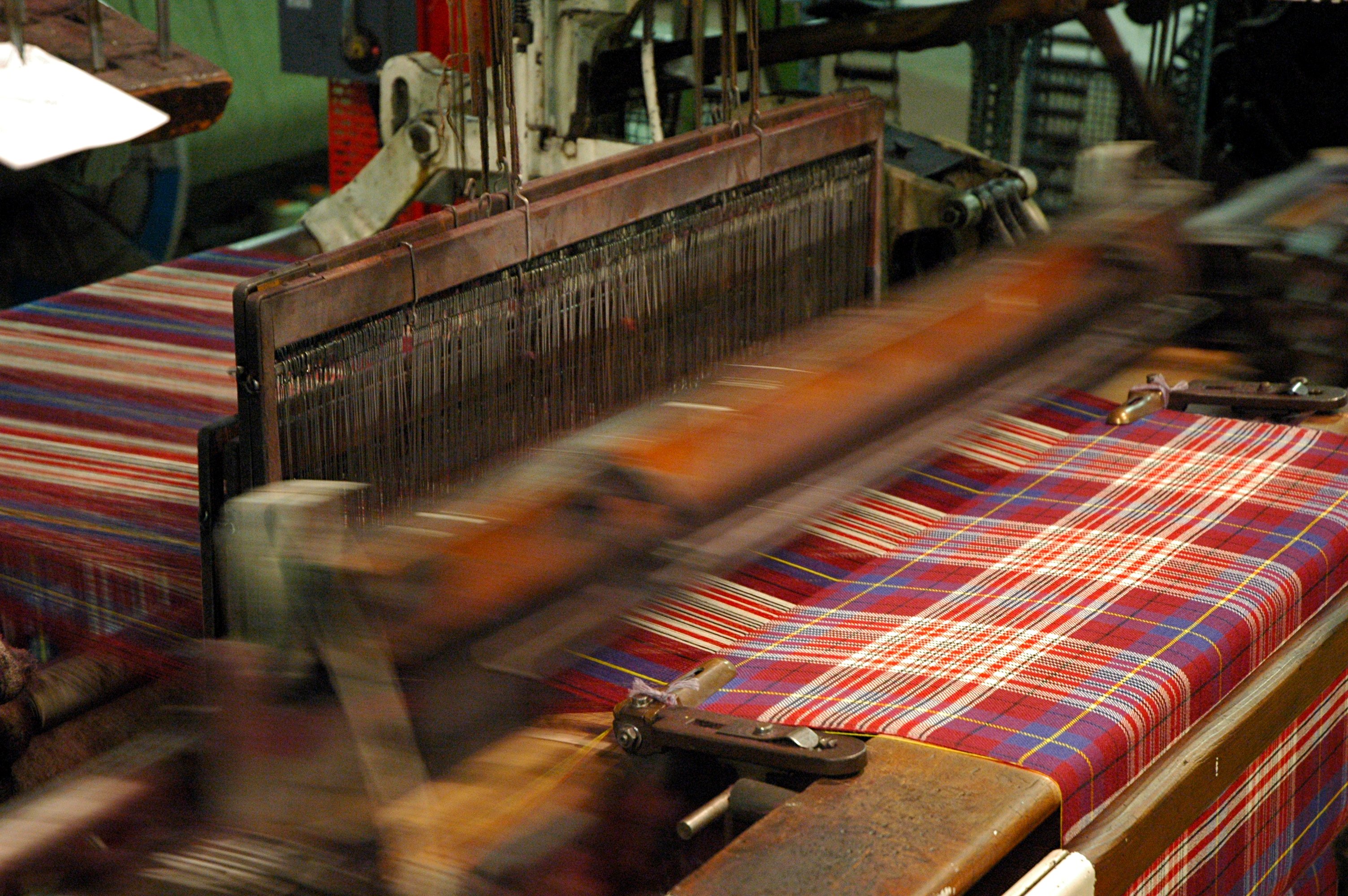
To date (2024) about 280 yards of single-width cloth has been woven, in two batches, which was then made into about 30 kilts, as well as a few other garments including a Breacan Feile, skirts, trousers, a shawl, and 40 ties.
Update July 2025: 60m more have just been woven, and future batches will be done as required.

Registration
The tartan was originally registered in 2007 with the Scottish Tartans World Register (one of the three registrars available at the time). An act of the Scottish Parliament in 2008 then established The Scottish Register of Tartans, combining the pre-existing registries, so they now host the authoritative registration.
Below is a copy of the original Scottish Tartans World Register certificate, which also contains the source code, or "sett", of the tartan.

The Design
It's predominantly red, to reflect the red of Debian's logo, made of two shades of red to give a gradation towards the middle (the nearest thing I could get to a swirl in a plaid) the blue is "Electric Blue" which makes sense, since we wouldn't get far without electricity, and can be said to be a reference to Captain Blue Eye (Debian's original logo), there's a fair amount of black and white, and a little yellow, as a nod towards Tux's colours, and the white spells out DEBIAN in morse: -.. . -... .. .- -. (with a correct 1:3 ratio for dots to dashes, and for the pauses in and between letters).
Also, unusually (although not uniquely) for a tartan, it's only symmetric on one diagonal. The morse section does not repeat in reverse, so while it still looks like a fairly conventional tartan (if a little busy in the morse section) we don't get the reversed morse (which the designer helpfully pointed out would spell ANIVEU ;-). This means that the morse section can be made relatively larger without increasing the overall size of the sett.
The colours seen on the registration page provide a reasonable match to the finished cloth (on my monitor at least, but monitors vary, so no guarantees there). When woven, the pattern repeats about every 10 inches.
When instructing a tailor/weaver, it's worth making sure that they get the cloth the right way round, so that when made into a kilt, the morse will read left-to-right and top-to-bottom, rather than bottom-to-top as it is in the images on the registration site. There has not been a problem with that so far, but they're not used to having to worry about such things, so it's probably worth making a point of reminding them.
Copyright
The copyright on the pattern currently (2024) resides with Philip Hands.
The initial design was done by Philip Hands (i.e. the colour selection, and the morse code section). Geoffrey (Tailor)'s tartan designer then modified the placement of the Blue and Maroon in the design, and made the pattern be symmetric on only one diagonal -- their copyright in the pattern was then assigned to Philip Hands (via Hands.com Ltd.)
Weavers can be reluctant to weave a "corporate" tartan without explicit permission from the owner. If you have any problem getting it woven, draw their attention to the fact that that the authoritative registration has nothing in the Restrictions: field. Also, the Information notes: field includes the text:
- This tartan may be woven by anyone without requiring any sort of permission.
If that's not good enough for them, you could try pointing here, where:
- I hereby grant permission to use the sett to anyone that wishes to have it woven.
If all that's not good enough for your weaver, feel free to ask me to tell them all of that again (or get another weaver).
How to get some
Make it yourself
As mentioned above, anyone is allowed to make this tartan (or to modify it to your own preferences, and make that). The "source code" is linked to above. People have woven it by hand, but you could also instruct a weaver, and could choose to create fabrics from whatever yarn you like (not just wool).
Buy the traditional Scottish cloth
Geoffrey Tailor & Kilt Maker carry stock of Debian Tartan.
Their prices (as in 2025)
- 8 Yard hand sewn kilt + flashes £950 (less £100 machine sewn)
- Neck tie - £35
- Bow tie - £50
- Self tie bow tie - £50
- Ladies 4 yard kilted skirt - £500
- Ladies Hand sewn kilt 5 yard - £750
- Ladies sash - £90
- cloth £55 per meter -- single width == ~30in == ~70cm
All prices include UK 20% VAT (so divide by 1.2 for non-VAT export price).
Machined kilts are pretty-much indistinguishable from the Hand sewn. AFAIK, the main difference is that they can only be reasonably expected to last a lifetime, rather than 3+ generations for the hand sewn (assuming you keep the moths away).
If you go for all the optional extras, and get a suit jacket, waistcoat, sporran etc. don't expect to get much change out of £3k.
Remember the cloth is expected to be in stack (or the next batch in production) forever, so do not skip meals to afford this silliness.
Get it woven elsewhere, possibly in other materials
Please feel free to fill this section out when you do that