Clue cell

From Wikipedia, the free encyclopedia
Revision as of 20:54, 30 April 2024 by 154.160.5.191 (talk)
(diff) ← Previous revision | Latest revision (diff) | Newer revision → (diff)
Jump to navigation Jump to search

Template:Short description

File:Micrograph of a clue cell, annotated.jpg
Micrograph of a clue cell (center), covered in bacteria, as compared to an unremarkable squamous cell at bottom left, and a neutrophil at bottom center. Pap stain
File:Clue cells in bacterial vaginosis.jpg
Phase contrast microscopy of clue cells in a vaginal swab

Clue cells are epithelial cells of the vagina that get their distinctive stippled appearance by being covered with bacteria. The etymology behind the term "clue" cell derives from the original research article from Gardner and Dukes describing the characteristic cells. The name was chosen for its brevity in describing the sine qua non of bacterial vaginosis.[1]

They are a medical sign of bacterial vaginosis, particularly that caused by Gardnerella vaginalis,[2] a group of Gram-variable bacteria. This bacterial infection is characterized by thin gray vaginal discharge, and an increase in vaginal pH from around 4.5 to over 5.5.

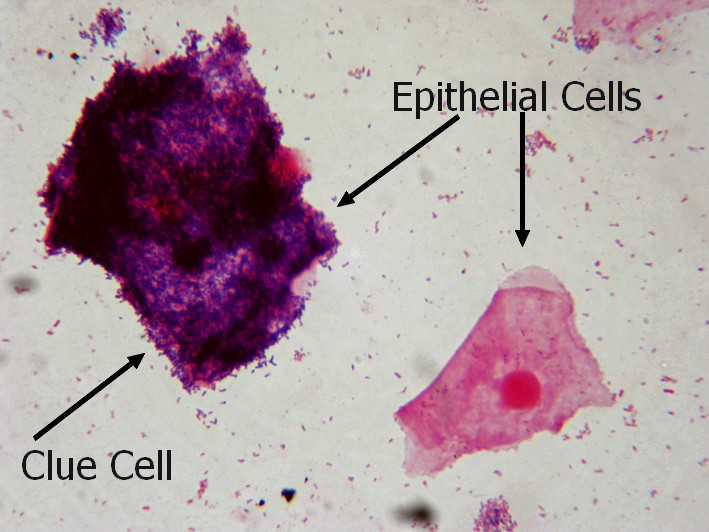
File:Clue cells - CDC PHIL 3720.jpg
Bacteria obscuring the surfaces of vaginal epithelial cells, giving them a stippled appearance

References

Template:Reflist

External links


Template:Pathology-stub

  1. Script error: No such module "Citation/CS1".
  2. Script error: No such module "Citation/CS1".